

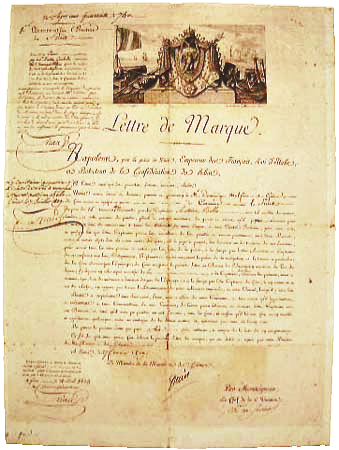

I’ve been seeing commentary that a presidential memorandum released yesterday is a new spin on the “letter of marque.” If your history is a little rusty, a letter of marque is a government-issued license to commit piracy against the shipping of a designated adversary.
The presidential memo tells the National Coordination Center to set up a program to authorize US companies to go on the cyber-offensive against foreign criminal organizations. This sounds like a cool idea that makes you go “Yar!” until you stop and ask why companies would want to do this. In the Age of Sail, a would-be privateer would be in it for their share of the captured booty. But in the age of AI-assisted hacking sprees, what are companies supposed to confiscate from cybercriminals? Wouldn’t anything captured probably be itself stolen goods that should be returned to their rightful owners?
The answer seems to be “nothing.” I thought maybe there would be a provision entitling participants to receive a portion of any reclaimed cryptocurrencies or something, but no. There’s no mention of booty to be captured at all, nor of any bounties for successfully disrupting criminal operations — not even compensation for resources spent doing this work. In fact, participating companies are to put up a $1 million bond they might have to forfeit if they break the program’s rules.
So why would companies risk losing a million bucks and drawing the ire of criminal organizations? The best answer I could find is that they are already doing so. Not many. But Microsoft, for example, has long gone on the offensive against criminal operations creating botnets out of Windows machines, attempting to disrupt command and control of those networks and close the vulnerabilities to protect customers and the Microsoft brand. This has historically been done through a less formal set of understandings with government agencies. So I think the new memorandum is really just a kind gesture to some of the White House’s allies in big tech: a safer corridor for legally tricky operations. If so, it might not even have anything to do with AI.
But given the nature of the times, I’m going to guess that it does.
If the administration were on friendlier terms with Anthropic, I would wonder if maybe the AI company had complained about its inability to legally disrupt the organizations reselling stolen Claude credentials, which then get used to distill Anthropic’s models and undercut its lead. But with the latest ChatGPT and Grok models now at or near the frontier, it might make sense for OpenAI and SpaceX to get similarly worried about distillation. Perhaps it is these White House allies who had letters of marque on their wish list. Or perhaps the White House wants to invite the AI companies to “voluntarily” use their models to strike at foreign thorns in the administration’s side. Politico’s analysis arguably points in this direction, and offers a readable account of the rules of engagement.
We may never learn any specifics about how these permits get used. One of their stipulations is that operations are to be carried out “with the intent to remain undetected.”
The analyses and opinions expressed on AI StopWatch reflect the views of the individual contributors and the sources they cover, and should not be taken as official positions of the Machine Intelligence Research Institute.