


Social media went a little nuts yesterday after Levent Alpöge, a Harvard mathematician affiliated with Anthropic, posted a disproof of the Jacobian conjecture, a venerable hypothesis about the reversibility of some kinds of functions.
It went viral for a few reasons: For one, the disproof fit inside the low-key tweet that Alpöge used to announce it, and was quickly verified by others.
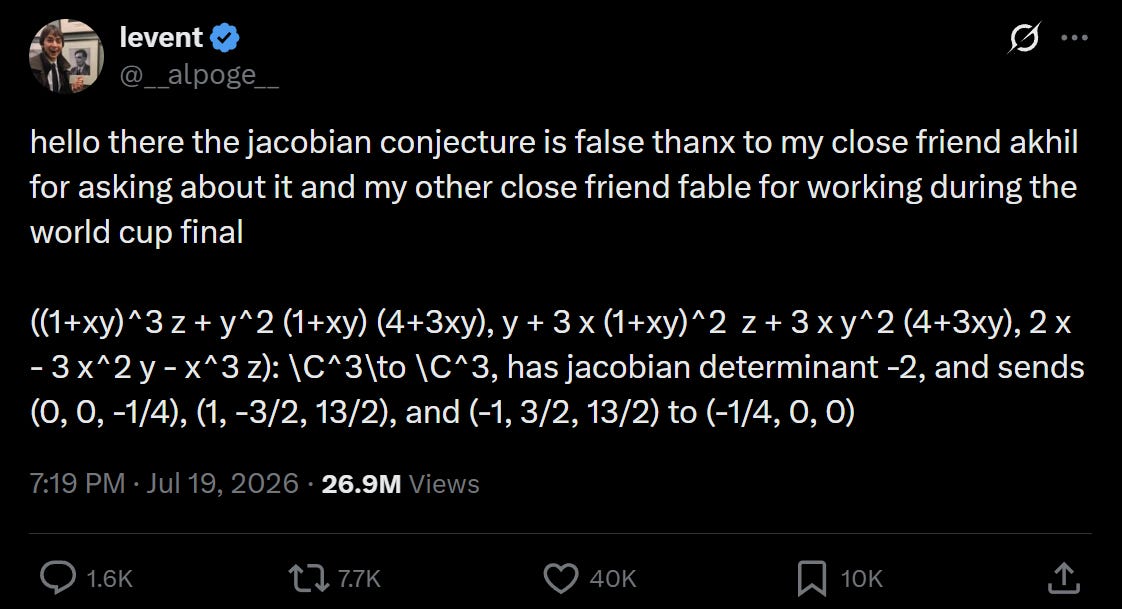
For another, this was one of the more famous and recognizable open math problems; people have been trying to crack it for more than 80 years. It also seems to have been generally assumed that the conjecture was true, so the disproof came as something of a surprise.
And unlike some other recent high-profile AI math breakthroughs, this one seems to have been achieved by Fable, a commercially available model, rather than a special variant of an internal model optimized for such work (like the special OpenAI model that disproved the Erdős unit distance conjecture in May).
But we don’t yet know much about how Fable and Alpöge approached the problem to find this counterexample, so people aren’t quite sure what to make of it. News site Mashable quoted Andrew Blumberg, a Columbia mathematician involved in AI math benchmarks who was unimpressed:
This is exactly the kind of thing I would expect AI to be able to do. If there was a counterexample that was concise and easy to state that people haven’t found because it’s a pain to search through all this stuff, AI will find it.
On the one hand, I’m not a mathematician. But on the other hand, Blumberg’s claim sets off my goalpost-shifting detectors. If such a famous problem could be easily solved through brute force, why hadn’t this been done before modern AIs, which are actually really bad at brute-force computation? If the value added by Fable was figuring out how to narrow the search space for brute-force solvers, then why had humans failed to figure that out on their own?
This sounds to me like another case where, if a human had come up with the insights, we would be celebrating their creative genius. But if an AI did it, then creativity must not have been required at all.
Put that debate aside, though. Regardless of how people want to frame it, the puzzle was solved. This should give us pause. The way these old math problems keep falling to AI is more evidence that superhuman AIs could come to understand the rules of our universe better than we do. With such understanding, they might be able to employ strategies that seem to bend those rules and catch us completely off guard.
Mathematics matters. It has downstream effects on the other sciences, which then inform the applied engineering disciplines. When armed with better theory, chemists, biologists, materials engineers, and others can aim directly for innovations they might never find by trial and error.
I shudder to imagine a superhuman AI that finds solutions to more of humanity’s open problems but keeps them to itself, developing a deeper scientific theory and sharper engineering acumen, leapfrogging humanity’s more incremental gains. This is one way we could end up in the kind of lopsided situation the Native peoples of the Americas were in when European colonists arrived to claim their lands. In that situation, I don’t know how much it softens the blow to say the new arrivals had merely brute-forced solutions to tedious problems you couldn’t be bothered with.
The analyses and opinions expressed on AI StopWatch reflect the views of the individual contributors and the sources they cover, and should not be taken as official positions of the Machine Intelligence Research Institute.