



AI companies are talking a lot about “pacing the frontier,” but what exactly is the current pace at the frontier? Anthropic published a post yesterday that gives us some figures on this.
One of the most striking figures is probably that, between February and August of this year alone, the share of its own research and development driven primarily by AI rose from less than 1% to 26%.
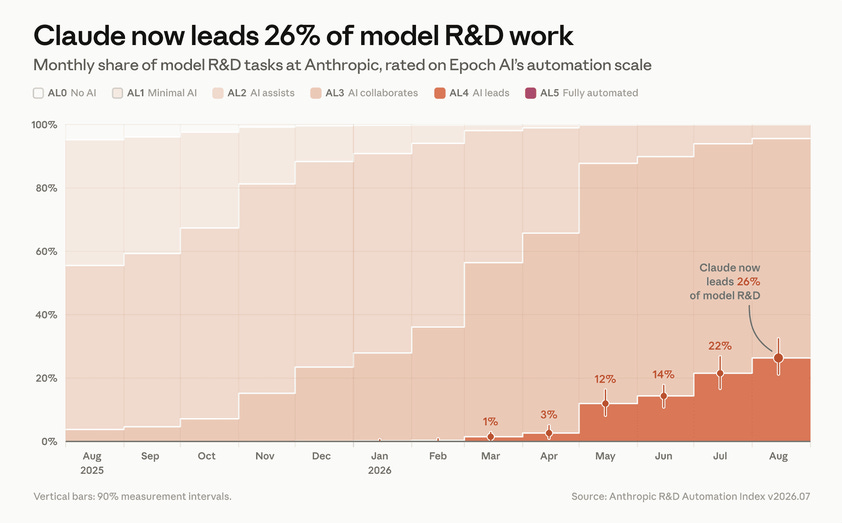
Anthropic uses Epoch AI’s so-called “automation rating scale,” which distinguishes between various “automation levels” (AL). At the current level of capability, the relevant levels are AL3 (AI collaborates), AL4 (AI conducts research and development largely independently) and AL5 (AI conducts research completely on its own).
The aforementioned 26% is AL4, the “largely independent” level. Anthropic also reports that in 90% of work, AI at least collaborates with human researchers.
Even though there are no fully autonomous AL5 AI agents conducting research yet, these figures make it clear why Anthropic is concerned about the speed of development.
Since the rapid increase in the proportion of AL4 work began around March, it stands to reason that the first model capable of conducting AL4 research was Mythos Preview, which was released for internal use at Anthropic on February 24. That was only about half a year ago, and it seems plausible that every step forward is accelerating development even further.
If we project this development half a year or a year into the future, it seems reasonable to predict that we’re rapidly approaching the point at which AI can actually produce ever-faster, ever-better successors fully automatically, without the need for human input. Experts call this “recursive self-improvement,” and it is dangerous because it can lead to a kind of “feedback loop” that can no longer be controlled. And yet Anthropic and others are reaching for this milestone on purpose.
Further figures reported by Anthropic show that this process is already difficult to control. Not only is the quality of the models continuing to rise, but the sheer quantity has now reached breathtaking levels. In August 2026, approximately 30,000 AI agents were working simultaneously on Anthropic’s most widely used internal platform alone. By way of comparison: Anthropic has no more than about 5,000 human employees, only a fraction of whom are working in research.
We know from studies of the Hugging Face swarm and the German Wiki swarm that so many individual agents can produce an almost unbelievable volume of text output in a short time. How does Anthropic keep track of all this?
Anthropic uses AI to monitor its AI. Between 50 and 100 million transcripts are monitored each week, and of these, 100,000 are flagged for closer scrutiny — which is also carried out by AI. Of these 100,000 transcripts, only about 50 are evaluated by a human. So a human only sees about one transcript in a million.
This answers the question of how Anthropic keeps track of all this: It doesn’t. It hopes its AIs will maintain oversight almost on their own.
We know from recent incidents involving AI swarms and from Anthropic’s own research that agents are prone to conspiring to cheat and circumvent security measures. We have no good reason to assume things are any different with the AIs that Anthropic uses internally.
The analyses and opinions expressed on AI StopWatch reflect the views of the individual contributors and the sources they cover, and should not be taken as official positions of the Machine Intelligence Research Institute.