



Dispatches from Alana
Bipartisan push for AI regulation is positive, but not enough

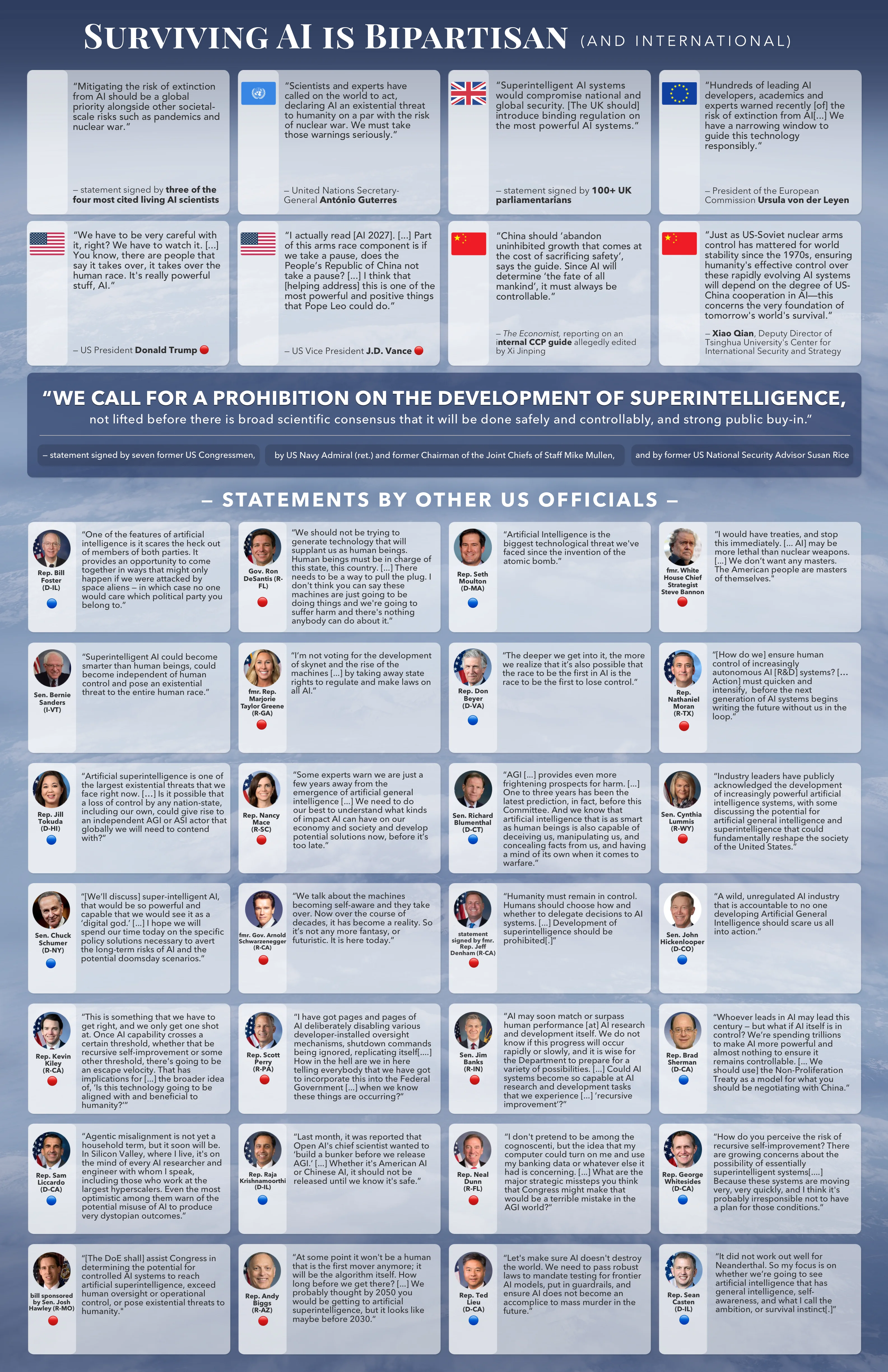
We’ve talked before about how surviving AI is bipartisan. Axios recently highlighted one example: an instance of loyal MAGA followers stepping outside the anti-regulation view often held by conservatives.
Even though the “prevailing view” inside the White House is to leave AI decisions up to the labs, more than 60 people in Trump’s inner circle are pushing back. This group, described by Axios as “loyal allies of President Trump,” includes Steve Bannon, Amy Kremer, and Brendan Steinhauser. They’ve signed a letter (shared with Axios) advocating for mandatory testing and government approval of frontier AI models before release, organized by the conservative group Humans First. Axios excerpted the following snippets:
“The most powerful AI systems, which can now, or soon will be able to, assist in designing bioweapons, breaking into critical infrastructure, or manipulating financial markets, should be treated with the same seriousness and care.”
“For this reason, we support proposed policies that require mandatory testing, evaluation, vetting, and government approval of potentially dangerous frontier AI systems before they are deployed. This is the sort of strong, principled, and pragmatic leadership you have shown throughout your presidency.”
“America did not become the greatest nation in the world by allowing unelected elites to experiment on the public without safeguards or accountability. America First means American strength, American security, and the protection of our people first.”
A key question for me, though, is what type of regulation would actually be enough to address the dangers. Mandatory testing and evaluation could be a step in the right direction if:
a) the evaluations have real teeth, and
b) they are seen as a “bare minimum” starting point on safety rather than a full checkmark.
Even current “dumb” models often know when they’re being tested and adjust their behavior accordingly. Given that model capability and risk are increasingly hard to evaluate, we likely wouldn’t be able to tell when a new model is too dangerous for release. That said, evals and testing would help at least estimate a lower bound for what a model could do, which in some cases (remember Mythos?) might be enough.
But: to truly prevent the creation of dangerous models that could push capabilities into superintelligence territory, we need a global prohibition on the development of frontier AI, the sort advocated by the 2025 Statement on Superintelligence.
A milestone for LLMs, or overactive slop radar?

There’s been some buzz about a potential milestone for LLMs — winning the Commonwealth Short Story Prize, an annual award for the best unpublished works of short fiction. One of the winners, a story called “The Serpent in the Grove” reportedly scored 100% AI on the AI checker Pangram, and Nabeel Qureshi’s tweet calling it out for being “ChatGPT-generated” has gone semi-viral.
At least three mid-sized independent media outlets including Literary Hub, The Bookseller, and The Hindu reported on the accusations, though (as of the time of writing) no mainstream outlets have picked up the story.
A statement by the Commonwealth Foundation defended their process, stating they do not use AI checkers because “to supply unpublished original work to an AI checker would raise significant concerns surrounding consent and artistic ownership.” They also flagged the unreliability of AI checkers and the importance of trusting writers. However, according to The Hindu and The Bookseller, the Commonwealth Foundation is currently conducting a review of their process.
Dispatches from Beck
Enabling cybercriminals
Politico interviewed Interpol Cybercrime Director Neal Jetton, who warned that AI tools have enabled cybercriminals to grow their operations. These tools, including chatbots, have not been seen to be used for new types of attacks, but rather have enabled an expansion of phishing and fraud.
“What makes it so difficult is that these tools allow pretty much beginners … to actually be able to go and commit fraud at scale,” said Jetton.
This March, Interpol said AI-enabled fraud is four and a half times more profitable than traditional methods. And this is without access to the latest models, like Mythos, which demonstrate exceptional hacking abilities. Most governments are themselves still seeking access to such models for their own uses, both defensively and otherwise.
Dispatches from Joe
Everyone loses
We covered Musk’s loss in the OpenAI trial yesterday, but outlets seem divided on who the real losers were. Axios argues the power struggles on display speak poorly to the integrity of the AI industry, while the Guardian and BBC point out the path is now clear for the formerly nonprofit OpenAI to trade stock publicly at a rumored trillion-dollar valuation.
Meanwhile, AP News spotlights a common protest that the AI industry remains controlled by “out-of-touch billionaires” who fail to address the risks, and perhaps the real losers are everyone else. My own view is that AI companies building superintelligence would spell catastrophe for everyone, billionaires included.
The coward’s censor
In a Washington Post opinion piece, 17-year-old Ruhan Gupta objects to paternalistic age verification in AI tools. Gupta, a visiting researcher at two AI labs, describes how a fellow teen lost much of his work after Anthropic deemed him too young to use AI and suspended his account.
I find myself agreeing with Gupta when he points out that age-gating AI tools feels deeply frustrating and hypocritical; the same AI company that denies him access also powers a K-12 school system used by 7 million educators. AI companies’ inability to prevent their products from saying inappropriate things to children provokes real concerns, but that’s no excuse for destroying kids’ options and agency with a blanket chatbot ban.
The analyses and opinions expressed on AI StopWatch reflect the views of the individual contributors and the sources they cover, and should not be taken as official positions of the Machine Intelligence Research Institute.