


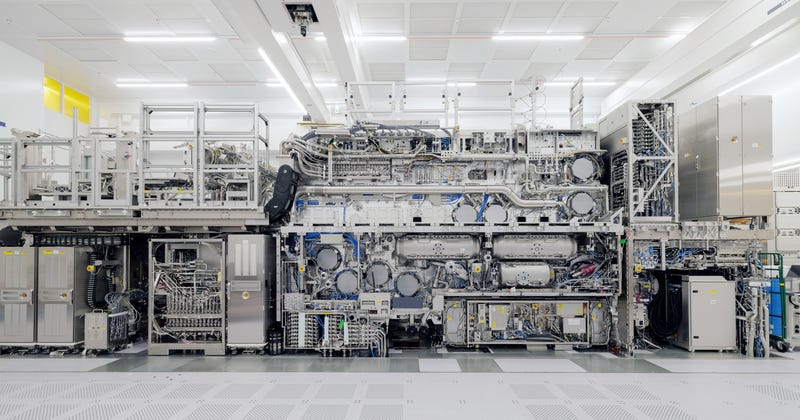
Writing in The Guardian, Alexander Hurst argues that the EU should ban exports of extreme ultraviolet (EUV) lithography machines, which are used to produce the most advanced computer chips in the world. The AI industry’s dependence on those chips — and therefore these machines — is absolute, and just one company in the world, the Netherlands’ ASML, builds the machines that make those chips. (China is attempting to reverse-engineer the technology, but they are not there yet.) As my colleague Mitch noted previously, they are very big — the size of a bus — and very rare: In June ASML counted 314 EUV machines in operation worldwide, with another 26 decommissioned.
All machines have a limited lifespan. This is true of the computer chips that the frontier labs use to train more powerful AI models, and true of the fabrication equipment that makes those chips. The more intensively the frontier labs use their chips, the more quickly those chips have to be replaced. Sufficiently strict export controls would force the AI industry to “tread water, to jog in place,” as Hurst puts it — giving the rest of the world some breathing room. Regulators could have a hope of catching up. But how much breathing room, and how much hope, depend on the strictness of those controls.
If you simply ban the sale of EUV machines, then you’ve put a cap on production capacity. That will have a real effect, but slowly, in an industry whose pace of change is one of the chief reasons to ban exports. The fabs that produce the chips already have EUV machines, and by ASML’s own account, “almost every lithography system that we’ve ever shipped is still in use at a customer fab.” (One of its earliest lithography machines, the PAS 5500 model, was released in 1991 and remains in service thirty-five years later.) It’s less like putting out a fire in your house than sending away the people who are pouring gasoline on your lawn; you’ve just spared yourself one future headache.
However, export controls can extend from hardware and other goods to the technical assistance that is required to maintain them. An update in 2025 added advanced lithography equipment to the European Union’s regulation on dual-use export controls, which governs that technical assistance. And do EUV machines require technical assistance? Loads and loads of it. In 2024, when the United States was pressuring ASML to restrict maintenance of machines operated by Chinese customers, a commentator quoted by Asia Times stated, “that equipment will become useless once it has any minor problem.” And these were only deep-ultraviolet (DUV) lithography machines — incredibly sophisticated, to be sure, but markedly less so, and less demanding of maintenance, than the EUV machines on which the frontier labs depend.
This doesn’t do anything to the chips that exist, but the chips that will exist in the future (or rather the chips that may exist, that a ban could preempt) are crucial to the frontier labs and their partners. Each training run is made with the assumption that there will be sufficient chips for the next training run to be even bigger, and every hyperscaler is building datacenters on the assumption that chips will arrive to fill them. The semiconductor manufacturer TSMC doubled its historical pace of construction in 2025 and 2026; its chief executive told shareholders in June that “it will be a long time before we can meet customer demand.” But add one thorough ban, let simmer, and subtract year upon year of planned-for chips — and those floating castles that the industry built up in its collective mind become mere rough-shaped clouds: The buildouts stall and compute can no longer be treated as cheap, because the most advanced chips simply cannot be replaced.
It’s a sound proposal. I mean, it’s no international treaty to ban the development of artificial superintelligence, but it could have a near-immediate impact. My praise comes with a few caveats, though.
There’s a possible short-term downside: Regulations don’t usually take effect as soon as they’re proposed. As soon as regulators look serious about a ban, chip manufacturers will try to surge production; and the frontier labs may be tempted to sprint — true, the most advanced chips can’t be replaced, but they can’t sit on a shelf indefinitely, either.
Cutting off the chip supply won’t freeze progress on its own, because recent capability advancements have come partly through improvements in techniques like post-training. Progress will slow, but not be halted. If export controls are the tool that’s used to sever the supply chain, the natural response will be to relocate chip manufacturing to Europe. That process could take a couple of years, even on the low end, though. Chip manufacturing requires other infrastructure and specialized personnel.
Regulations can move slowly, too, but there’s a salve for this: The Netherlands can take action first, while slower political processes go to work in the European Union. The Netherlands has historically handled ASML extremely lightly, but historically, the world was a safer place. Last year, AI agents were not breaking out of test environments and autonomously performing cyberattacks. Next year, who knows — and this year, there’s still time left for the Dutch to do something.
The analyses and opinions expressed on AI StopWatch reflect the views of the individual contributors and the sources they cover, and should not be taken as official positions of the Machine Intelligence Research Institute.
You can receive emails of dispatches as we write them, or subscribe to our Daily Digest for a once-a-day compilation.