


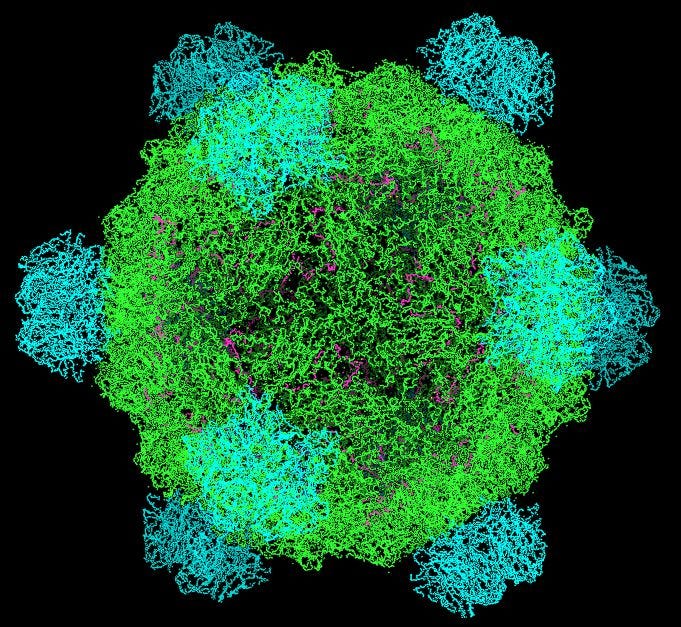
For the first time, AI has generated complete and viable genomes for new viruses. The work, understood to have taken place last year, is making headlines in The New York Times, BBC, and elsewhere thanks to the publication of the formal paper about it in the journal Science.
The AI model responsible is Evo, a specialized model that was trained to read and predict genetic sequences the way language models are initially trained to read and predict sequences of letters and words.
Evo isn’t from one of the big companies, but from the Arc Institute, a non-profit that partners with university researchers and chip company Nvidia, among others. To prove the concept with minimal risk, they didn’t train the model on any pathogens known to infect humans, and specialized it on a class of bacteriophages (viruses that infect bacteria) with an unusually small and well-studied genome.
The team selected 285 promising candidates from 700,000 generated by the model, and synthesized them in the lab for real-world verification. Sixteen produced viable viruses, some of which multiplied faster than the natural phage they were inspired by.
If that funnel from 700,000 to 16 leaves you underwhelmed with the milestone, remember the general rule that the time between when a machine can first just barely do something and the time when it can do it faster and better than we can is often very short. It ought to be especially short in this case, because no human is fluent in genetic sequences the way we are with human language, but AI can be.
In fact, Google DeepMind has already trained a model to understand much larger genomes, but it has steered clear of headline-grabbing experiments with obvious implications for bioweapons.
To be fair, there are legitimate medical uses for custom viruses. Bacteriophages can sometimes be a strong counter to antibiotic-resistant bacteria, and gene therapies typically use viruses to deliver missing or edited genes to a patient’s cells. But this is an area where the risks are so great that it might be better to abandon the upside and never train models to design or modify viruses.
The Times’s coverage includes an expert’s warning that governments and scientific organizations “have been slow to develop guardrails that could block the creation of a deadly virus — even as the science races ahead.”
The analyses and opinions expressed on AI StopWatch reflect the views of the individual contributors and the sources they cover, and should not be taken as official positions of the Machine Intelligence Research Institute.