



Dispatches from Beck
Musk loses OpenAI trial
We’ve written a few times about the trial between OpenAI and Elon Musk, who sued the AI company over its conversion to a for-profit entity. Today, Judge Yvonne Gonzalez Rogers and the jury found that Musk’s claims were beyond the statute of limitations. The court has yet to reach a conclusion on antitrust claims, but Judge Rogers told attorneys that they are “not very good claims,” reports the New York Times.
On X, Musk wrote:
... the judge & jury never actually ruled on the merits of the case, just on a calendar technicality. There is no question to anyone following the case in detail that Altman & Brockman did in fact enrich themselves by stealing a charity. The only question is WHEN they did it!
I will be filing an appeal ...
Readers may wonder why the case reached a full trial if the merits were not to be considered. Under California law, breach of contract disputes must be brought within three years of when the plaintiff knew or should have known of the breach. Judge Rogers denied summary dismissal to OpenAI and determined that Musk’s legal team had to show that the billionaire “had no way of knowing that OpenAI had breached its founding agreement before August 2021” (or Nov 2021 for the separate antitrust question, NYT.)
Musk’s attorneys argued that he did not know about the breach until 2023, when a Microsoft deal was in the news, while OpenAI’s attorneys argued he was aware of such issues since at least 2019, when he fractiously left OpenAI, and the case was allowed to continue to resolve this question of fact. Demonstrating Musk’s state of awareness was why the trial included so many texts and emails as evidence.
Expect more coverage if and when an appeal is filed.
Surveillance Mode
The Atlantic chronicles the ongoing fight between surveillance tools and those who wish not to be surveilled. New technologies, from the microphone and camera to AI-powered lapel pins, enable those who wish to record, whether police departments or private citizens. In many cases, surveillance is in the public interest, but advancements in these technologies can also threaten everyday privacy. And while individual pieces of technology can assist the surveilled, the broad trend since the telegraph has clearly favored the surveilling.
The big, potentially revolutionary, advancement that current AI brings is not just in recording people, but in interpreting them. First, machine learning tools can help extract conversations from noisy signals, like a coworker’s Zoom call or an informant’s wire. Then AI models can enable the analysis of huge swaths of data. In the past, any government’s ability to monitor its citizens’ communications was limited by the quantity of such communication. Even if a state recorded every call, no security agency could monitor them all. Now, AI tooling may enable states to search through that data, tracking and reporting it to a security apparatus that does not always have the citizens’ best interests at heart.
As this technology sprints forward, we don’t know how these capabilities will be distributed. Which states, which corporations, will have and use this tech when? You may remember the dispute between Anthropic and the Department of War over concerns about autonomous weapons and mass surveillance that kicked off just a couple of months ago. And how almost immediately, OpenAI and other companies jumped into that niche, signing contracts without legally binding language to prevent mass surveillance.
The Atlantic ends with privacy law professor Woodrow Hartzog. He said, “The thing about cat-and-mouse games is that we know how they usually end up for the mouse. And in this case, the cat includes some of the most powerful corporations to ever exist.”
Dispatches from Mitch
Compute frustration at Google
Researchers working on AI at Google are having to fight for computing resources, according to a report by Bloomberg’s Julia Love. AI research is expensive, consuming a lot of cloud compute that could otherwise serve paying customers.
I report on this piece as yet another data point that there’s no AI bubble of the sort that would take down the whole industry. Chips aren’t idling; capacity is going to the highest bidders. Demand is so high that even researchers working on the next generation of models are sometimes losing out — though it sounds like they’re mostly losing to other researchers with different ideas. Even before it had so many paying AI customers, Google was having to make hard choices about which experiments to run.
Love’s reporting focuses on the contrast between the curiosity-celebrating spirit of Google’s past and the hard-driving business environment of its present, but I’m less concerned with Google’s morale than with the race it’s participating in.
According to one researcher who recently left the company, the top AI labs all feel that “you have to build the world’s best coding model, because no one wants to be second to [reach] AGI.” Within the AI industry, that milestone, Artificial General Intelligence, is increasingly associated with models that can do recursive self-improvement -- doing their own research to improve themselves in an accelerating loop.
One of the new startups devoted to that goal, Ricursive Intelligence, was formed by a pair of Googlers who didn’t like having to fight for computing resources.
They’re making a new Westworld movie
I was about to start this dispatch by saying that a movie announcement probably isn’t among the most important AI news items of the day. But maybe it is? Movies have enormous reach, and they can spark discourse among people who may have been waiting for an excuse to talk about something.
As reported in Deadline, Warner Brothers is developing a new Westworld film. I will surely end up reviewing it for this site.
The same writer who adapted Michael Crichton’s more famous theme park horror story for the big screen, Jurassic Park, has been tapped for the screenplay. Rumors are swirling that Steven Spielberg may direct.
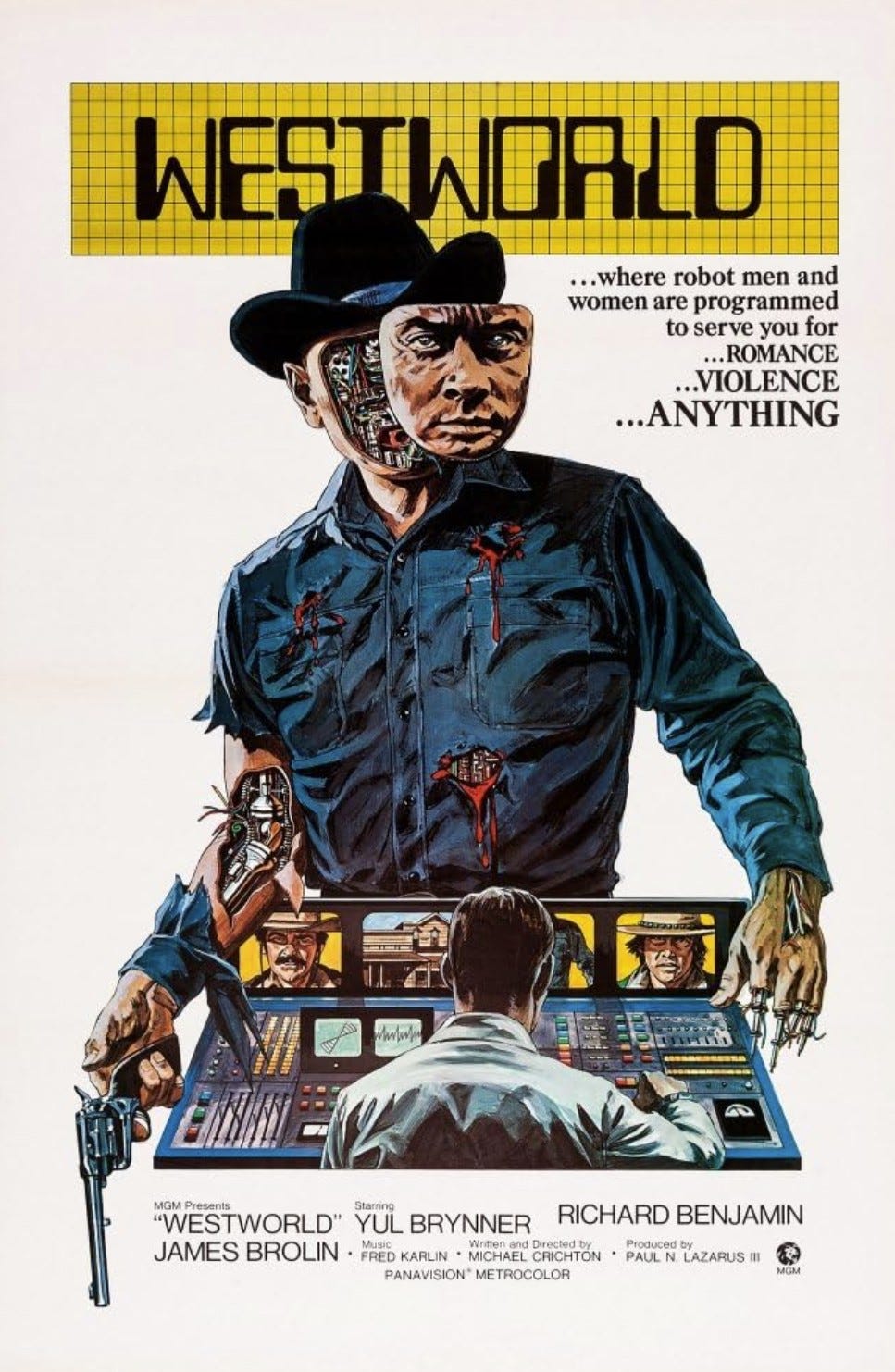
That’s about all we have to go on. I have no idea if this movie will be any good or in any way useful to the discourse. The original 1973 movie, directed by Crichton himself, starred Yul Brynner as a rogue AI gunslinger. By modern standards, it is almost unbearably slow and sterile.
In my review for that film, written decades ago as a teaching assistant for a college course about depictions of the end of the world in fiction, I called Westworld “Jurassic Park in a 10-gallon hat.”
I stand by that. The same Frankenstein-like theme about scientific hubris underlies both films, but neither is really about technology. These are classic horror movies: morality plays in which the evil and the depraved will be gruesomely punished for our amusement while the good and the worthy make a thrilling escape.
In Westworld, the depravity is to be found in the theme park’s patrons, who pony up for the right to enact their sexual or violent fantasies on the animatronic denizens of Medieval World, Roman World, or Western World. When a malfunction leads to an ill-conceived shutdown attempt, the predators become prey.
While it’s a safe bet the new film will depict the park’s creators as repugnant tech bros, I’m less certain about whether the androids will come across as moral agents victimized by their creators, like they do in the cable TV series. That twist is interesting, but at movie length it may get you something more like Blade Runner than a summer blockbuster.
The Guardian’s Ben Child muses that a Westworld adaptation speaking to the anxieties of 2026 would lean into the horror of love robots that work exactly as intended, and of sycophantic machines that “make you feel like the most fascinating person in the universe.”
But I would disagree that the “nightmare scenario” would be one where “none of the humans really want to leave.” Hedonistic idleness is a condition you can recover from. Being run-through by the Black Knight? Not so much.
The analyses and opinions expressed on AI StopWatch reflect the views of the individual contributors and the sources they cover, and should not be taken as official positions of the Machine Intelligence Research Institute.
The old Westworld poster is great, I love 70s-era sci-fi art