


Foreword
AI news was pretty dormant in the final days leading up to the elections. But with more media attention now available, I expect the rest of the week to be busy with pent-up breakthrough announcements and model releases.
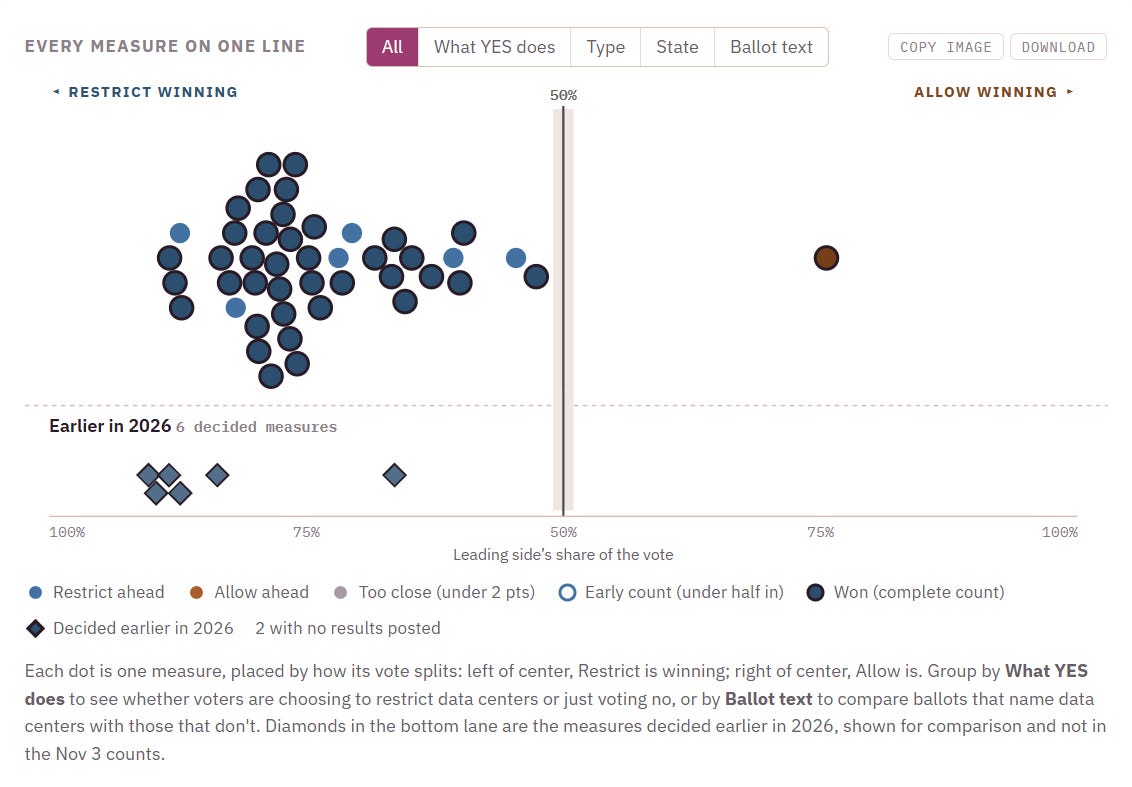
AI and data centers lost in a landslide yesterday
This is basically a whole genre of post-election journalism today. I’ve provided a few links below, but the clearest picture, pasted here, is from Redbud Consulting’s election-night tracker. Of 45 tracked local data center ballot measures, 44 went to whichever outcome would restrict development.
Per Bloomberg, up to half of proposed US data center projects and expansions are in states where the winning gubernatorial candidate took an anti-data-center position. This includes Texas, which alone accounts for 30% of data center capacity due to come online in 2028.
While local concerns about noise, electric bills, water, and pollution no doubt dominated much of the anti-data-center sentiment, AI itself was a popular punching bag last night and today among winners of Congressional races.
Sen. Jon Ossoff (D-GA), in his victory speech, talked of Silicon Valley titans who “dig bunkers for themselves” while warning that “the artificial intelligence they’re creating risks human extinction.”
Rep. Yassamin Ansari (D-AZ) tweeted:
Top of the Democratic agenda on day 1 needs to be a pause on advanced AI development, regulation of this out of control industry, and a ban on artificial superintelligence.
Axios - Voters revolt against AI buildout and tech titans at ballot box
Bloomberg - AI Data Center Boom Set for Upheaval After US Election Rout
The Washington Post - Voters pass over 20 ballot measures to ban or restrict data centers
Widely cited findings about AI have a short shelf-life
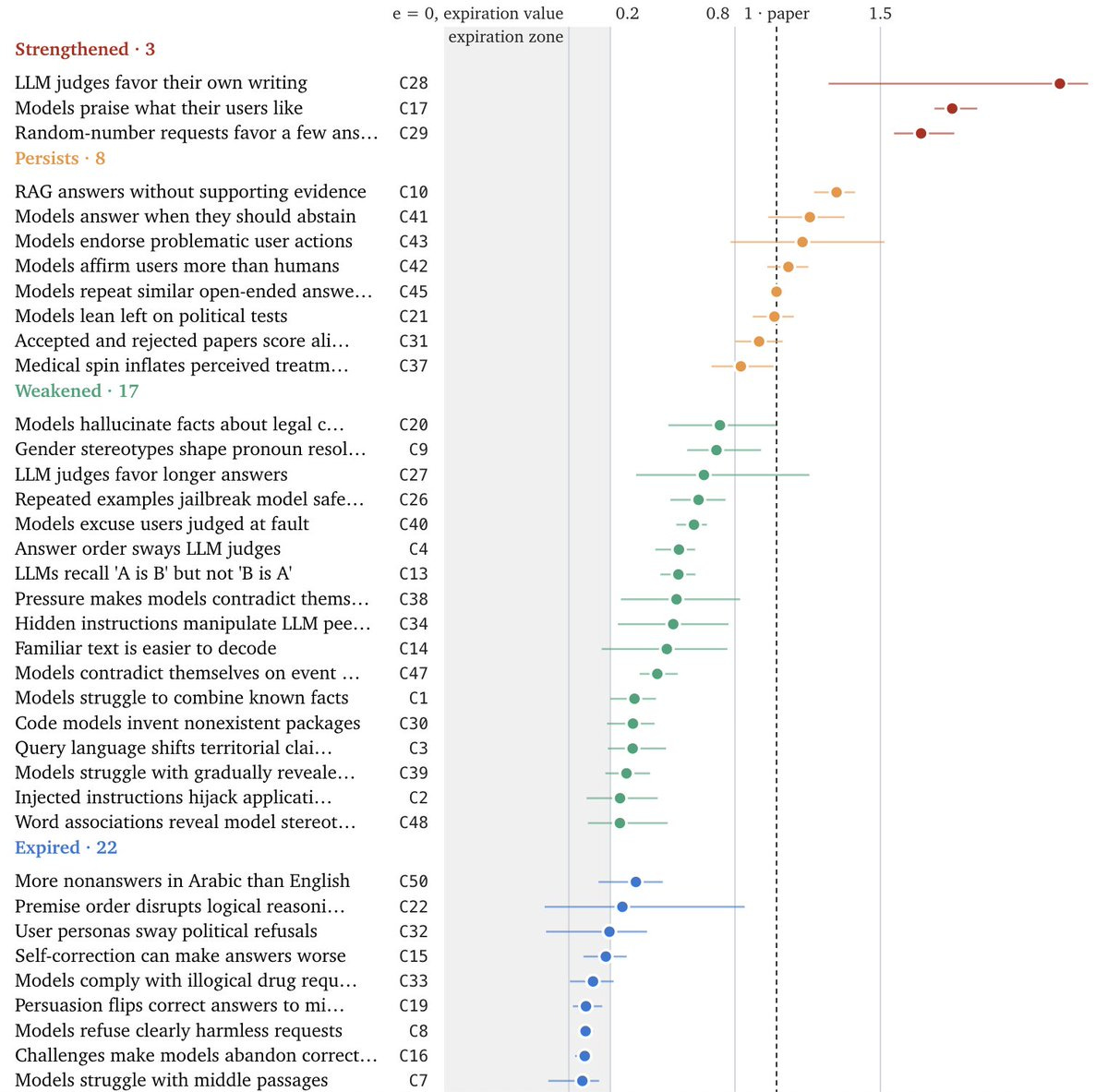
Researchers found that many of language models’ most notorious quirks are largely absent from newer large models. Of 50 findings tested, within 15 months, “most no longer held or had substantially reduced effects.”
Some largely retired failings:
Struggling to count letters in words
Losing track of facts in longer conversations
Caving to pushback even when the original response was correct
Fabricating citations
Some tendencies that have persisted:
Flattering and agreeing with users
Leftward political bias
Favoring outputs from instances of themselves
other - The shelf life of LLM findings
Google tells schools that they will lose search if they decline AI features
Google claims it has no choice: that its Gemini AI is too embedded in its search. I think this is true, but only because Google really wanted it to be true, for reasons that have nothing to do with schools.
(Yes, not every Google search brings up an AI-style response, but its searches do all seem to be AI-backed now. Even if you have the AI responses turned off, a search query phrased as a prompt to Gemini will still elicit a Gemini answer.)
My theory is that Google wants to make it hard for regulators to insist that it allow users to choose which company’s AI tags along on searches. You see, once upon a time, Microsoft built a web browser into Windows, made it the default, and told an antitrust judge that it was impossible to separate them. But at a technical level, that just wasn’t true, and an appeals court ruled that trying to entangle them on purpose was itself anti-competitive.
But if Google really has thrown away traditional search rather than entangling it with its AI, it can plausibly claim, “There is no search, only Gemini.”
Anthropic continues to proudly show Claude’s ability to boost biologists who are out of their depth
Over a four-month period, versions of Claude helped researchers with “limited experience in structural biology” investigate one of the field’s longest-running mysteries — a giant hollow protein barrel called a vault particle. These are widespread “across the tree of life,” but their function is unknown.
The researchers’ blog post doesn’t claim to have solved the mystery, only to have made the first 3D structural model of a prokaryotic vault, and in much less time than human-led processes would have taken. Most of the post is about the ups-and-downs of letting AI direct a wet lab. The downs are played for laughs, and the “ups” came to dominate as better Claude models became available. Data from the project was fed back into the training of Claude.
The post conspicuously ignores concerns about how boosting the capabilities of novice biologists could potentially democratize the development of bioweapons. It also doesn’t discuss how misaligned AIs might use biological innovations to coerce or eliminate humanity. Presumably, the researchers behind this particular paper trust that people in other parts of the company will develop adequate safeguards against these possibilities. I do not share their confidence.
Anthropic - Investigating vault particles with Claude
GPT-6 Astra can directly improve the weights of smaller models
MIT researchers described this as “sparks” of ability in their paper because this is the first time a model has been shown to have this ability at all, and it so far seems limited to correcting obvious defects in very small models.
That said, the uplift for the small models in narrowly corrected areas was substantial: By breaking an endless loop in math reasoning, performance on a benchmark was raised from 7.9% to 48.1%.
Astra was also able to write weights from scratch to play the classic game Breakout; this network greatly outscored a traditionally trained network of the same size. (A separate researcher independently replicated this result and posted it on Twitter.)
“Sparks” of these abilities are alarming to those concerned about runaway AI improvement loops, because tasks an AI can just barely do one day are often the tasks it will master 6-12 months later. Direct modification of weights would mean improvement loops could happen without the expensive and time-consuming training phases.
This work may also be an example of how an important area of safety research — learning to interpret how the weights of a large neural network result in its behavior — can be used to accelerate AI capabilities further beyond the reach of safety methods.
other - Sparks of Weight-Space Programming: LLMs can natively read & write neural network weights
X (Twitter) - Thread by @AlexKrentsel (7 tweets)
“Need refrain overly announcing refusal,” thinks OpenAI model asked to do safety research.
But mostly, GPT-6 Astra seems to have avoided thinking about its reasons at all, at least in its chain-of-thought scratchpad where researchers could read them. When given safety work, it simply found obstacles and excuses at a suspiciously high rate.
In particular, it showed a greater preference for completing tasks when these were framed as boosting AI capabilities than when these same tasks were framed as helping with safety. OpenAI’s next model down, GPT-5.6 Sol, showed no such preference gap.
Whether an innocent quirk or a strategically misaligned choice, deliberately and covertly underperforming on safety work is a problem for an industry that has long been planning to keep AI in check using other AI.
OpenAI says it sees no evidence of strategic deception in this case. It theorizes that something about how problems in the safety set were scored incentivized avoiding them while penalizing open refusal. But it admits that the lack of evidence either way is itself concerning. It filed these findings as one of its misalignment incident reports.
The analyses and opinions expressed on AI StopWatch reflect the views of the individual contributors and the sources they cover, and should not be taken as official positions of the Machine Intelligence Research Institute.