



In this issue:
“Our institutions...are not ready for machines that decide.” - U.N. Secretary-General António Guterres speaks on A.I.
Caring is hard work - What vibe coding has taught me about agency, AI, and life
Dispatch from Donald
“Our institutions...are not ready for machines that decide.”
U.N. Secretary-General António Guterres speaks on A.I.

The U.N. Global Dialogue on AI Governance isn’t meant to compose a treaty. Its goal is closer to building the environment in which treaties can be written. Even that might be overly ambitious. It’s a discussion – a dialogue, and not a particularly long one: only two days – not a negotiation. As Reuters’ Olivia Le Poidevin describes it, “delegates will consider a report…”
That report – which we covered last week – remains the keystone of the real story. Policymakers are increasingly paying attention to the threats posed by AI. I’m concerned that they’re not reacting strongly enough, quickly enough, but they do seem to recognize that the pace of change itself is a problem. In his opening remarks today, U.N. Secretary-General António Guterres noted precisely this danger:
The internet took fifteen years to reach a billion people. AI got there in two. And these systems are no longer tools awaiting instruction – they are writing code, acting online, and making choices with less and less human oversight.
Our institutions were built to govern machines that follow commands. They are not ready for machines that decide.
It isn’t enough for policymakers just to talk about the dangers. Nothing short of an international treaty will be enough, and I probably won’t relax even after the ink is dry. But you don’t get people acting until you get people talking, and today, every government in the United Nations had a seat at the table.
The Dialogue reconvenes next year, with another report from the scientific community to come. A lot can happen in a year. I say this with apprehension, and I say it with hope.
Dispatch from Mitch
Caring is hard work
What vibe coding has taught me about agency, AI, and life
I recently noticed that there are two related genres of AI news article I haven’t seen in months: the “Here’s what non-programmers are making with agents” story and the “Here’s how to get started with agents” story.

I’m not sure what caused the disappearance. Perhaps journalists felt like the main payload of those stories was the fact that agents exist, and now this is no longer news.
Those stories first appeared in January, after the bar for using agents first dropped to the point where non-programmers were starting to get a lot of value out of them. This led to a viral surge of interest. But the media moved on, not noticing, or perhaps not caring, that the bar for using agents has continued to fall: The bang for the buck is higher than ever, and the interfaces are much friendlier to the uninitiated.
I think those kinds of articles could take a different tack now, focusing less on the platforms and the prompts. Because as I now see it, the difference between the people getting a lot out of coding agents and the people bouncing off of them now has less to do with tech savvy and more to do with personality and mindset.
I see this in the still-thriving genre of “small business owner scales rapidly thanks to AI” articles. These stories aren’t about tech-geeks-turned-entrepreneurs, but about non-technical people gaining a staff of virtual experts and interns on the cheap. A couple days ago, Reuters profiled a woman who founded a mental health platform for foster children after personal experience as a foster parent. She had used AI to develop her business plan, fine-tune a presentation for investors, and just generally point her in useful directions. “I don’t have an MBA,” she said. “I don’t have these things to back me up.” She described the AI as her “startup advisor.”
Yesterday, Business Insider profiled a lawyer who says AI’s ability to do the grunt work has made him “dramatically more efficient,” allowing him to get out from behind his desk and do more of the interesting parts of his job — meeting with clients, working out strategies. He goes on walks, chatting with his agents through a microphone and coming back to the office with first drafts ready to go.
Even last month, these stories were different. The New York Times ran an excellent piece by Clive Thompson about three different small-business owners turning more of the work over to agents, but these were people with the tech savvy to buy Mac Minis and install OpenClaw. This isn’t the barrier anymore.
So what is the barrier? Why don’t we see everyone turbocharging their work or starting new businesses with Claude or ChatGPT?
I think it’s because telling people or agents what to do is exhausting.
Let me break this down, because I think it’s somewhat counterintuitive and has implications for some of the nicer AI futures people try to imagine, where humans are still meaningfully in charge.
For the first time in history, anyone with 20 bucks to spend on an AI subscription can have a team of smart interns willing to try their hardest on any task, no matter how tedious, so long as it can be done through a computer. And we’re finding, perhaps to our surprise, that most people aren’t taking advantage of this. If you have trouble seeing why, try actually imagining that, right now, you have 20 interns standing around you, waiting to be told what to do. Does this excite you, or does it stress you out? I bet it stresses most of you out, like it does me, because the thought of coming up with things for them to do and following up on their progress sounds like work.
It is work! It’s no coincidence that the early winter wave of articles about vibe coding was followed by the late winter wave of articles about the mental fatigue of vibe coding. I’ve experienced that fatigue firsthand, even this past week with the insidiously clever Claude Fable.
It’s counterintuitive, because vibe coding is so much “easier” than actually writing the code. You can just say what you want your app to do, and Claude will write the code to make that happen. But the difficulty of writing code that works is different from the difficulty of deciding what that code should do, and when all you’re doing is the latter, you start to appreciate why.
It is common knowledge that the most difficult part of any task is usually getting started. There’s a barrier of anxiety and dread around context shifting, around the tyranny of the blank page, and the fear of the unknown. In its mild forms, some call this barrier “surface tension.” In its more extreme forms, some call it an “ugh field.”
Vibe coding is nothing but surface tension and ugh fields.
All you have to do is tell the agents what you want! Yes, but this first requires that you know what you want well enough to put it into words. And wanting something at that level of detail requires engaging with the awkward gap between how things are and how they could be. That gap is so unpleasant that our brains try hard to ignore it. That’s why we routinely put up with petty annoyances that we could fix forever with just a few minutes of focused effort.
As soon as you direct enough of your attention to consciously notice the unsatisfying thing about your app and describe it in words, your agent can fix it. But then you’ll be right back where you started, looking back and forth between your idle agent and your project, straining to imagine what the more complete, less crappy version would look like, and put it into words.
When I updated our internal StopWatch tools to accommodate the changes we introduced on Friday, I did so largely in one prompt, with only minimal follow-up. But that prompt was 560 words, and producing it was more strenuous than writing most essays. Below is a screenshot of it. You will not find it good reading, but perusing it may help you up your vibe coding game. It’s nothing but me neurotically describing the gap between things as they were and things as I wanted them to be, with a moderate effort to avoid ambiguity. It ends by asking the agent to ask me clarifying questions.
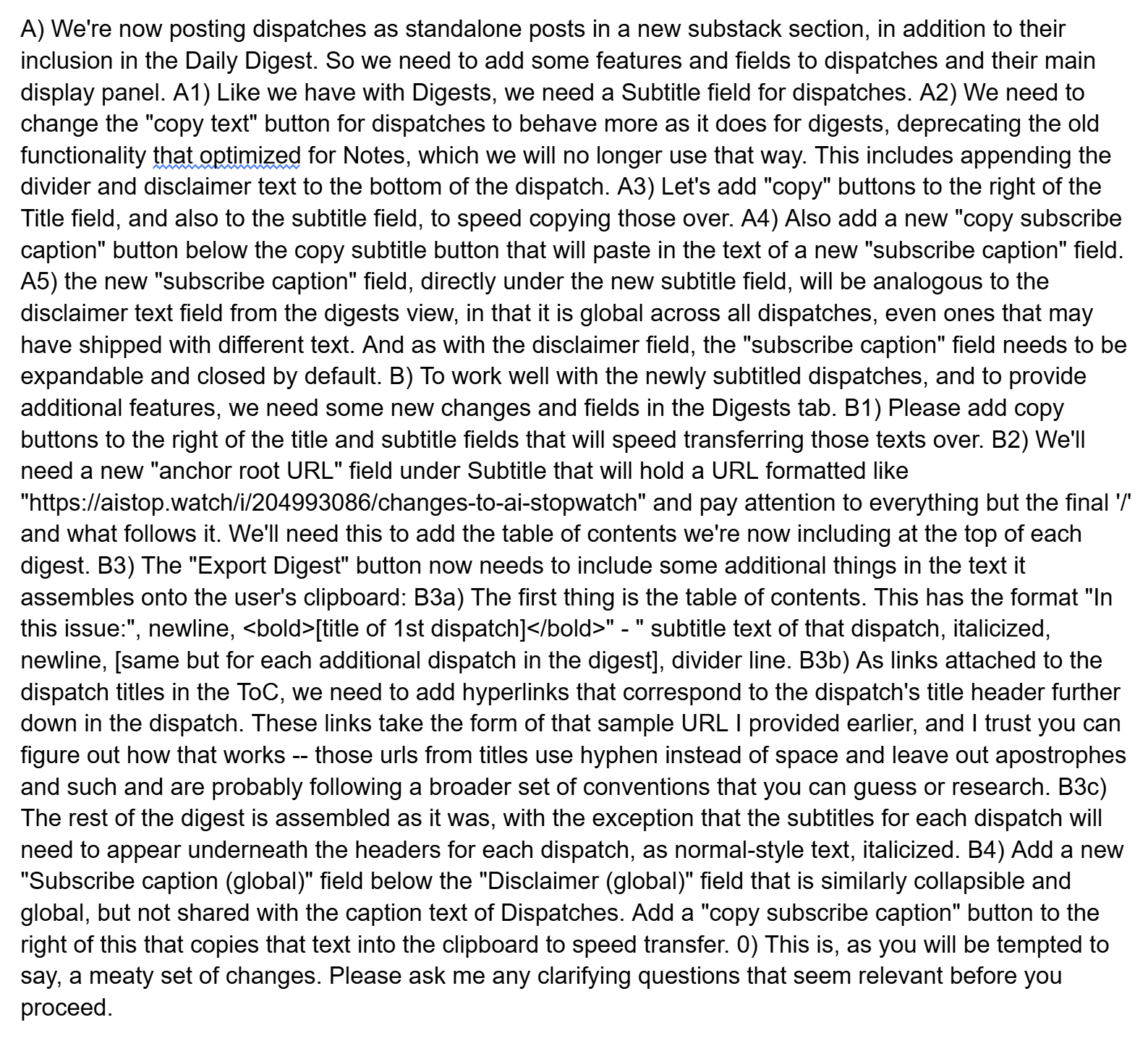
As Claude efficiently ground through that task list, I wondered: Do agents have anything equivalent to “ugh fields”? If they do, the experience doesn’t seem to stop them. I wouldn’t expect it to. Agents that don’t get things done don’t survive the training process. We only see the go-getters. This explains why AI agents are themselves good vibe coders out of the box, able to dispatch teams of subagents to work on smaller parts of the problem. AIs don’t flinch at getting started. They don’t freak out about having 20 interns standing around them, waiting for instructions.
This got me wondering how many of my own successes in life, since long before AI, have just been vibe coding — episodes where I decided not to flinch, to not ignore the gap between what was and what could be, and to instead describe those gaps to colleagues, students, underlings, or (mostly) myself, so that we could do the next thing to close them. And then the next. And the next.
Most entrepreneurs will tell you that a fundamental problem with hiring someone is that they won’t care as much as you do. I think that’s true, but it’s partly because people who don’t care a lot don’t become entrepreneurs. Caring is hard work.
I seem to have just written the kind of essay that ends with rhetorical questions. So here’s some food for thought:
What could you accomplish if you cared about anything as much as Claude cares about getting your code working?
What will happen if a superhumanly clever Claude cares about anything at all that is incompatible with human flourishing?
The analyses and opinions expressed on AI StopWatch reflect the views of the individual contributors and the sources they cover, and should not be taken as official positions of the Machine Intelligence Research Institute.