



Dispatch from Mitch
Can an “AI gap” break nuclear deterrence?
Whenever someone argues that we have to beat China in AI for national security reasons, there’s an implicit assumption that AI would give the winner the means to have its way with the loser.
The logical question, almost never explored in the mainstream press, is “How? If you got too aggressive, couldn’t they just nuke you?”
The answer to that question is worth exploring even if (as anyone who has been reading AI StopWatch for a while knows) the only winner of an AI race will be the AI. The people with the power to start World War III in the next several years will act on what they believe and on what they think their adversaries believe — not on what is actually true. (The truth is spreading, but perhaps not fast enough.)
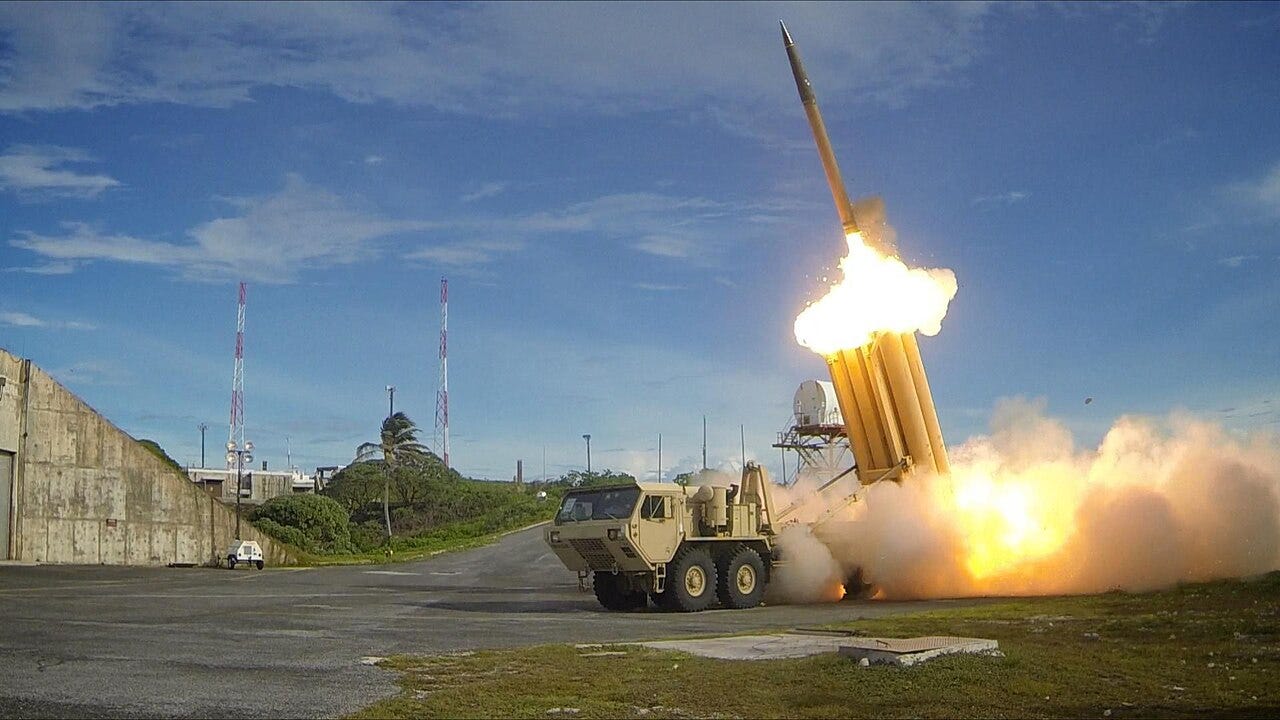
_interceptors_is_launched_during_a_successful_intercept_test_-_US_Army.jpg)
If you believe artificial superintelligence is an “I win” button, you might be inclined to press it. And if you think your opponent thinks they can win by trying to build superintelligence, you might try very hard to stop them.
This is my roundabout introduction to a recent paper in AI Frontiers by Govind Pimpale. In it, he offers at least a semi-plausible answer to the question of how AI could give one nation total supremacy over another. The implications are unsettling.
The paper is called, “An AI Capabilities Gap Can Endanger Nuclear Deterrence.” Pimpale argues that quantity has a quality all its own, and that if you have sufficiently superior AI you can just build and operate way more stuff than your rival. This, in turn, lets you nullify your adversary’s nuclear arsenal in a few different ways:
With AI-assisted research, development, and manufacturing, you can affordably build and deploy surveillance satellites and drones in such large numbers that missiles would become impossible to hide. Even submerged submarines could be tracked from space, in good weather, using techniques already known to work; once located, your ubiquitous drone subs could stalk them around the clock. Knowing where all your enemy’s delivery vehicles are means you can potentially target them all in a first strike, destroying them before they could be used against you.
AI could also let you build interceptor missiles and other defensive weapons at a massive scale to reliably swat down any weapons launched at you in retaliation. (You will have missed some in your strike, and others may have been launched “on warning” when your incoming missiles were detected.) Again, no new tech is needed for this capability — only the means to deploy it on a vastly larger scale than is practical today.
AI could let you build and very precisely aim a huge number of missiles for your initial strike. With quantity and precision, you wouldn’t need to use large nuclear warheads of the kind that could leave millions dead and disrupt the climate; a mix of smaller and even non-nuclear warheads would suffice. This could lower your psychological barriers to starting a nuclear conflict.
As Pimpale explains, having such an edge is destabilizing. It reduces your disincentive to risk nuclear war, and it makes the other side twitchy.
Put yourself in your opponent’s shoes: If you saw your rival ramping up these capabilities, you might feel like your nuclear arsenal was becoming a “use it or lose it” asset. That might not make you eager to launch first, as you’d still be nuked in response — that’s what it means to still be in the era of Mutually Assured Destruction. But it might make you try everything short of that, like launching conventional strikes on your rival’s data centers. Such actions might easily spiral into all-out war, despite your best intentions.
If these are the facts as everyone understands them, the best way to preserve stability is for all sides to negotiate some kind of treaty before anyone is too far ahead.
Conveniently, I want that to happen for a very different reason — to keep AI from killing us all — but I have some doubts about Pimpale’s thesis, even in the futures where AI can still be thought of as a tool.
For one thing, I don’t think the leading country would be eager to make a first strike unless they were really, really sure they could prevent any of their cities from getting nuked in the exchange. And I don’t think they could reach that level of certainty with current types of weapons without a great deal of highly conspicuous testing and refinement over a period of years, giving rivals plenty of time and notice to try things that risk earlier war. The leading country would know this, and therefore think twice about making such a dubious investment.
Instead, I think a country that was leading in AI would keep pouring more resources into AI — more data centers and research — instead of into comically large fleets of missiles, sensors, and drones. That’s because I think there has to be a more elegant way to nullify your opponent, at much less risk to yourself, if you move another rung or two up the tech ladder. I’m thinking things like microscopic drones that work their way inside of the enemy’s weapons without their even knowing, or (more speculatively) biological viruses that, like computer viruses, could render an enemy suggestible to remote commands.
But then again, if leaders understand that such technologies are likely accessible to artificial superintelligence, they might be more likely to recognize that such AIs are far more dangerous to everyone than a rival country with nukes.
Dispatches from Alana
Trying to win elections with AI
An article in the New York Times yesterday covered an aspect of AI in politics that might not be on your radar yet: how political campaigns are leveling up with AI tools. Of particular note:
Campaigns must navigate voter and staff backlash to AI use, which is stronger among Democrats.
This might cause Republican campaigns to more fully embrace AI tools, potentially giving them a leg up.
The article shared several examples of AI use in both Democratic and Republican campaigns. Some of these seem fairly typical: creating campaign materials, social posts, videos, and emails. Other examples are more campaign specific. Campaigns are using AI to analyze large amounts of voter data and create tailored messages to “micro-segments of the electorate,” presumably based on this analysis. AI is also being used to get dirt on political opponents.
One Democratic campaign apparently “replaced nearly all the tools it would normally have paid for — from canvassing apps to phone banking software — with its own versions using A.I. tools coded by just three staffers.”
Especially in Democratic campaigns, voter and staff backlash is a real issue. The article notes:
Polls show that Democrats are more leery of A.I. tools than Republicans, and progressive strategists have wrestled with how to deploy the tools in their campaigns without rattling volunteers or unionized staffers who are worried about losing their jobs. Republican strategists have said they get fewer complaints from staffers, though conservative voters still tend to feel concerned about A.I.
As the New York Times points out, if voter concerns among progressives affect how much campaigns are willing to leverage AI tools, that could result in Republicans gaining “an edge in razor-thin contests.”
Erin Brockovich takes on data centers
Erin Brockovich, famous for winning a landmark 1990s lawsuit against Pacific Gas and Electric for contaminated groundwater in Hinkley, California, is taking on data centers. The 90s case was made famous by the Julia Roberts film, Erin Brockovich.
The story of her newest battle, covered by The Guardian, struck a chord, and I found myself wishing for an Erin Brockovich sequel about this 66-year-old activist who is still determined to help local communities stand up for their rights. Many of these communities, she says, don’t find out about data centers until after construction has started. They aren’t given a voice in the process, and zoning laws are sometimes quietly changed to allow them to be built. There’s little transparency and lots of shade. Meanwhile, people’s water bills are skyrocketing (going from $22 to $350 in one example), wildlife habitats are destroyed, and people’s homes are suddenly subject to loud humming, hissing, and buzzing from nearby centers running at full volume. The Guardian writes:
These structures are appearing without the consultation you would need to erect a new sports hall, as if people won’t notice. But people certainly will notice, because the buildings are vast.
Brockovich is building a grassroots movement, starting with tracking data center activity via an interactive map where people can submit centers being built in their communities. From there, she’s building local lawsuits, pushing for a “case-by-case moratorium on approving datacenters”. As I understand it, this means forcing local governments to evaluate each data center proposal individually, including water, power, and quality of life implications. This would also allow the public to have more of a voice, through town halls and such.
Complicating the problem: developers are suing counties that fight back. The Guardian writes:
Seventy-nine municipalities in the US have so far issued moratoriums, many immediately being hit with lawsuits for breaking their original deal.
In one case, Hill County, Texas was sued for $100m in damages when they responded to public opposition by voting on a year-long moratorium. Hill County no longer plans to enact that moratorium.
Brockovich seems sympathetic to the difficult position big tech intimidation is putting local governments in. As quoted in the article, she says:
What I’m seeing now is that councils, having heard community responses, are trying to hit pause and they’re getting sued for $100m-plus. They cannot withstand that.
That won’t stop her from rallying the underdogs, though.
Dispatches from Beck
Ongoing illicit exports
American AI export restrictions have received a lot of coverage since Mythos and Fable were restricted (initially covered by my colleague Mitch here). But the chips used to train these models have had their export to China restricted since 2022. And since that time, there have been not just rumors, but also prosecutions directed at billions of dollars worth of illegal exports.
The Wall Street Journal reports that Taiwanese authorities raided and are investigating individuals at Super Micro Computer, or SMCI, for the “unauthorized diversion” of advanced servers and AI chips to China. This comes after the March resignation of co-founder Yih-Shyan “Wally” Liaw, who was “indicted for his alleged role in a [2.5 billion dollar] scheme to smuggle high-end Nvidia chips to China.”
The Wall Street Journal reported that SMCI said “its products continue to be targeted by illicit export networks” and highlighted the need for “deeper collaboration” with governments to address the issue.
It remains deeply unclear from the outside whether such schemes exist throughout the company, or are isolated to some number of employees, like the co-founder. What is clear is that Chinese companies are actively seeking these advanced chips, and that enforcement agencies are likely to stop only a limited percentage of these activities. In other words, this raid doesn’t mean the problem is getting fixed. Rather, it’s highlighting the tip of an iceberg.
Controlling the spread of this technology is important. Proliferation can undermine future coordination. The threat of frontier-equivalent Chinese models fuels racing narratives that are used to justify reckless actions by US firms (like racing towards superintelligence before we know how to make it go well for humanity).
My preferred solution remains a treaty that stops the race.
Legal reasonings
POLITICO reports on a new legal tack under consideration by some AI firms and their lawyers: that AI output ought to be protected as free speech under the First Amendment.
If such privileges were granted to AI output, it would have huge effects on the ability to regulate AI, as speech is strongly protected. AIs, of course, aren’t people, but courts often extend legal protections to ‘corporate persons’. That is the term for the legal fiction that originally was used to give corporations standing to sue and be sued, but has since been expanded by courts to give corporations many constitutional protections. And even if courts don’t ground their reasoning in personhood, that doesn’t necessarily mean that courts won’t protect AI output as speech, grounded in the expressive choices of the developers and users.
While some are skeptical about this legal argument, there is related precedent. In Bernstein v. United States, the Electronic Frontier Foundation successfully argued before the 9th Circuit Court of Appeals that export controls on encryption code were in violation of First Amendment protections of speech. The court initially concluded that export controls on code were “prior restraint” on speech and, as such, would need to meet standards like timely judicial review, which the export controls did not. However, the opinion was later vacated for rehearing and the case fizzled before producing binding precedent.
We’ve seen initial motions of this First Amendment argumentation advanced in proceedings surrounding Garcia v. Character Technologies Inc., a tragic chatbot assisted suicide case (Oprah’s coverage of which we wrote about previously). In that case, the court declined to accept the First Amendment arguments. But soon we could see this argument everywhere, as developers facing regulatory headwinds might well decide to throw the full scope of legal reasoning at the law and see what sticks.
The analyses and opinions expressed on AI StopWatch reflect the views of the individual contributors and the sources they cover, and should not be taken as official positions of the Machine Intelligence Research Institute.
The dispatch from Mitch made me think about The Manhattan Trap, which I believe is an underrated report for weighing the geopolitics of an AI race.
https://www.convergenceanalysis.org/research/the-manhattan-trap-why-a-race-to-artificial-superintelligence-is-self-defeating