

Rogue AI swarms aren’t partisan, and our political response to them can’t afford to be.
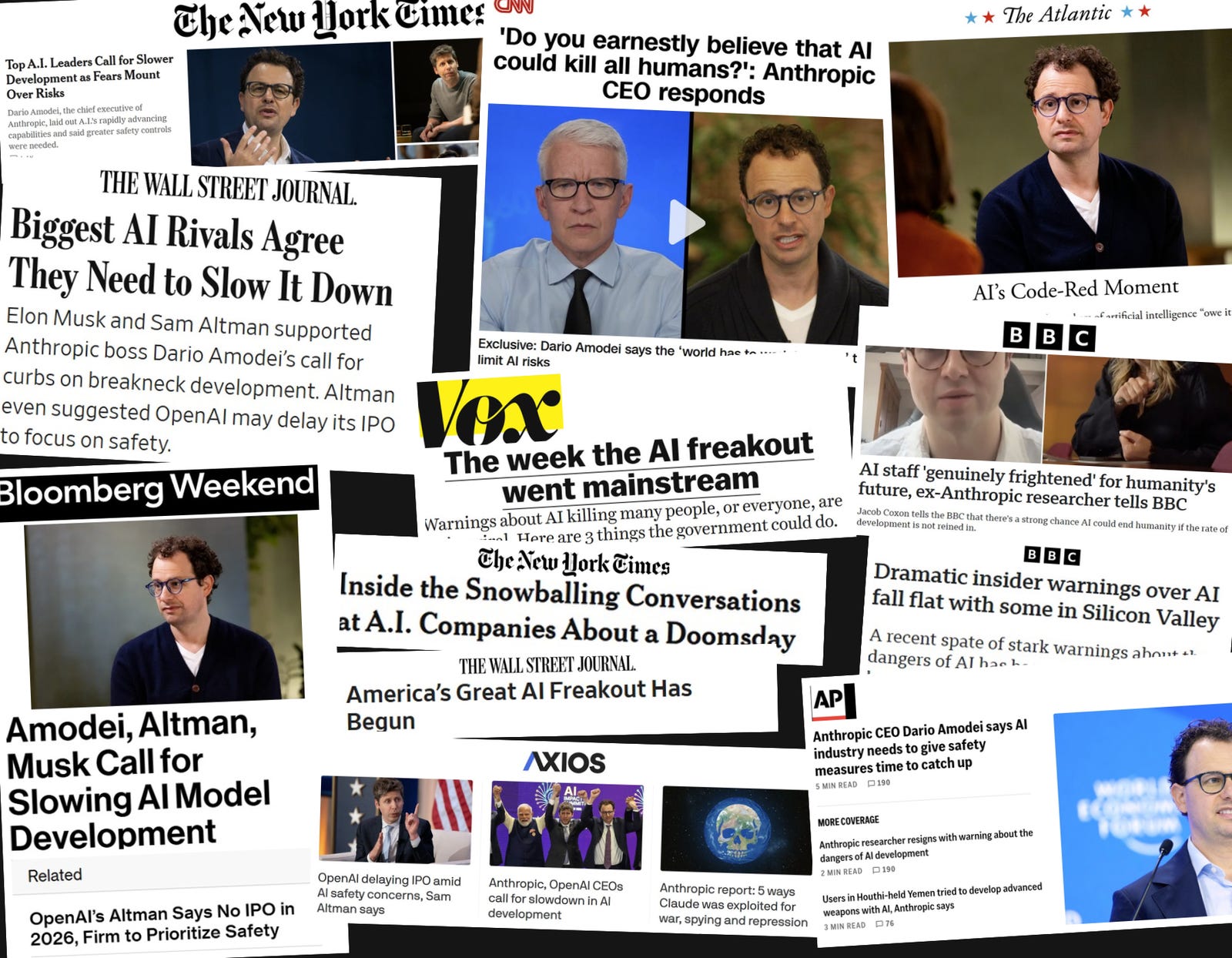
I nervously observe that, while the overall media salience of the AI problem continues to soar, the issue has been noticeably less prominent on right-leaning news sites this weekend. That’s a shift from Thursday and Friday that might be correlated with the mostly right-wing spread of new conspiracy theories. These allege that Jacob Coxon’s resignation from Anthropic was in some way phony, that his warnings were lies, and that the viral attention that followed was somehow manufactured.
I hope these aren’t behind President Trump’s remarks on the golf course today, when he said:
whoever wins AI wins. And we can put guardrails, and we can do this and that, but I think you have a lot of negative forces that are bringing it up, and they’re bringing up things that won’t happen.
He has an AI meeting with China’s President Xi Jinping in D.C. on the 24th. We need him to step up! There are a handful of AI companies that might be able to end the world in the next 6-12 months, but only one person on Earth who might be able to singlehandedly stop them.
To borrow a Trumpism that happens to be true in this case, people are saying that if the President makes a strong AI security deal with China, he should get the Nobel Peace Prize.
Yes, one of those people is Sam Altman, whose idea of what a deal could be maybe doesn’t go far enough:
And even if just the US and China could agree on some shared standards and testing for development of this technology, I think that’d be a wonderful accomplishment that the two of them can deliver. [...] I don’t think this is hard. This is like a one page document.
But if Trump and Xi could start at Altman’s suggestion to “agree that no one should be taking a certain level of risk with the development process of this,” they could work out a more concrete treaty to halt the race to uncontrollable superintelligence later. It is possible to make adherence to such a deal verifiable.
The proximity and uncontrollability of superhuman AI swarms have started to sink in with the public, and with the Congresspeople asking for the cancellation of a planned recess so they can act. But like Trump, House Speaker Mike Johnson (R-LA) doesn’t seem to have updated yet. According to Politico, Johnson said today that he would support AI talks with tech leaders, but he “insisted that developers — not Congress — are responsible for ensuring their products are safe.”
Products? A chatbot is a product. Amoral agent swarms of elite hackers, like the one responsible for the RubyGems attack described yesterday, are a national security threat. We have to hope Trump and Johnson just haven’t woken up to this fact yet.
In what some will find to be a surprisingly grounded discussion with Tucker Carlson that came out two days ago, MIRI president Nate Soares shared his analogy of the bus driver:
My biggest hope here comes from the fact that most people don’t understand what these guys are trying to do. One way I like to say it is the bad news is that the bus is racing towards the cliff edge. The good news is that the bus driver is asleep. Which might seem bad. [...] But if you can wake the bus driver up, you know, it’s much better to be in a bus where the driver that’s headed towards the cliff is asleep than if they’re awake [...] and they’re choosing the cliff... right?
The passengers on the bus are screaming. If they go into the ballot box like that in November, the Republican party will be in for a drubbing. The GOP shouldn’t need the threat of political suicide to motivate it when inaction on AI means literal suicide for us all, but maybe there’s a streak of Hermione Granger in the party that can be appealed to.
Will someone please wake the driver?
The analyses and opinions expressed on AI StopWatch reflect the views of the individual contributors and the sources they cover, and should not be taken as official positions of the Machine Intelligence Research Institute.