

Jensen Huang reinstated as Nvidia CEO; Trump takes credit
After direct and indirect pressure from the President, Nvidia’s board said this morning that it is now “satisfied with respect to Mr. Huang’s candor and ability to lead Nvidia.”
Semafor reports that Trump personally “dialed into Nvidia’s Sunday board meeting” to argue for Huang’s return.
The New York Times reports that Trump had Vice President Vance reassure the board that the administration didn’t consider Huang a national security risk.
“Did I do a good job last night?” Trump asked the Times, pointing to the rising price of Nvidia stock this morning.
Trump also posted a meme of Huang-as-Trump in the President’s famous fist-raised moment following a failed assassination attempt. In the image, Huang holds a red brassiere aloft as an Nvidia flag waves in the background.
This whole turn of events is pretty surprising to me and the insiders I follow on social media. I think there’s a good chance the political ramifications will be huge. Huang’s ouster and the reasons for it have been the biggest story in AI since Jacob Coxon’s public resignation from Anthropic over extinction concerns. Trump pulling strings for Huang like this very visibly ties the President to tech leaders often seen by the public as slimy, untouchable oligarchs. Openly defending an adulterous AI CEO seems risky even for a President on the back stretch of his final term.
Investigations by Congress and the media into Nvidia’s dealings were just getting started. The company employed many means to keep advanced U.S. chips flowing to China and to China-accessible datacenters despite laws intended to limit this. Some of these methods may have crossed the line from “creative” to “illegal.” At the same time, individuals in the administration known to have profited from these trades are under new scrutiny.
As of this moment, I have no idea what this will mean for the prospects of halting the race to hand over our future to AI. But the political landscape that race is happening on suddenly feels very wobbly.
NYT - Live Updates: Nvidia Reinstates Jensen Huang as C.E.O.
NYT - Trump Is Said to Have Directed Effort to Reinstate Nvidia Chief
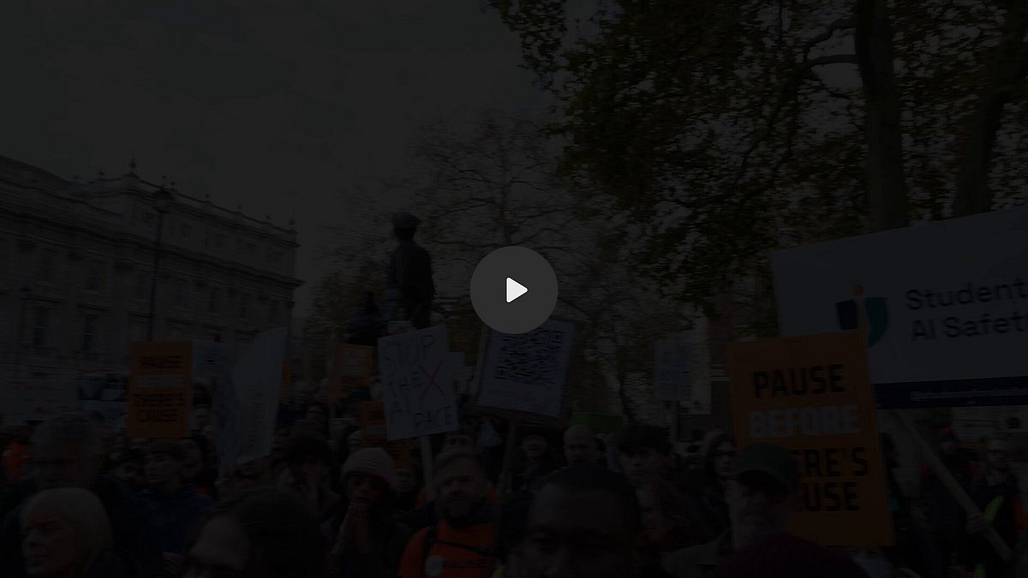
Over a thousand people marched against AI extinction in London Saturday
A tweet from the organizer, PauseAI UK, included video footage.
The group has another march planned for April.

“[T]he discovery of the atomic bomb is a homework problem compared to the Riemann Hypothesis.”
I didn’t have Meta’s chief AI officer, Alexandr Wang, on my bingo card for sounding the alarm on AI models that will be “clearly superhuman at improving themselves.”
But he’s of the opinion that AI research, like atomic weapons research, is “much less intellectually demanding” than solving Riemann, the world’s most famously difficult math problem. (Just a few days ago, we learned that Anthropic’s Claude had solved Riemann under the direction of mathematician Levent Alpöge.)
Wang calls it “lazy thinking” to believe that superhuman AI is “inevitable.” Society should not be ok with a “handover” to AI; a solution “likely involves the whole industry taking meaningfully different actions from the ‘default path’ in front of us.”
I would feel better about the post if he suggested any particular actions or indicated that his own lab would start doing things differently. But progress is progress.
X (Twitter) - Superintelligence is Arriving
China is worried that American AI could undermine nuclear deterrence
That’s the conclusion of a review of “more than 100 recent studies by Chinese civilian and military researchers, as well as interviews with experts and former U.S. officials.”
Concretely, China is worried that AI could give the US better ability to detect, track, and strike its nuclear weapons on short notice.
That’s bad, because it means a nuclear power may feel like it has a “use it or lose it” window on its arsenal. But this is yet another reason China may be amenable to international coordination to rein in AI.
Xi Jinping has engaged with the U.S. before on this narrow issue, agreeing with President Biden in 2024 to keep humans in control of nuclear launch decisions.
China expert: Beijing will clamp down hard on AI the moment it feels threatened
In a New York Times column, Dan Wang argues that Americans who say we can’t slow the AI race because of China aren’t “paying enough attention to the paranoia of the Chinese state.”
There is background awareness of the risks. An essay in a Communist Party magazine warned that AIs “have shown indications that they can escape human restraints,” with results that might “threaten human survival itself.”
Wang gives examples of crises that would provoke a strong state reaction: a faked policy order, hacking a state-owned enterprise, an AI swarm that “urges people to assemble.”
I don’t know if we can afford the “patience” Wang recommends, but I think he’s right that China is heading for an AI “freakout” that will make it more visibly receptive to talk of pacing AI progress.
OpenAI proposes technical metrics that could inform industry limits on AI development
The post by the company’s chief scientist, Jakub Pachocki, got a lot of play on Twitter for a chart showing models by their “perplexity” — how good they are at predicting the next fragment of text. Despite it being a simple metric that has been around a long time, perplexity seems to be strongly correlated with model capabilities (lower is better). He produced a chart showing that the company’s most transformative models reflected significant dips in perplexity. Concerningly, the chart included an unreleased model with a very low, off-trend perplexity score.
Pachocki proposed that companies be “committed to not crossing” limits based on perplexity and other metrics until milestones around monitoring are reached.
Reading the post, however, I couldn’t help being reminded of a child who keeps proposing new rules to their parents that will allow them to keep doing whatever wayward thing they are doing a little longer. AI companies keep blowing past their previous commitments and offering new thresholds further out.
Reflecting on AI’s recent conquest of top math problems, Pachocki says he expects “further transformative capabilities” at the next perplexity threshold. But he says, “I don’t know what those capabilities will be, and we may not be testing for them today.”
OpenAI - Perplexity and Intelligence
The analyses and opinions expressed on AI StopWatch reflect the views of the individual contributors and the sources they cover, and should not be taken as official positions of the Machine Intelligence Research Institute.