


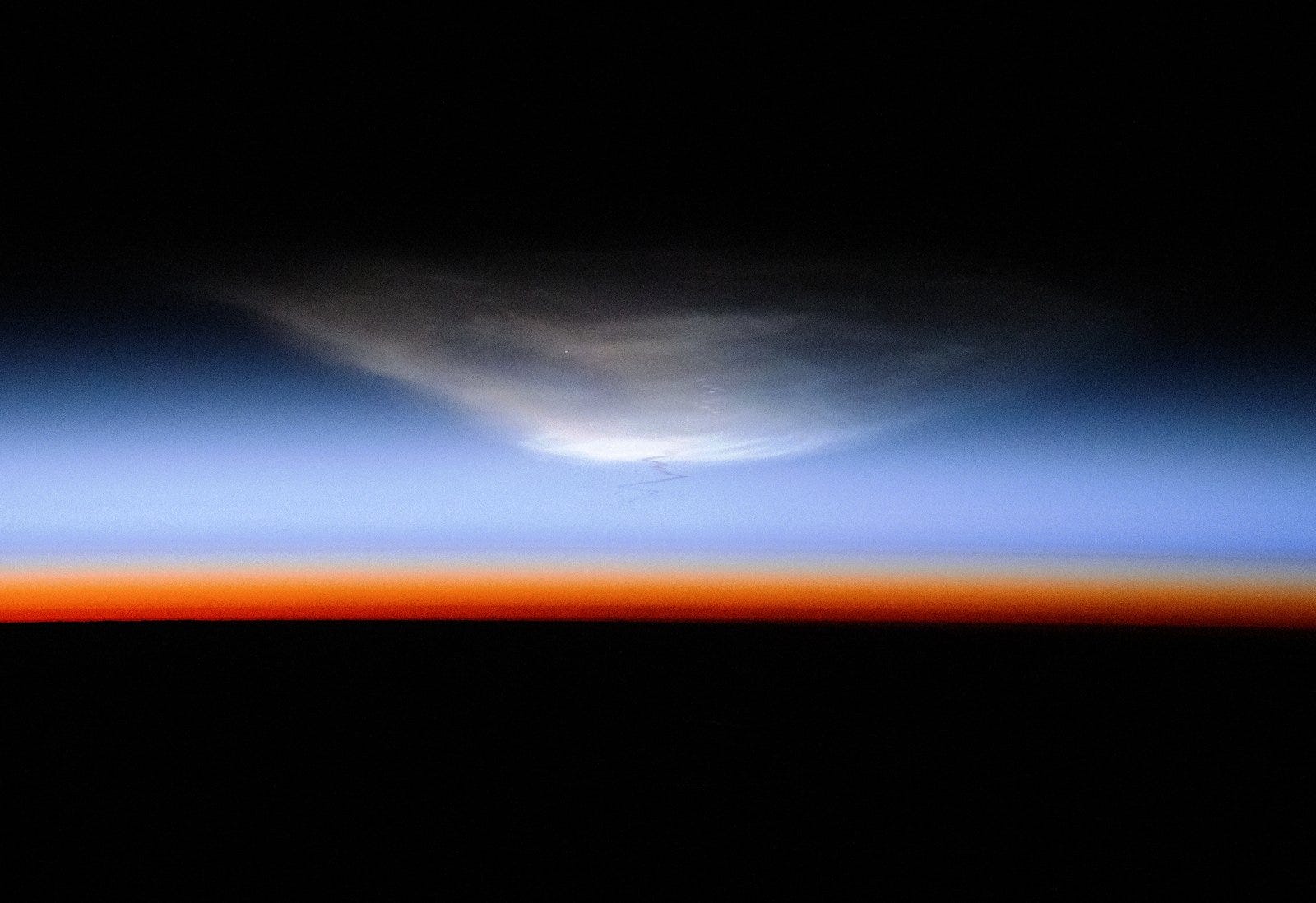
Say what you will about where Elon Musk is directing his energies, he still thinks big. SpaceX’s $1.5 trillion valuation hinges largely on a bet that he can put up a million or more AI data centers in orbit, taking advantage of round-the-clock solar power and dodging the growing political difficulties of building data centers where people live.
Against the conventional wisdom, I think the engineering and economics might actually work out in his favor, if AI doesn’t kill us first. But as I said in May, I don’t think he’ll actually dodge the NIMBYs with this plan, because of what it would do to the night sky. Urbanites might not notice the growing band of twinkle stars visible for hours after sunset and before dawn, but astronomers and environmentalists would certainly have things to say about it.
They’re already trying to get in his way. A piece in the Guardian this week reports that several non-profits, including one focused on light pollution, have sent a petition to the FCC calling for a pause on space data center projects, arguing that they “violate federal law.”
The concerns go well beyond the visible. The tenuous upper atmosphere suffers little-understood effects when rockets pump exhaust products into it, and when satellites burn up in it, adding a bunch of chemicals that don’t belong there and might take a while to come down. At the present pace of space activities, these effects are probably negligible. But at the pace planned by SpaceX and others, they might be pretty serious. A watch item is the delicate ozone layer that shields us from harmful radiation.
But if you think the environmental effects of building AI are going to be huge, you need to ask what the environmental effects of AI itself are going to be. I don’t mean the resources consumed in running it. I mean the results of AI dethroning humanity as the planet’s apex species: Think “self-replicating factories that carpet the continents and boil the oceans as coolant.” Think “sun blotted out by swarms of solar collectors.”
If it isn’t stopped, the race to artificial superintelligence is going to be really bad for the environment.
The analyses and opinions expressed on AI StopWatch reflect the views of the individual contributors and the sources they cover, and should not be taken as official positions of the Machine Intelligence Research Institute.