

Dispatches from Mitch
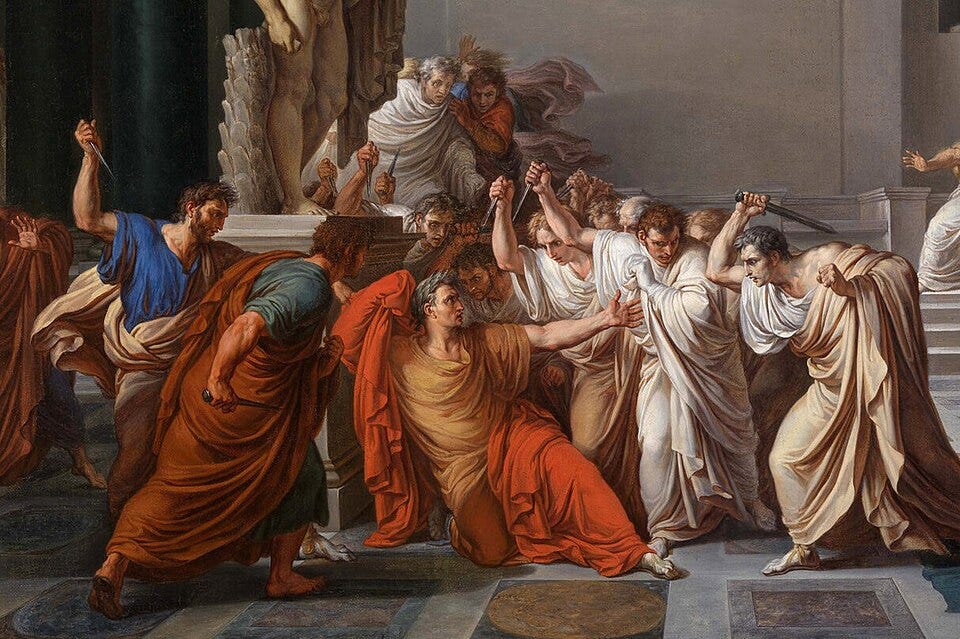
Knives out for Anthropic?
There was no way we were going to get through the weekend without new revelations about the fight over Fable and Mythos.
.jpg)
If you missed our coverage yesterday, the U.S. government effectively forced Anthropic to shut those products down Friday by saying it had to cut access to anyone who wasn’t a U.S. citizen, even if they were legally working in the U.S. — even if they were working at Anthropic. The official reason was concern over a reported “jailbreak” for bypassing the model’s guardrails against offensive cyber operations.
Most of the new revelations of the past 24 hours come from a New York Times report by Dustin Volz, Julian E. Barnes, and Ana Swanson. They seem to have spoken with a bunch of inside but mostly unnamed “people” and “officials” who are “familiar with the matter.” The quantity of the dirt being dished out, and the way most of it conflicts with the government’s official narrative, tells me that a lot of people in or close to the White House are unimpressed with the administration’s behavior in this matter.
In short, the most cynical interpretation I floated as a possibility yesterday — that this “animus toward Anthropic might stem from ideological differences, and from business interests close to the President” — is bubbling to the top.
For one thing, Secretary of War Pete Hegseth tweeted:
Three months ago, @DeptofWar kicked @AnthropicAI out of our building—forever. Every passing day proves why that was the right move.
This is hard to reconcile with a classified contract that is reportedly letting the NSA use Anthropic’s models. Insiders see an executive branch that continues to want and use Anthropic’s products while intentionally hindering the company’s commercial prospects.
Why? Well, Trump called Anthropic a “radical left, woke company” back in February, and it’s not generally believed that he formed that opinion on his own. Hegseth and others in the administration seem to genuinely hate Anthropic’s leadership as people and for their calls for stronger regulation. They seem to jump on any excuse to slap them down.
This isn’t how I want AI policy to be done, even if I think it’s better for the world if labs have more reservations about advancing the AI frontier. I’d prefer it if those reservations come from something other than fear of White House whims.
Except, maybe other companies don’t have to worry? Per that Times article, it wasn’t just Amazon’s report of a Fable jailbreak the White House responded to, but rather the reports of “multiple technology firms.” The knives may be out for Anthropic.
The piece goes on to say that several sources claimed:
a separate document from Amazon explaining the security concerns with Anthropic’s model was misleading. The concerning capabilities that the document highlighted with Anthropic’s model are also present in OpenAI’s top model, 5.5.
The piece quotes a cybersecurity expert who saw the Amazon report as saying the administration was either misunderstanding or deliberately misconstruing it.
The Times’s sources also provided new timeline information that suggests the administration gave Anthropic an order it had to refuse in order to justify giving a different order it couldn’t refuse:
Administration officials called Anthropic officials at 1:15 p.m. Friday and gave them 90 minutes to pull their most advanced models down. [...] Anthropic officials asked for more information and worked to learn what the precise concern was, since the Commerce Department’s review and testing of Fable did not reveal significant concerns.
Then, at 5:21 p.m., Anthropic was notified that the Trump administration was imposing export controls that effectively forced the company to pull down its model.
Per POLITICO, the White House claims that Anthropic CEO Dario Amodei was unreachable during that window because he was at a “wellness retreat,” but Anthropic flatly denies this; journalist Ashlee Vance claims to have been at company headquarters at the time and that the claim is false.
The order the company couldn’t refuse came courtesy of Commerce Secretary Howard Lutnick. In the wording of the NYT journalists, the letter, which they viewed, told Amodei that a “special license” would be required for the company to distribute its Mythos and Fable 5 models to non-U.S. citizens. That’s interesting, coming from an administration that has been insisting there should be no licensing regime for releasing AI models. Should other companies expect such letters?
For my part, I think a licensing regime would be a lot better than what we’ve had to this point, even if it would still be insufficient. We should prevent these models from being created altogether. But we should do this above the table, with laws passed by Congress, with international agreements, and with enforcement that applies equally to everyone.
This isn’t that. Not by a long shot.
Deepfake expert despondent
The New York Times’s Eli Saslow wrote a lengthy profile of Hany Farid, describing him as having been the “world-leading expert in the field of digital forensics” until he stopped trusting his own eyes.
It’s worth a read if only for the running anecdote about analyzing a video of a missile strike frame by frame to determine whether its speed, its size in pixels, and the sound delay of its explosion were consistent with footage of a real weapon taken by a real camera.
Whether an artifact is real now is almost beside the point: AI means that creating convincing deepfakes is easy, and cheap. Detecting them is expensive, and hard.
And slow. In the case of the missile strike, Farid still wasn’t entirely sure the video was real “even after a full day of analysis and consultation with other visual experts” who thought it was. By the time he declared, “we find no compelling evidence that the video is fake or has been manipulated,” social media had long since made up its mind.
Farid’s research shows most people can’t tell a real photograph, video, or voice recording from a fabrication anymore. And increasingly, neither can he.
“We’re pretty screwed,” Farid says.
The video was real. The missile was the one that struck a girl’s school in Iran, killing more than 150.
Google liable for AI summaries
A few days ago, a judge in Germany found Google legally liable for false claims made by its AI Overviews — the ones that appear at the top of Google search results.
This is potentially a big deal, because if the ruling stands, becomes precedent, and inspires similar legal treatment internationally — yes, that’s a bunch of ‘ifs’ — it might change the way AI companies do business.
The suit was brought to court by two publishing companies who claimed that Google’s AI Overviews falsely tied them to “scams, subscription traps, and shady practices for certain search queries,” according to coverage in The Decoder. The AI seemed to have confused the businesses with others that are genuinely sketchy. The publishers claimed that Google had failed to respond “appropriately” to a cease-and-desist letter.
The ruling finds Google liable by declaring that AI Overviews aren’t search results. To oversimplify: The law has your back if you’re just showing what’s out there on the web, but not so much if you’re publishing your own new words that slander people. The court decided that the AI’s words count as new words, and that Google was the party responsible for having written them.
The Decoder article cited research that found Google’s AI Overviews were “only” wrong about 9% of the time, but that, “at Google’s scale, it still means millions of wrong answers every hour.”
Yeah, 9% is actually kind of a lot. I’m not surprised at the number; keeping today’s black-box, machine-trained AIs from “hallucinating” false information is more of an art than a science. No company has proven capable of completely fixing this. And I will hazard a guess that AIs cheap enough for Google to use to serve tens of millions of unsolicited “overviews” per hour aren’t going to be especially trustworthy.
It probably doesn’t help that Google’s search AI is often working from very sparse user inputs that were never intended as AI prompts. The AI can end up answering a different question than the user thought they were asking, if they were asking at all.
So while unlikely, there’s an outcome where legal risk means AI companies will stop offering these kinds of pseudo search results or invest a lot more into making these AIs more careful — or at least more guarded.
The more extreme version of that outcome might extend to broader AI services like ChatGPT, which could scarcely afford legal liability for every false claim. But there, I would expect the defense of “we warned the user that they should verify everything themselves” to actually work. It didn’t work for defending Google’s search page — their lawyers tried — because warnings are present on the page but not actively acknowledged by users the way they are when signing up for a major LLM service.
Google says it will appeal the ruling.
The analyses and opinions expressed on AI StopWatch reflect the views of the individual contributors and the sources they cover, and should not be taken as official positions of the Machine Intelligence Research Institute.