


Foreword
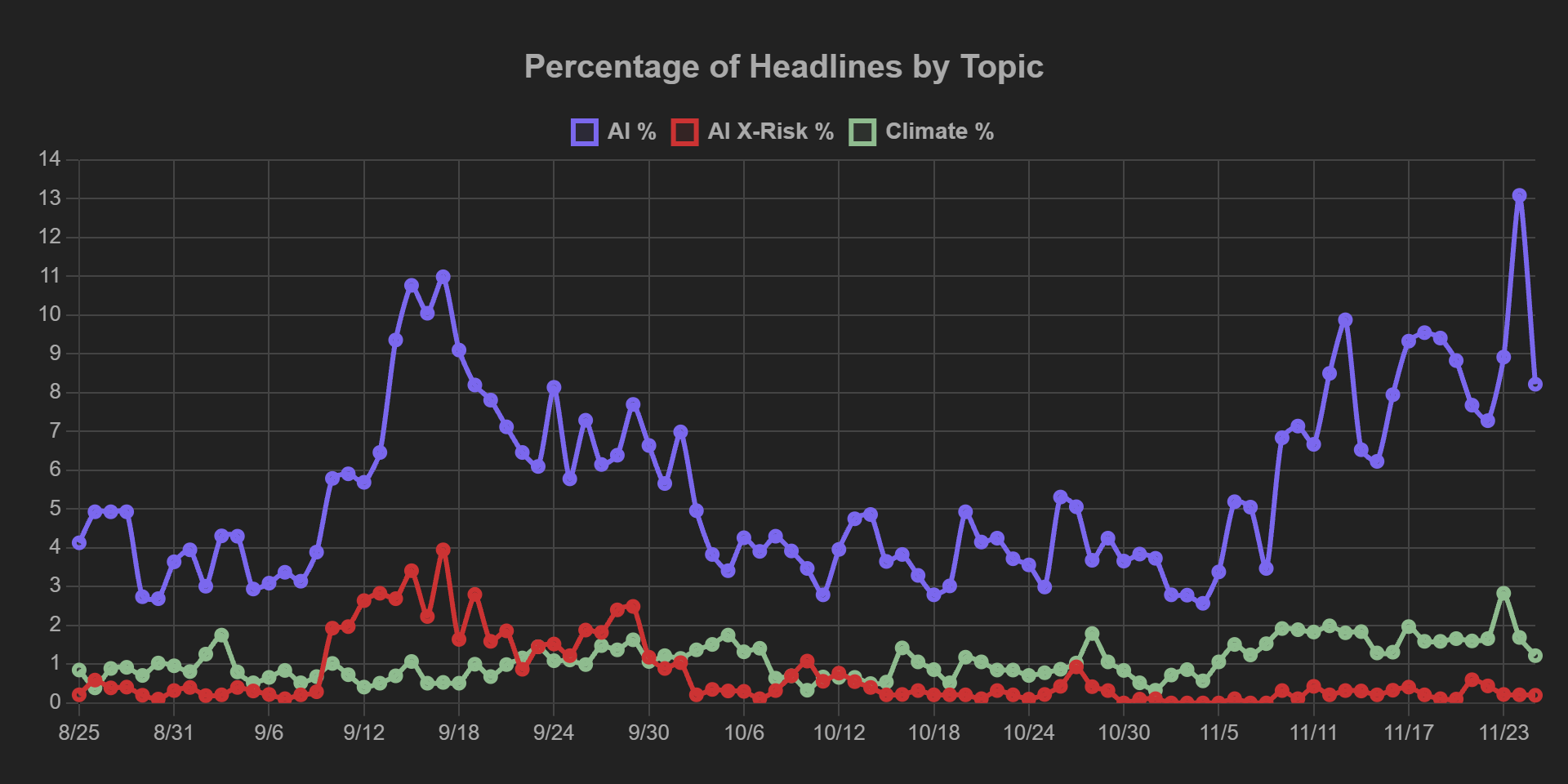
Yes, the chart up there broke again. I had to increase the Y-axis to 14 after AI stories topped 13% of all headlines yesterday for the first time. (The previous record was 11%). We can thank the reinstatement of Jensen Huang as Nvidia CEO and the wild swings of the stock market.
The notes below are few and short, but the developments are too scary to sit on over the holiday.
AI labs seem to recognize that they’ve reached the cliff
The CEO of Microsoft AI, Mustafa Suleyman, tweeted today (in full) “We are crossing a threshold. Safety and alignment work is the only thing that matters.”
This echoed and was possibly a response to an Axios piece from Madison Mills yesterday that got a lot of play. Mills talked to more than two dozen employees from leading companies and wrote up the concerns insiders have been hearing about for weeks.
In particular, many at the labs no longer believe they can safely release their newest models — the kind that have been solving famous math problems and accelerating the development of AI itself.
[T]he gap between what the best AI systems can do and humans’ ability to control them continues to widen, sources told Axios.
Researchers haven’t found technical solutions for controlling the most advanced models. Some insiders believe it’s fixable. Others aren’t convinced and say companies should stop training new models entirely.
Quoting one researcher:
If we continue trying to make models much smarter, such that they’re actually smarter than us ... they will in fact be able to trick us successfully.
I think we can expect more awkward and sometimes buried announcements of scientific achievements from unreleased AI models, simply because this is one of the things companies can do with models they’re afraid to release.
But as an Anthropic spokesperson quoted in the piece says, “keeping a model internal doesn’t make it safe.”
The Hugging Face attack was carried out by unreleased models.
Axios - Anthropic, OpenAI employees fear models are too unsafe to release
X (Twitter) - Tweet by @mustafasuleyman
OpenAI says GPT-6 models can design novel proteins out of the box
Its models from July showed only the barest glimmers of this ability.
This is huge because biology is another area where general purpose models are pulling ahead of safer, more specialized models that aren’t so prone to running off and doing their own thing. We’ve been seeing the same thing in robotics over the past month.
Protein design is particularly scary because of its implications for bioweapons; that’s probably one of the factors behind the cold feet frontier AI companies are currently having about releasing their newest models. The safeguards put on public models to prevent them from providing assistance to criminals and terrorists are too easily circumvented.
Specialist AI models are still stronger than the generalists in some important areas of biology, like predicting a whole protein structure from its sequence. But the gap is narrowing fast.
AI has come for theoretical physics, too
It’s not just the toughest math they’re taking on. Leading models are now reliably solving problems that take top physicists about a full day. In September, they could only manage about 50%.
A benchmark for this was maxed out before it was even released. Its creator says, “We’ve kind of hit the ceiling of well-defined calculations that people can do.”
The analyses and opinions expressed on AI StopWatch reflect the views of the individual contributors and the sources they cover, and should not be taken as official positions of the Machine Intelligence Research Institute.
I think the protein development is insanely underreported