


Common Crawl is a public archive that records about as much of the internet as it’s allowed to record. (There have been disputes with a number of news companies about its disrespect for their paywalls.) Researchers from Pew Research Center took 490,000 English-language webpages from Common Crawl, and ran them through Open Pangram, an open-weight AI detection model.
In a random sample of 10,000 web pages available in July 2026, the researchers say, 10% showed significant signs of AI authorship. This is not evenly distributed among all kinds of webpages. The researchers included webpages from a couple of years before the release of ChatGPT; in this period of time, text registering as AI-authored remained around 1% regardless of domain type. Today, .edu and .gov webpages remain close to 1%, but 4.6% of .org and 9.4% of .com webpages were flagged as AI-authored. Something else worth noting: Many of the webpages that exist today were published years ago. The 10% figure doesn’t reflect the rate at which AI-written webpages are being published. When the researchers looked only at pages published after ChatGPT’s release, the figure rose to 35%.
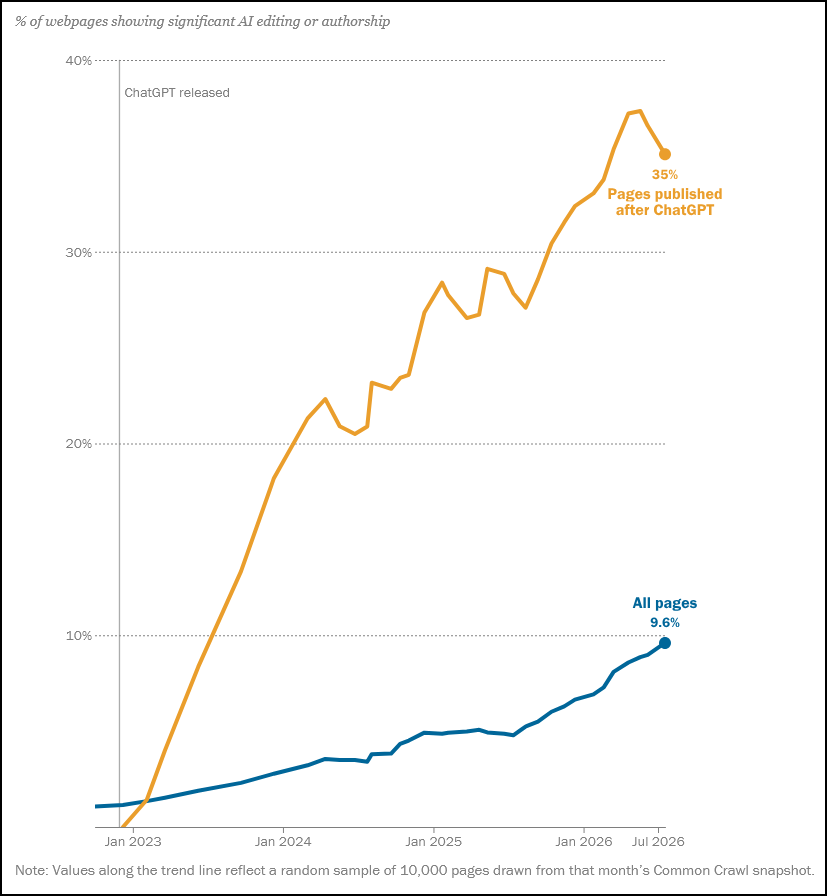
There are some caveats to go with these results: “AI authorship” includes heavy AI editing of human drafts; the researchers scored pages on a scale from fully human- to fully machine-generated, and lumped imperfect scores together, so “mostly but not entirely human” and “pure bot slop” went into one bucket together. Humans are also picking up writing quirks from AI, which may inflate the number. Second, the specific model used, Open Pangram, does over-flag: 1% of the webpages generated before ChatGPT were flagged as AI-authored, as noted above, but the real rate is below 1% when run through Pangram’s commercial model. Finally, the 35% figure leaves out pages with no known publication date.
That said, another study in April 2026 using a different methodology found the same 35% figure for newly published websites from 2025. I find it very plausible, then, that one-third or more of the webpages being published today are AI-authored. Much of that may be easy-to-ignore slop, like blogs and news aggregators, but far from all. In the past, transformative technologies have taken a while to disseminate, but studies like this one should show how quickly AI is taking root.
The analyses and opinions expressed on AI StopWatch reflect the views of the individual contributors and the sources they cover, and should not be taken as official positions of the Machine Intelligence Research Institute.
You can receive emails of dispatches as we write them, or subscribe to our Daily Digest for a once-a-day compilation.