


AI Futures Project, the team behind the AI 2027 forecast and AI 2040: Plan A scenario, just put out its quarterly forecast update. The headline figures:
Reality seems to be progressing about 75% as quickly as the original AI 2027 scenario (so still very fast).
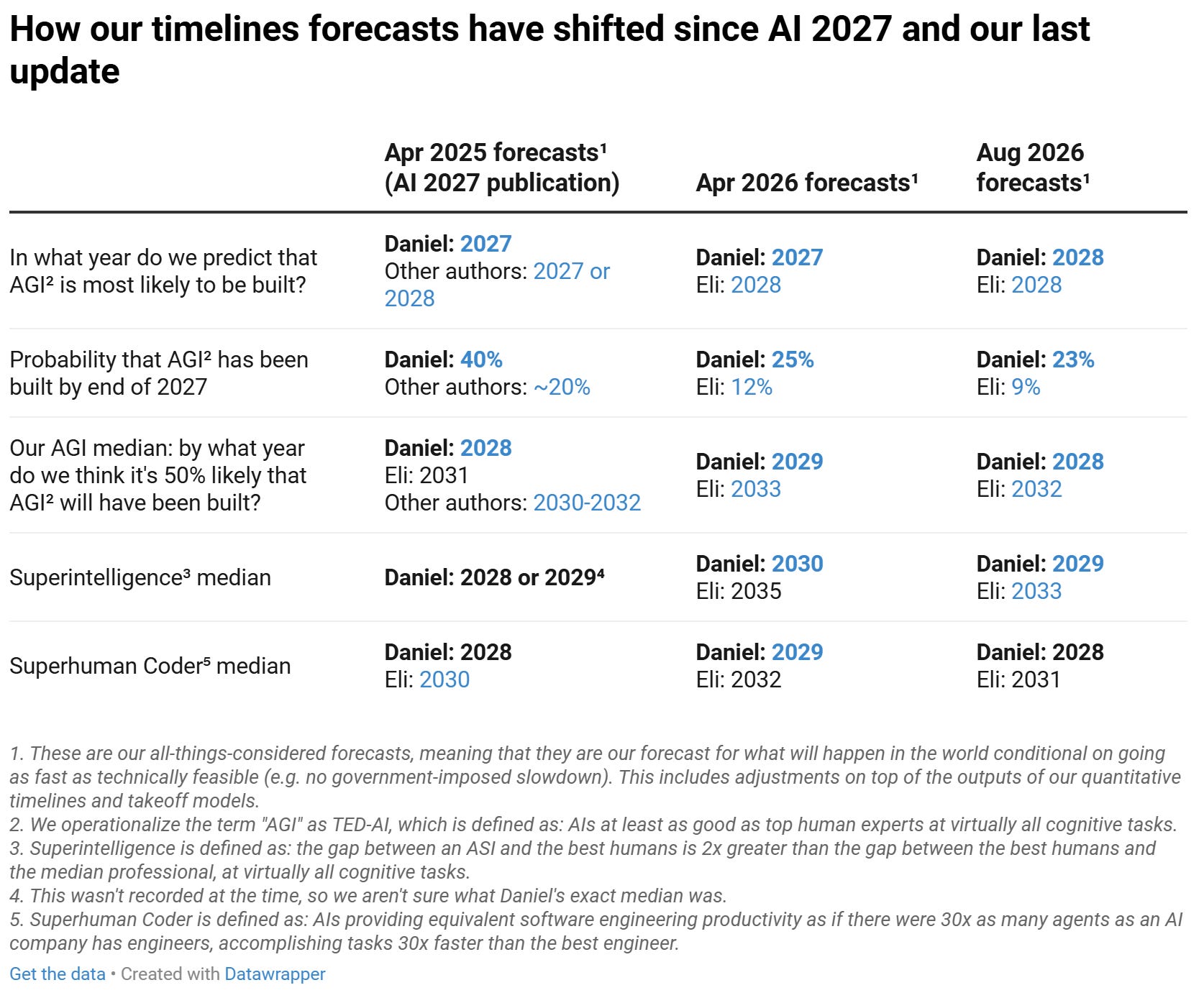
Daniel Kokotajlo’s median prediction for the arrival of artificial superintelligence (ASI) is now 2029, vs. 2030 in the previous quarterly update. Eli Lifland now predicts this for 2033, vs. 2035 from the previous update. Their definition of ASI seems reasonable to me: “the gap between an ASI and the best humans is 2x greater than the gap between the best humans and the median professional, at virtually all cognitive tasks.”
The team now specifies that their forecasts assume AI development continues full speed ahead; a government-imposed slowdown would change things.
While they never claim high confidence in their forecast dates, they say that three different new methods they’ve devised for tracking the rate of progress are all, to their surprise, giving very similar answers.
These methods are interesting. One involves looking at Anthropic’s employee surveys that ask how much of a speedup at coding its developers think they’re getting. While AI Futures agrees with Anthropic that these figures are probably inflated, they’re going up — doubling about every 3.5 months, after some adjustment — and it seems very unlikely that employees’ tendency to overestimate is growing at the same rate.
An intermediate milestone that this is used to estimate is what the team calls the “automated coder” (AC): the point where “the leading AI company would rather fire its human software engineers than forego AI usage for coding.” Kokotajlo’s estimated date for this is now November 2027, vs. May 2028 in the previous update.
Reflecting on AI 2027, published in April 2025, the authors note things seem mostly on target, but they flag a few of their misses. One of those misses is probably good news: They originally expected that Chinese leadership would have “woken up” to AI by now and started unifying its leading labs’ efforts to match or exceed America’s frontier models. But while the world in general is more “awake,” the Chinese Communist Party still seems more interested in spreading present AI benefits across its economy than in racing to superintelligence, leaving each of its domestic labs to pursue ASI (or not) as they see fit.
Another miss, the team’s claimed “biggest predictive error,” is probably bad news: They expected greater public salience of AI by now. Growing awareness of the proximity to ASI and the extreme stakes this entails could make an imposed global slowdown more likely. But while the team thinks public salience is definitely higher this year than last, their chosen metric for this has barely budged, and awareness is not as high as it probably needs to be.
AI 2027’s forecast that the best Chinese models would be about 7 months behind the best American models by now seems about right to its authors (and to me). But in another bad-news miss, the team assesses that AI companies haven’t yet reached the expected degree of security with regard to their model weights and other secrets. The forecast expects serious efforts by nation-states to steal these. This year’s string of leaks and autonomous breakouts isn’t what anyone would expect from labs positioned to thwart nation-state intrusions.
The analyses and opinions expressed on AI StopWatch reflect the views of the individual contributors and the sources they cover, and should not be taken as official positions of the Machine Intelligence Research Institute.