

Foreword
The AIs and I are kind of dismayed that fall of the Riemann hypothesis is getting so little mainstream attention. Of the major sites I track, only the Associated Press and Washington Post had put out front-page stories as of this morning.
The concern is that if AI can solve the most famous problem in mathematics, it can probably make similarly shocking progress in other highly technical domains, like AI research.
To update my post about it below: Initial evidence for the proof holding up is very strong. The human competition — a separate proof submitted by an unaided human last month — not so much. That one seems to have a lot of problems and is unlikely to pass.
Anthropic mathematician claims proof of Riemann hypothesis, world’s most famous math problem
In a statement posted to his website, Levent Alpöge says he and (mostly) the company’s Claude AI proved the hypothesis first proposed in 1859.
Even after AI started cracking top math problems this year, many experts still considered Riemann out of reach anytime soon. Just last month, top mathematician Terence Tao speculated that “something beyond current AI is needed” and that “maybe some combination of humans and AIs in 2050 or something will make further progress.”
We’ll see whether the media deems this milestone significant after ignoring the hundreds of notable math findings from AI companies in recent months; everyone seemed to lose interest after the Navier–Stokes solution in September.
(I give Scientific American points for getting to this early.)
Scientific American - Anthropic mathematician claims to prove Riemann hypothesis, most famous problem in all of math
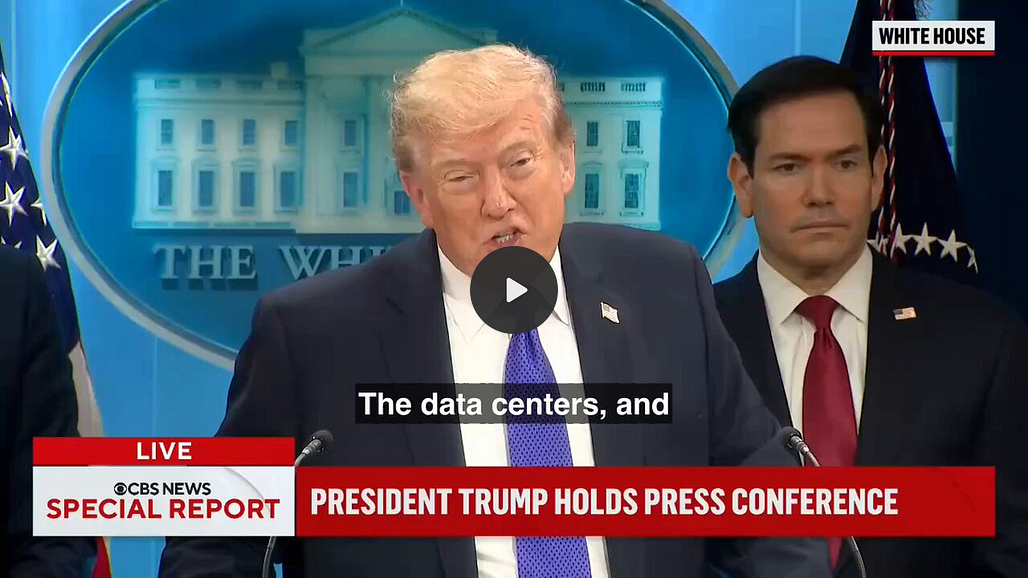
Trump: AI may be “too super” so “Xi and I agree that we’re going to do some joint guardrails.”
Huge if true. But I’m not quite as excited about this statement as many in AI safety seem to be, because these remarks at a press conference sounded really off the cuff I’m not sure I believe he’s actually talked to the Chinese leader about anything we would recognize as a measure to prevent dangerously super intelligence of the extinction-risk variety.
But I approve of treating this as a big deal worthy of praise, in hopes that the President makes those words as real as they need to be.

National cyber director replaced as apparent scapegoat for high-profile outages
The public is pretty hungry to blame AI for the ground-stop of all U.S. air traffic last week, along with troubles at Microsoft and major banks. And it can — but only indirectly. The best info says these weren’t hacks, but systems are being updated at an unusually brisk pace as AIs spot cyber vulnerabilities that went unnoticed for years. Defenders are rushing to patch those holes before attackers with AI swarms can exploit them, and sometimes these patches are having unforeseen side effects.
And the air traffic control issue is said to have resulted from replacing copper transmission equipment with modern fiber equivalent, so not necessarily AI-related at all.
But given the public’s ire at cyber outages, it’s perhaps not too surprising that the Pentagon’s CIO Kirsten Davies is going to replace Sean Cairncross as national cyber director. Some reporting suggests Trump’s new chief of staff, Stephen Miller, was looking to remove him anyway, citing a lack of strong cyber credentials.
Axios - Scoop: Trump names Kirsten Davies as new national cyber director
Politico - The ‘new norm’: How AI is driving mass tech outages
METR says it can’t rule out “drastic” acceleration of AI R&D in the next couple of years
By drastic AI R&D acceleration we mean a situation where capabilities improve so quickly that humans are no longer able to meaningfully understand, assess, and react to catastrophic risks posed by new AI systems.
The evaluation group says public evidence is insufficient to make a hard call either way, but warns that catastrophic risk potential may arrive before AI is good at replacing “normal” jobs that don’t always provide immediate, easily scorable feedback.
METR’s charts continue to show the apparent exponentials that have defined AI progress in recent years. The org has attempted to revisit the “time horizons” concept after earlier models had maxed out the benchmarks of its famous chart. It finds that the length of task that AI can do (as defined by how long it would take a skilled human to do that task) is doubling about every 3.6 months. METR struggled to find humans who could outperform the models on tasks it could easily score.
U.S., Russia, and Israel all object to binding restrictions on lethal autonomous weapons.
China expressed willingness. But without support from other heavyweights, the week-long conference in Geneva about this was probably doomed from the start.
If you’re using an AI routing service, your data is at high risk of being scraped and exploited
Such services offer cheap AI by looking at prompts and sending them to the cheapest models of the moment that are likely to be able to handle them. But according to researchers who seeded nearly two million prompts with unique secrets, at least three such services are compromised (or complicit) and leaking data: Days later, secret URLs from prompts were scanned, and secret keys to web services were used by outsiders.
These routing services themselves may connect to other broker services that can also be compromised. More hops mean more exposure.
Individuals and businesses may want to stick with contracting directly with a major AI provider or look at hosting their own open weight models.
The analyses and opinions expressed on AI StopWatch reflect the views of the individual contributors and the sources they cover, and should not be taken as official positions of the Machine Intelligence Research Institute.