

As a scrupulously perfectionist middle schooler, I once pulled a prank on my parents: I forged a miserably failed spelling test, even convincing a friend to write “I’m very disappointed in you” in angry red pen. When my mother asked me what I had to say for myself, I replied, “April Fools.” We still laugh about it even today.
I wish I could say “April Fools” about the latest report card for AI companies. But the failing safety grades assigned by the Future of Life Institute are no joke.
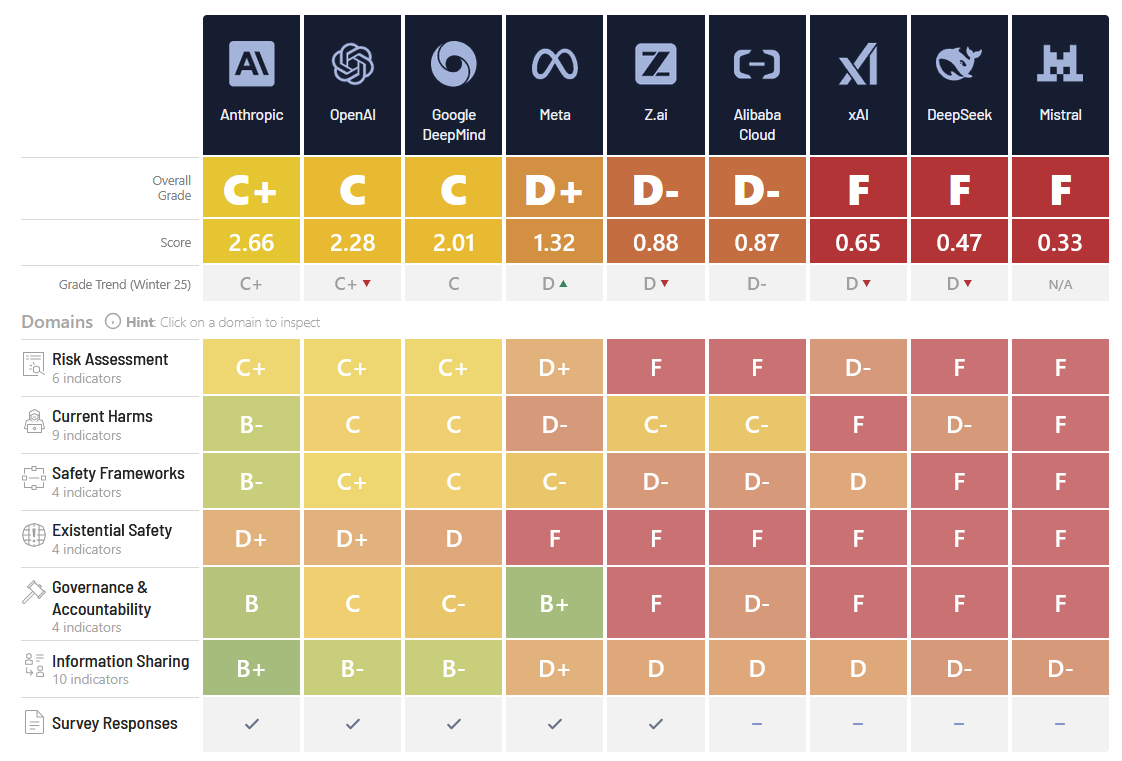
The row of D’s and F’s by “Existential Safety” is particularly disturbing to me, though not very surprising given what we already knew. That’s the section that potentially outweighs all the others, measuring how well an AI lab seems equipped to prevent their AIs from causing global catastrophe. A “D” corresponds to “Weak strategy; vague or incomplete plans for alignment and control; minimal evidence of technical rigor.” Yikes.
AI firm Anthropic scored modestly better than its competitors in most areas. And it does indeed deserve credit for a great deal of safety work. This makes sense; the appearance of safety is part of their brand. But “better” is not the same as “good enough”, and the graders seem to agree.
For years, AI companies have shown unreasonable confidence in their own self-assessments of safety. They’ve been similarly overconfident, or perhaps deliberately dishonest, about their voluntary commitments.
Covering the report, Ina Fried of Axios observes that leading AI companies, Anthropic included, “have weakened or eliminated earlier commitments to pause development if their systems approached specified danger thresholds.”
What commitments does Fried mean? A few years ago, AI companies (starting with Anthropic) began announcing voluntary standards for “responsible” AI development. But when their push for ever-smarter AI ran headlong into their own promised restraint, the commitments they had insisted would hold under pressure evaporated instead.
The AI labs have clearly demonstrated what happens when they are allowed to draw their own red lines. When their work approaches the danger zone, they move the line.
I wish that were the end of it, but the risk that humanity faces from superhuman AI is even greater than it seems at a glance. The right-hand columns of F’s represent companies whose approaches seem even more catastrophically dangerous than those of the “safest” labs. The bar is set by the most reckless actors, and reality doesn’t grade on a curve.
Nor are those actors localized to one country. The worst performers are American, Chinese, and European respectively. Without global governance of AI, we as a species are on track to permanently fail the most important test in history.
The analyses and opinions expressed on AI StopWatch reflect the views of the individual contributors and the sources they cover, and should not be taken as official positions of the Machine Intelligence Research Institute.