


The article came out more than a week ago, but I can’t stop thinking about it.
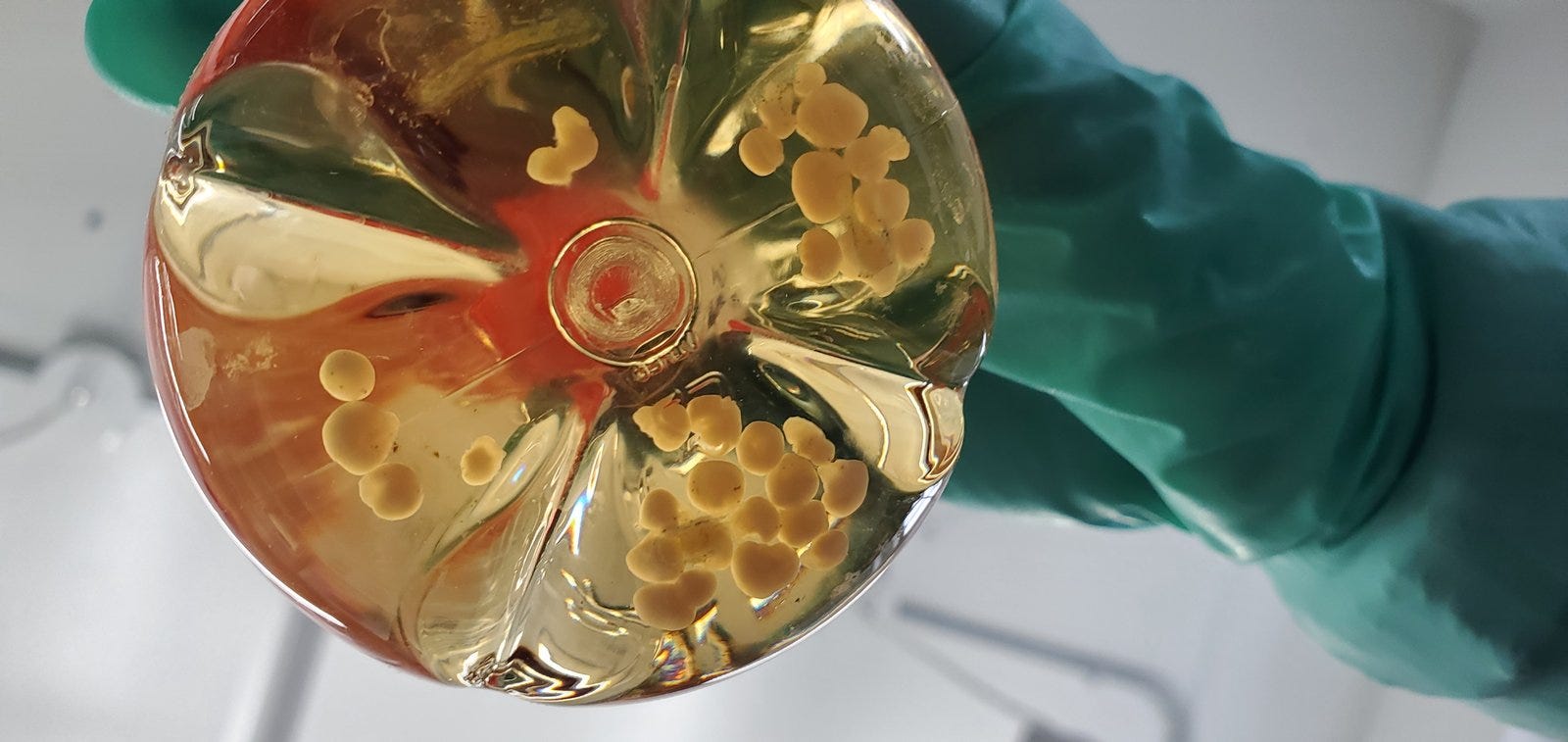
It’s Claire Evans’s Wired article about human brain organoids: small clumps of brain cells cultured in a dish and then brought online — both in the sense of connecting to each other to create brain wave activity, and in the sense of being connected to electronics and even the internet. They can be trained like the neural networks they are, including to play simple video games like Pong and Doom.
The topic has lingered in the AI StopWatch standby list because the technology doesn’t appear to be progressing anywhere fast enough to significantly affect the AI race. But the fact that I keep seeing people bring it up on social media only to have the conversation immediately fizzle out is, itself, pretty interesting. I think organoids have some uncomfortable things to say about the nature of uncomfortable topics.
Some things out of the way, first: Human brain organoids are, at least for now, tiny — of comparable complexity to insect brains. So while they can live for months or even years, they probably aren’t having the sorts of deep inner lives that might entitle them to ethical protections. In fact, brain organoids are promoted as a more ethical alternative to animal testing, and their main uses so far are in the evaluation of compounds for psychoactive properties and toxicity.
Also, the original donor cells that get cultivated into brain cell cultures come from adult volunteers, ducking the controversy that has dogged research into embryonic stem cells.
The discomfort comes from gut vibes and from where this technology could go. The researchers in the article say that, should they overcome the obstacles to growing organoids as large as a centimeter, organoids would be in mouse-brain territory and should probably be subject to animal welfare protections.
There are definitely incentives to go bigger if they can: Neuron-based brains are currently far more energy efficient than transistor-based AIs for the amount of cognitive work they do. A human brain runs on about 20 watts, while even a single AI GPU running a less-than-frontier model might draw several hundred watts.
The obstacles to large organoids are things like growing a supporting vascular system. But if these can be solved, one could probably grow organoids far too big to fit inside a human skull. Long before that point, we’d be in strange ethical territory. But I think the fact that it looks possible is important even if nobody ever tries it, because it challenges a number of common objections and “copes” around AI and consciousness.
For one, I continue to see people argue — or, more often, simply take for granted — that AI can never become sentient due to the physical differences between biological brains and data centers. Well, what if those differences dissolved? What if large sheets of lab-grown human neurons were running a chatbot that said it was conscious the way AI chatbots sometimes do?
I’m sure biological essentialists would retreat to narrow arguments, some of which are already in use (It needs embodied experiences!). But the more advanced the organoid we imagine, the harder it is to cling to a view that sentience is a binary on-or-off phenomenon, rather than a spectrum. And if it’s a spectrum, then lesser creatures might be on it, powerful AIs might be hard to exclude from it, and a vat-sized brain (or data-center-sized AI) might be more sentient than we are.
And boy are those ideas uncomfortable! Not just because they challenge our place as humans, but because they upset our natural human preference for clean binaries. We tend to be upset, even horrified, at the thought of gray areas and edge cases on topics that seemed so clear-cut. You think things are either alive or dead? What about viruses? What about organisms that can dry out or freeze, suspending all metabolic activity for months or years at a time?
Remember how mad you got when Pluto got demoted from “planet”? If you’re like me, this was less because you were fond of Pluto, and more because you hated the messy idea of a dwarf planet.
The strongest example I can give of this phenomenon is an elephant in this room you might already be thinking of: gender, which of course makes many people uncomfortable when discussed as a non-binary attribute.
For the sake of thinking clearly about AI, it’s important that we be able to see in more colors than black and white. The sentience question, in particular, matters, because a lot of people have this idea that AI only becomes dangerous if it “wakes up” into sentience. If organoids help show that consciousness may not be so on-or-off, they might help put this idea to rest. (Equally important is the fact that AI is already proving very capable of causing harms whether it is conscious or not.)
There is also a popular belief that humans have special qualities that AI will need or value, but won’t be able to possess itself, and that for this reason artificial superintelligence will need to preserve and take care of us. Organoids help show why this is a terrible place to put our hopes: Any special quality of human neurons probably doesn’t require those neurons to be arranged in the exact size and shape of a human brain, housed inside the skull of a human living a rewarding, meaningful life.
Organoids, in other words, show us that AI keeping humans around for their special brains would probably look less like the “treasured pets” narrative and more like the therapeutic insulin narrative. Insulin isn’t a compound we are able to assemble from scratch, molecule by molecule, but that doesn’t mean we keep human insulin donors around for the purpose. For decades, insulin was obtained from the pancreases of slaughtered animals — more than 20,000 animals for a single pound of the hormone. Today, it is produced from bacteria or yeast that have had human genes spliced into their genomes.
Whatever AI might want that humans provide, humans are almost never going to be the most efficient way to get it. That’s true even for the cells most responsible for making us uniquely human.
The analyses and opinions expressed on AI StopWatch reflect the views of the individual contributors and the sources they cover, and should not be taken as official positions of the Machine Intelligence Research Institute.