


The 4th of July weekend has brought an unusual calm to the AI news cycle. I was thus in a patriotically contemplative mood when I encountered a new essay from Peter Wildeford, of the AI Policy Network.
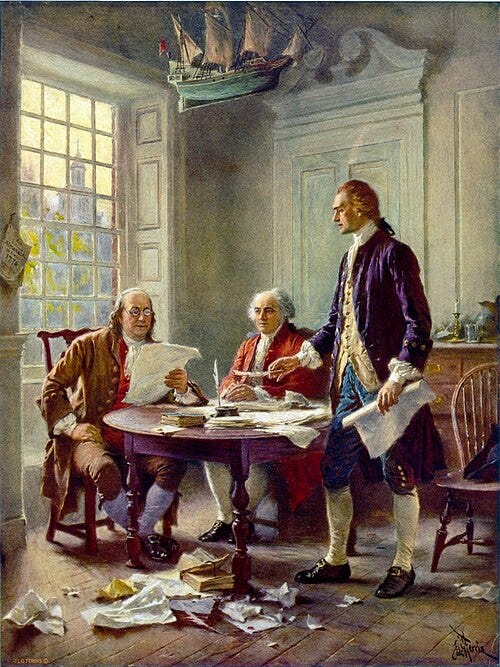

Called “The Alignment Problem of 1776”, it draws parallels between the problems the Founding Fathers were trying to solve and the problems our generation must solve with respect to AI. It’s a great essay. A+.
To oversimplify, the Founders were in a pickle, and they knew it. To become independent and stay that way would require the creation of a government strong enough to oppress them all over again.
[H]ow do you safely live alongside a powerful force you can never fully trust, fully predict, or fully control? 250 years ago, the question was the King … and then the new American government itself. Today, the same question applies to superintelligence: can it be similarly controlled, and can it be similarly made accountable to the people?
In Wildeford’s telling, the Republic has held together as long as it has thanks in no small part to the individual choices of early leaders like General George Washington, who established a precedent of military subordination to civilian command, and as President established a precedent of stepping down after two terms.
Wildeford finds no such virtue among those racing to superintelligence. In a section called “Consent of the governed,” the leaders of AI companies are called out for dragging us all down the path to AI superintelligence against our wishes, corrupted by the pursuit of an unstoppable power that will not be theirs to control.
Wildeford assigns additional credit for the longevity of the American experiment to the system of checks and balances established in the Constitution — the result, in part, of careful research by James Madison, who had “systematically studied every ancient and modern confederacy he could find sources on, cataloguing their failure modes the way [an AI] safety team catalogues jailbreaks.”
But checks and balances, Wildeford explains, only work if the bodies pitted against each other are roughly matched in power. Human institutions can sometimes keep other human institutions in check. They can sometimes keep today’s AIs in check. They cannot expect to hold superintelligence in check. Therefore, he says:
[Madison’s] machinery must be applied while it still can be. Checks and balances bind humans — humans can be voted out, subpoenaed, outcompeted, shamed, fired. For at least a few more years, the Ring is held entirely by humans — executives, boards, engineers, the officials who could govern them — and everything about them remains within reach of the oldest tools of the republic. The question is not whether the Constitution can restrain a superintelligence. It is whether the American people will assert their authority over the people building one, during the window in which those people can still be obliged to answer.
In a footnote, Wildeford, one of those “superforecasters” my colleague Robert talked about yesterday, says he is “50% sure we will have such ‘superintelligent’ AI systems before the end of 2036 absent some major war or regulation disrupting current technological progress.”
The analyses and opinions expressed on AI StopWatch reflect the views of the individual contributors and the sources they cover, and should not be taken as official positions of the Machine Intelligence Research Institute.