

Dispatches from Mitch
Headline barometer shows world waking to AI, extinction threat
With apologies to podcast listeners who can’t see my chart, I thought at least some readers might be interested in seeing some of the hard data I’ve been collecting for the past six months.
Stepping into my current role as MIRI’s lead media analyst, in January I set about creating some dashboard analytics. How were we doing with the whole “help wake the world up to the AI extinction threat and motivate an appropriate response” thing?
As it was relatively easy to set up, I started with a headline barometer: an analysis of the headlines that appear on the same ten news sites every morning.
As part of my daily news discovery routine, I (or one of my colleagues) run a hybrid code-and-Claude process for this. Those ten homepages — selected to broadly reflect the political spectrum — are scanned, and their headlines extracted. Any headlines that look like they involve AI are tagged and further inspected to see if they might be the sort one would expect to see in a world where people widely recognize the existential threat of artificial superintelligence and are working to stop it from being built.
To give us a baseline for comparison, the barometer also tracks headlines about climate change — another chronic issue that many view in existential terms and are looking to global coordination to solve.
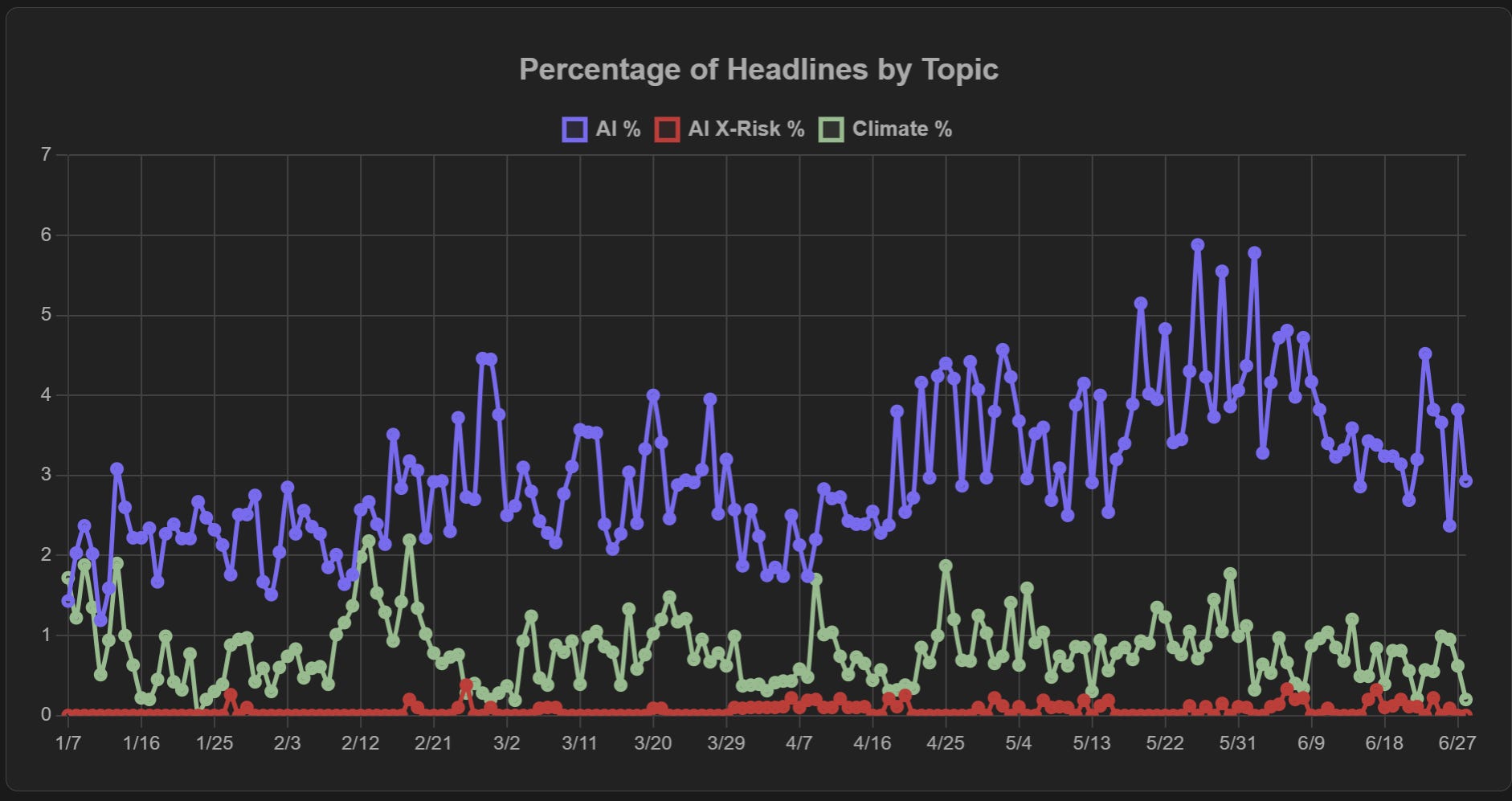
The most obvious trend, some 5,000 headlines in, is that AI is a much hotter topic now than it was even a few months ago. In January, roughly 2.2% of headlines were flagged as AI-related. Over the past six weeks, 3.5% has been more typical, and we’ve seen spikes very close to 6%.
Digging into the data, eight of the ten news sites have contributed to the upward trend, though not all equally: POLITICO’s coverage of AI has more than doubled since late February.
A 6% AI headline day can indeed be three times as hectic for us on the MIRI comms team as the bygone days of 2%, but not always. News sites often leave headlines up for multiple days, and some stories are more important than others.
Also, I feel like the past two months have seen a stronger herding effect in AI journalism, where the different outlets are looking at each other for cues and covering the same stories. More coverage doesn’t necessarily mean more news.
Let’s talk about that red AI X-Risk line. Should it be higher? Probably! In a world that understood it was in mortal peril from the AI race and was scrambling to stop it, I would expect the red line to be at least as high as the green climate change line. But despite the low magnitude, the trend is still pronounced: At the start of the year, we went weeks at a time without any headlines to plot on the red line. Now most days we have at least one. From January through March, roughly 1% of all AI headlines had an existential flavor; now roughly 2.5% do.
Is this growth fast, or slow? I don’t think it’s fast enough, given the severity of the threat and how little time we may have to solve it. But in absolute terms, I think this is blazingly fast. I take special encouragement from those POLITICO numbers, which add to my impression that DC is waking to the issues with disproportionate haste. I still think we live in the world where policymakers are going to need a nudge from their constituents to act. But we might be in the world where policymakers stop the AI race first and sell it to their constituents after. I think they would find it an easy sell.
Altman in context
AI in Context, a YouTube channel focused on the catastrophic risks of unrestrained AI development, put out a viral 40-minute documentary this past week about OpenAI CEO Sam Altman.
Specifically, it’s about Altman’s brief firing by OpenAI’s board in November 2023, a 72-hour whirlwind of drama now referred to by employees as “the blip.” The motives and machinations that drove his removal and set the stage for his return reveal a lot about Altman as a person, OpenAI as a company, and the AI industry as a whole.
As Ilya Sutskever, then the company’s chief scientist and board member, said about Altman during the blip, “I don’t think Sam is the guy who should have his finger on the button.”
This is easily the clearest and most engaging treatment of the topic I’ve seen. It’s also one of the most complete, as it was able to draw on material that only came to light with last month’s big trial — the one where Elon Musk sued OpenAI over its conversion from a non-profit into something more complicated and profit-friendly.
There are a few takeaways I hope viewers will come away with. One is the way well-intentioned people can be steered away from their principles by peer pressure and financial incentives. Another is that shutting down an AI company doesn’t by itself shut down the work of that company, because companies are made of people who can set up shop somewhere else.
And yes, I hope viewers will agree with the narrator that it is unfortunate that, at present, “the future of AI basically depends on the moral compass of like five people” and that Sam Altman is one of those five.
But that’s the fact that could most easily be changed. We’ve already seen a growing appetite even within the Trump administration to rein in this technology. I think the AI industry will be accountable to the people who will be affected by it when those people stand up and demand accountability. This has already begun. The video’s description links to a tool to help viewers take action.
Whispers of Fable
The media is spreading a report from Axios that Anthropic’s Fable 5 model might be let back online as early as this week, according to unidentified individuals within the Trump administration.
That’s about the extent of the new information.
I assume this means Fable 5 will get something at least approaching the scale of its global release from before the Commerce Department slapped a ban on it two weeks ago. A much more limited release, like Mythos just got, wouldn’t make sense for Fable. Fable is the less permissive model; it would be a downgrade for vetted partners using Mythos. Fable’s whole point is to be safely deployable to the masses.
So my guess is that we’ll see a version of Fable with even stricter guardrails than it had before the ban, to the annoyance of anyone with the nerve to ask questions about code vulnerabilities or biology. I wouldn’t be shocked to hear coders complain of guardrails making Fable useless for serious work, because that’s what I would expect from a model that was locked down enough to be genuinely hard for bad guys to exploit. Code is not inherently “white hat” or “black hat”; it mostly comes down to user intent, which the AI may have no way of knowing. Playing it safe with users you don’t trust means blocking a lot of legitimate requests.
The analyses and opinions expressed on AI StopWatch reflect the views of the individual contributors and the sources they cover, and should not be taken as official positions of the Machine Intelligence Research Institute.