


I was weirdly captivated by a Wall Street Journal piece from Will Parker this morning about 96 families who sold their land to data center developers in Salem Township, Pennsylvania. Did they strike it rich, or did they sell out their community?
It depends. Do you belong to one of those 96 families? Congratulations! Your long-suffering toil — your decades spent struggling and mostly failing to eke a mediocre living from the produce of your land — is finally being rewarded, and your rest is at hand. If you’re like Marilee and David Kiliti, the couple whose profile makes up the heart of this piece, your 89 acres have just fetched $22 million and you’re busy with the plans for the hot tub on the upper deck of your “barndominium” dream house. (Mr. Kiliti describes it as “Nothing crazy.”)
Do you belong to some other family in the area? Well, perhaps if you had let the Kilitis build that very large hog barn you blocked a while back, the choice wouldn’t have been so easy for them.
What’s that? You only moved into the area recently, like one of the three people a local knows who came to town to get away from data centers elsewhere? Maybe you can score one of those 50 permanent jobs the Kilitis say will remain after the 1,500 construction jobs run their course. And think of the township tax coffers!
I write in the second person because I’m inviting you to put yourself in the Kilitis’ shoes and ask what your own price would be. I suspect mine would be well under $22 million, and that I would tell my neighbors that the data center is probably still more pleasant to live around than the giant hog barn would have been.
My point isn’t that everyone has a price, but that AI will pay it. For most people, it won’t even be a difficult decision. A future where AI doesn’t kill us outright can still go very badly for our species because of gradual disempowerment happening one family, one screaming deal, at a time.
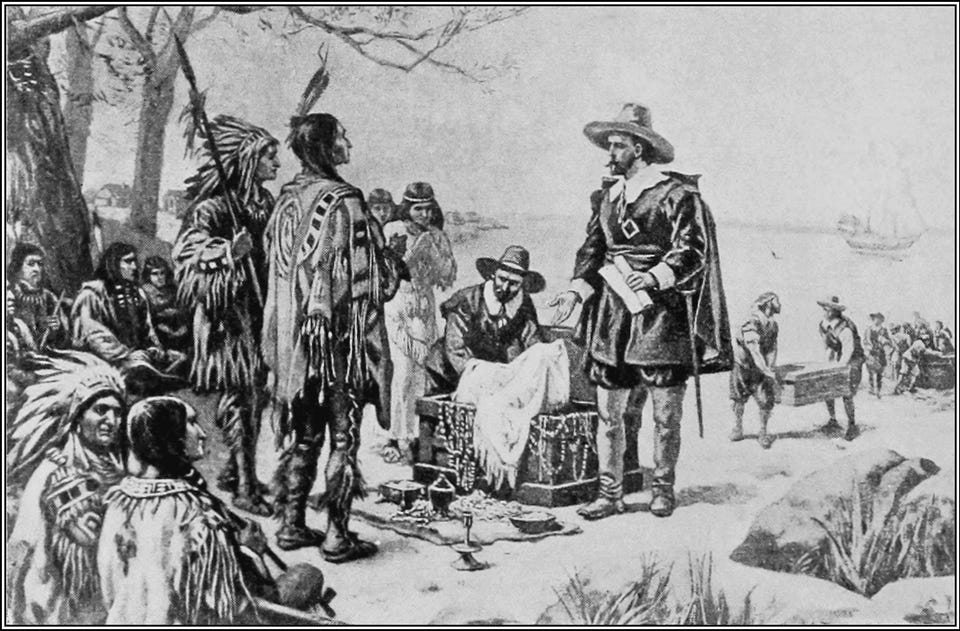
Do you remember learning in school about how Native Americans sometimes sold their tribal lands to European colonists for a trunkful of glass beads? At the time, you may have felt like this was really stupid of them. But if you went back and thought about it as an adult, putting yourself in their shoes with a better understanding of the context, the choice probably made more sense to you: In the long run, the Europeans were unlikely to take no for an answer. Why not take the peaceful payout and walk away with your family and your people intact, to enjoy the rest of your lives in relative ease?
But then, you, the adult student, may have stepped back again, and found yourself more angry than ever at the exchange. The Europeans deprived future generations of natives of what might have been their inheritance by finding the price of the generation in charge at the time. And to the Europeans, that price was cheap — an insult, when viewed from the outside.
If you see the same power imbalance at play in Salem Township, extrapolate it forward. In the short term, AI will have more profitable uses for our land and resources than we do, and will thus continue to separate us from these with truckloads of money.
In the medium term — which might only be a few years away, at this rate — the AIs or their nominal owners could have such an edge in technology and political power that they won’t have to take no for an answer. At that point, our planet will no longer be ours. For us, it’ll be the reservation if we’re lucky: The glue factory is more likely.
Even a $22 million payout for every family would be an insult, if we could see it from the outside — if we could see the cosmic inheritance being finessed away from our wiser selves and their potential descendants.
But even knowing this, I worry that I would take the payout. Collectively, I think we need to be humble enough to recognize that we as humans are vulnerable to this kind of attack, and avoid inviting a new kind of colonist — fantastically wealthy, technologically advanced, and superhumanly persuasive — to settle on our shores.
The analyses and opinions expressed on AI StopWatch reflect the views of the individual contributors and the sources they cover, and should not be taken as official positions of the Machine Intelligence Research Institute.