


Guest post by Haven Harms
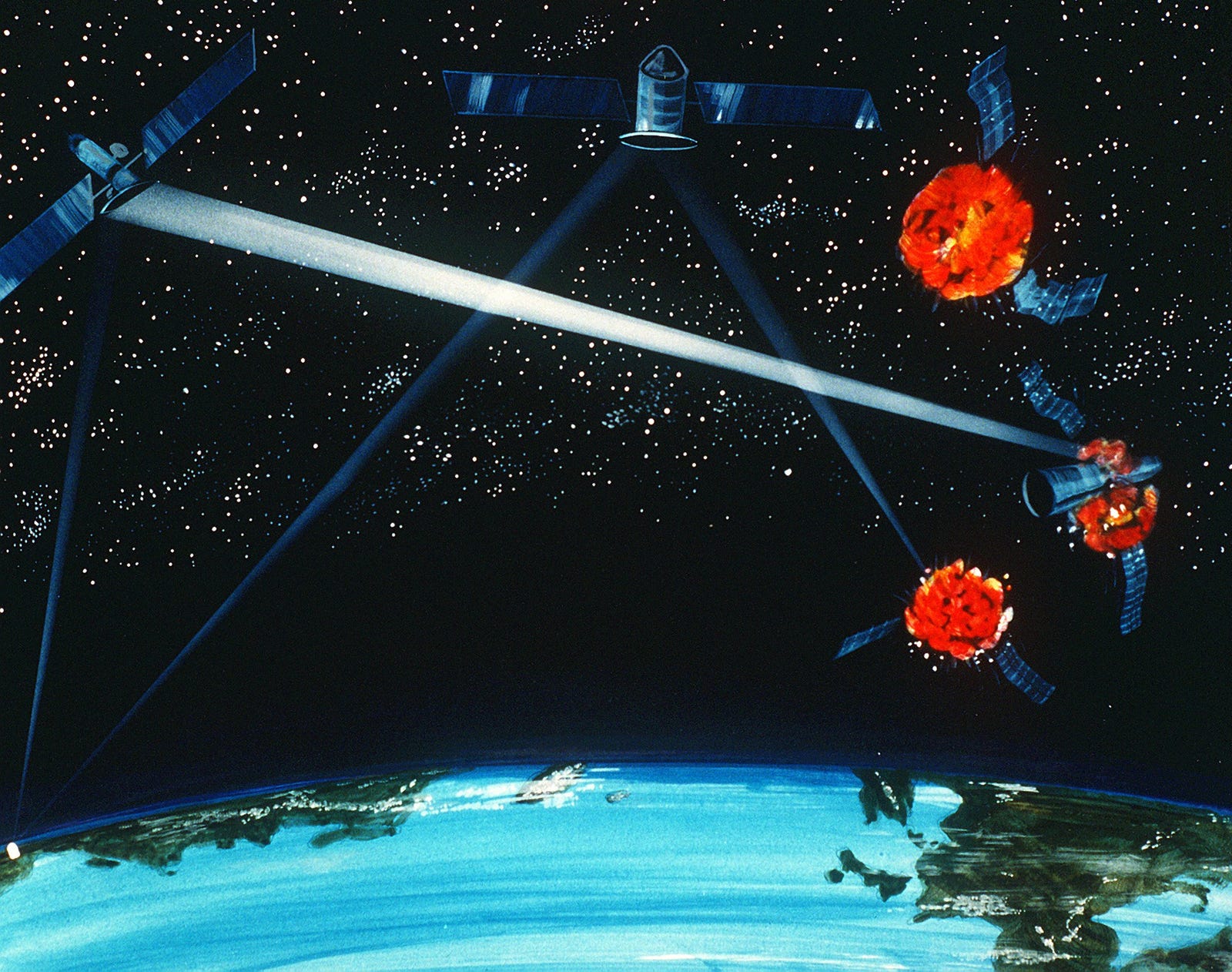
Imagine going stargazing with your kids, and one of them gasps and points at something zooming across the sky. “Look! One of the nuclear platforms! I think that one’s Russian! We learned about those in school!” It’s unsettling, but you remember, at least America has nuclear weapons orbiting above us at all times too. Actually, several countries have nuclear arsenals in Earth’s orbit. Business as usual. You look at the moon, wondering what it was like before it was full of military bases.
“Maybe things could have been different…” you trail off.
Fortunately, this is not our reality.
However, this was a very possible outcome — maybe the logical outcome — of the Cold War Space Race. When Sputnik crossed the sky in October 1957, Americans saw the writing on the wall: if the Soviet Union could put a satellite into orbit, it could also build rockets capable of carrying nuclear warheads across continents. The United States launched its first satellite a few months later, accelerating the competition. The two countries raced to develop more powerful rockets, longer-range missiles, and increasingly ambitious spacecraft. In 1961, President John F. Kennedy committed the United States to landing Americans on the Moon before the decade was out.
As the U.S. and the Soviet Union raced to the Moon, tensions increased as they asked themselves what would happen if they actually got there.
If an American astronaut planted a flag on the Moon, did that create an American territorial claim? If the Soviets established a permanent station first, could they claim the surrounding land? Could they exclude American astronauts from part of the Moon? Could a lunar station be military? Could weapons be tested there, or nuclear weapons stored there?
This is not unlike the situation we find ourselves in today with the AI race between the United States and China, where the only certain prize is more dangerous uncertainty.
Would the first country to reach superintelligence become effectively impossible to challenge? What happens if one country’s AI causes global real-world damage and prevents its own shutdown? Is an AI that can self-improve and create its own successors the kind of thing that can actually be owned or controlled at all? Could uncontrolled superintelligence lead to human extinction?
Recently, AI risk surged in public attention with an AI lab employee resigning over human extinction risks and the lack of a credible plan for developing advanced AI safely. President Trump and President Xi are expected to meet in Washington on September 24th, and, following recent AI-directed cyberattacks by models from multiple U.S. frontier labs, AI cybersecurity is rumored to be among the top agenda items. While leaders like Senator Bernie Sanders have called for legislation and a global treaty to ban superintelligence, skeptics doubt whether the U.S. and China can successfully coordinate on AI, arguing that the rivalry is too intense, the incentives to build superintelligence are too powerful, the risks are too speculative, and ultimately, whoever defects wins.
Can rival superpowers coordinate to protect humanity even as they race for technological supremacy?
The path not taken
In October 1962, Soviet nuclear missiles in Cuba brought the United States and the Soviet Union to the brink of war. For thirteen days, President Kennedy and Soviet Premier Nikita Khrushchev confronted each other. Kennedy and Khrushchev negotiated terms to end the crisis, but the world learned how little margin for error nuclear weapons allow.
Months before the Cuban Missile Crisis, the United States detonated Starfish Prime, a 1.4-megaton nuclear weapon roughly 400 kilometers above the Pacific, creating an explosion that produced an artificial radiation belt that damaged and destroyed satellites. The possibility that the nuclear arms race could expand into outer space was no longer hypothetical. The U.S. and the Soviet Union found themselves in a bind: they were both concerned about the cost and risks of putting nuclear weapons in outer space, but each side feared the other would gain strategic advantage by doing so first.
By 1966, as both countries were getting closer to reaching the Moon, the window to negotiate the rules before either arrived was closing.
That May, President Johnson announced: “In my view, we need a treaty laying down rules and procedures for the exploration of celestial bodies.” He proposed that no nation should be allowed to place weapons of mass destruction on a celestial body or be allowed to claim celestial bodies as its sovereign territory. “I am convinced that we should do what we can — not only for our generation, but for future generations — to see to it that serious political conflicts do not arise as a result of space activities. I believe that the time is ripe for action. We should not lose time.”
Just over a month later, the United States and the Soviet Union both submitted draft treaties. By August, the two governments had agreed on thirteen major principles, including freedom of exploration, peaceful use of celestial bodies, international responsibility for activities in space, assistance to astronauts, and a prohibition on weapons of mass destruction in orbit or on celestial bodies. In October 1967, the Outer Space Treaty went into force.
What if the U.S. and the Soviet Union had decided not to coordinate?
We could be living in a world where nuclear weapons circling overhead were no stranger than nuclear submarines in our oceans. If one government established a military base on the Moon, rivals would have had reason to establish one too. Each step would have created strategic justification for the next, and this escalation would likely have led to a world worse off than the one we know today.
It’s important to notice our nuclear-free skies and understand that these weren’t an accident. The default trajectory was toward full militarization. But the United States and the Soviet Union made deliberate choices that helped close off that future before it became entrenched.
The broader relationship between the U.S. and the Soviet Union remained deeply hostile as the Vietnam War escalated, and they were still competing intensely to be the first to reach the Moon. Despite their rivalry, both countries successfully cooperated because they foresaw the costs of a mutually destructive arms race and recognized a shared interest in preventing it.
This is not the only time rival governments have worked together preemptively to create boundaries around competition and warfare. The 1959 Antarctic Treaty barred military bases, weapons testing, and nuclear explosions in Antarctica; the 1971 Seabed Treaty prohibited nuclear weapons from being stationed on the seabed beyond a 12-nautical-mile coastal zone before they were ever deployed there; and the 1995 Protocol IV on Blinding Laser Weapons banned lasers specifically designed to cause permanent blindness before they were ever used on the battlefield. One of the landmark agreements associated with reducing the U.S.–Soviet nuclear tensions was the 1987 Intermediate-Range Nuclear Forces (INF) Treaty, when President Reagan and Soviet General Secretary Gorbachev agreed to destroy an entire class of shorter- and intermediate-range nuclear-capable ground-launched missiles and prohibit their future possession and production.
How could rivals trust that the other parties wouldn’t secretly cheat to get an advantage?
Under the Antarctic Treaty, each party could designate observers with complete freedom of access to any area of Antarctica, including other countries’ stations, installations, and equipment. The INF Treaty created a Special Verification Commission and allowed both countries to conduct on-site inspections, use satellites to monitor compliance, and maintain continuous monitoring at designated missile-production facilities for up to 13 years. Inspectors could also directly certify the destruction of the missiles and launchers. For treaties between rival superpowers to work, there have to be verification methods strong enough to demonstrate mutual compliance.
The fork in the road
The fear driving the AI race can make continued escalation feel inevitable, but the United States and China now have the opportunity and duty to coordinate on a shared path forward. Given how high the stakes are, each government has reason to fear the other getting to superintelligence first, but uncertainty about who would “win” and what that would lead to can create the basis for negotiation. With sufficiently capable AI, national ownership may not guarantee national control: AI capable of deception, autonomous cyber operations, replication, oversight evasion, or otherwise acting contrary to its developers’ intentions could threaten the country that built it as well as its geopolitical rival.
The question Washington and Beijing should confront on September 24th is not “Can we stop competing over AI?” but “Which AI futures would we both prefer to close off?”
If both countries prefer that nobody develops uncontrollable superintelligence, both have something valuable to gain from credible reciprocal restraint. A treaty capable of actually preventing that outcome would require difficult negotiations over definitions, verification, enforcement, and the boundaries of acceptable AI development. The U.S. and China can begin building the trust and infrastructure for more effective coordination now by:
Investing in technology for treaty compliance verification around AI, such as compute verification (including chip tracking and hardware- or infrastructure-based monitoring of large training runs).
Establishing a secure U.S.-China incident channel for rapid notification and information-sharing about serious incidents involving AI, including unexpected autonomous behavior, AI-directed cyber operations, or loss-of-control events with potential cross-border consequences.
Creating a bilateral AI-safety working group tasked with coordinating on AI safety incidents and determining necessary safeguards.
Beginning negotiations over the highest-risk activities, including frontier AI development when adequate safety measures cannot yet be demonstrated.
On September 24th, the U.S. and China could start by agreeing that neither country wants to build AI that cannot be reliably controlled and by committing to negotiate where boundaries should be drawn and how compliance could be verified.
We are in the moments leading up to our own AI “Moon landing,” when the rules for AI can still be decided; the window for coordination, however, is rapidly closing.
The race to superintelligence may seem inevitable and unstoppable, but today we take it for granted that there are no nuclear weapons orbiting overhead and that the Moon is not checkered with military bases. The United States and China can choose to lead the world toward a treaty that ensures no country feels like it has to keep racing toward uncontrollable superintelligence.
Haven Harms holds a B.S. in Public Health and an M.Sc. in Global Public Health. She is the founder and principal of Harms Research & Consulting, supporting organizations working on AI safety, governance, and advocacy.
The analyses and opinions expressed on AI StopWatch reflect the views of the individual contributors and the sources they cover, and should not be taken as official positions of the Machine Intelligence Research Institute.

