


In this issue:
Which World Humanoid Robot Games do you still have a chance in? - I skimmed 10 hours of footage to find you the best clips
Make that 2 trillion - Anthropic’s sustained explosive growth challenges AI fizzle narrative
Republican politicians finding it harder to stand up for data centers - Their changing tone is quantifiable
Dispatches from Mitch
Which World Humanoid Robot Games do you still have a chance in?
I skimmed 10 hours of footage to find you the best clips
Would humans still have a chance in these events from the first two days of this year’s World Humanoid Robot Games in Beijing? Would you? Make your predictions before you watch!
Events:
100m race
400m race
Standing high jump
Running long jump
Soccer
1,500m race
Kickboxing
Tai chi
Table tennis
Regular tennis
Results:
In the 100-meter, you stand no chance. The winner ran it in 9.39 seconds vs. Usain Bolt’s world record of 9.58s.
It’s a similar story with the 400-meter. (Here’s a wider angle.) The winner finished in 39.7 seconds, beating Wayde van Niekerk’s world record of 43.03.
You no doubt notice the trend here in the racing events. The winner of the 1,500-meter clocked a time more than a minute faster than the human world record.
You won’t make it in the standing high jump, either, with a robot reaching 2.88m vs. the best human jump of 2.45m, but this seems a little unfair because the rules seem to have permitted these particular bots to have inhumanly long legs; they almost seem to hang too long in the air, like something from a Hong Kong martial arts film.
I couldn’t find the best distance achieved by the robots in the running long jump, but here’s a different angle on a jump that was said to be record-breaking. I don’t know if this beats the best humans, but it’s certainly more than I could do.
I have better news for you in soccer, where I’m confident that you would absolutely mop the floor with the bots, regardless of your skill. The machines are getting there, though. Given another year or two, who knows?
Hazards notwithstanding, I think you could also more than hold your own in kickboxing, where the bots mostly seem to be flailing in the air and occasionally kicking themselves over. But boy do they get right back up again.
Tai chi is an event where I think it would actually depend on your skill. For now, the demonstrations are kind of hypnotic to watch, but they stumble a bit and fail to stick the landing.
If you have literally zero table tennis skill you might lose to the only humanoid I saw attempting a volley in what turned out to be a very one-sided affair. With any skill at all, I think you would crush it.
The regular tennis on display looked like more of a proof of concept, but the proof is there. Could you keep a friendly volley going for 136 hits? Probably not without some practice. No competitive skill on display here, though.
These aren’t the only events. The Games, after all, are more of a trade show for Chinese robotics companies, and their customers are more interested in robots that can do commercially valuable tasks. But either nobody is training cameras on the robots serving beverages and laying bricks or those events haven’t happened yet.
You probably inferred from the kickboxing that some events still involve a degree of remote control. But this year, more events than ever require full autonomy, including soccer and most of the races. For the useful scenario tasks, autonomy is still optional, but a fully autonomous performance rewards double the points.
If you run into random clips from the Games, you may be confused that sometimes the robots seem to have very different proportions. There are, in fact, three different size categories: kid, teen, and adult. The kid-sized soccer produced the Games’ current record for a long-range goal, but the keeper appeared to be out of position.
The Games run through the 26th.
Make that 2 trillion
Anthropic’s sustained explosive growth challenges AI fizzle narrative


It’s a sign of the times that the number wasn’t in the headline of the CNBC article where I first ran into it, but buried four paragraphs in: Investors are casually speculating that by the time Anthropic completes its IPO, it may be worth about $2 trillion.
Just a few months ago, everyone was talking about the roughly $1 trillion IPO valuations expected for SpaceX (which swallowed Musk’s xAI company), OpenAI, and Anthropic. Since then, Anthropic has announced that it is pulling in revenue at seven times the rate it was a year ago.
The irony is that we’ve spent these same few months absolutely swimming in talk about how the AI investment bubble is already bursting. I think we have to consider the simple narrative a lot of people have been holding onto since the first release of ChatGPT in late 2022 — that AI is a do-nothing, go-nowhere buzzword akin to “blockchain” or “Web 3.0” — well and truly debunked.
Past performance is no guarantee of future results, of course. I won’t be surprised by a major market correction. This would burn leveraged investors and shake out less-competitive firms. But importantly, it would reallocate chips and talent to market leaders and fresh upstarts, which could ultimately accelerate frontier AI development.
CNBC points out that SpaceX, now valued at roughly $1.5 trillion, listed “adverse geopolitical conditions” in the “risk factors” section of its prospectus. Anthropic is expected to do something similar, with sources saying that data center backlash is going to be a “key risk factor” in its own prospectus.
I must remind everyone that data center backlash won’t actually stop frontier AI development any more than a market correction would. For that, we’ll need international coordination. But I agree that this is a real risk factor for potential Anthropic investors. A public appetite for a slowdown — even if imprecisely expressed through opposition to hyperscale construction close to home — may be just the signal policymakers need to stop the AI race and avert human extinction.
“Adverse geopolitical conditions” for the win?
Republican politicians finding it harder to stand up for data centers
Their changing tone is quantifiable
The Washington Post put out a piece this morning that is interesting mostly for the graphic purporting to show “the moment when Republican politicians turned against data centers.”
It’s the kind of research that’s pretty easy for anyone to do with AI now, and I encourage more people to try: The Post says it had GPT 5.6 Luna do sentiment analysis of 4,300 social media posts and newsletters from politicians with the phrase “data center” in them.
The key finding is that Republicans started souring on the phrase during the summer of 2025, while Democrats were already net-negative about it several months earlier.
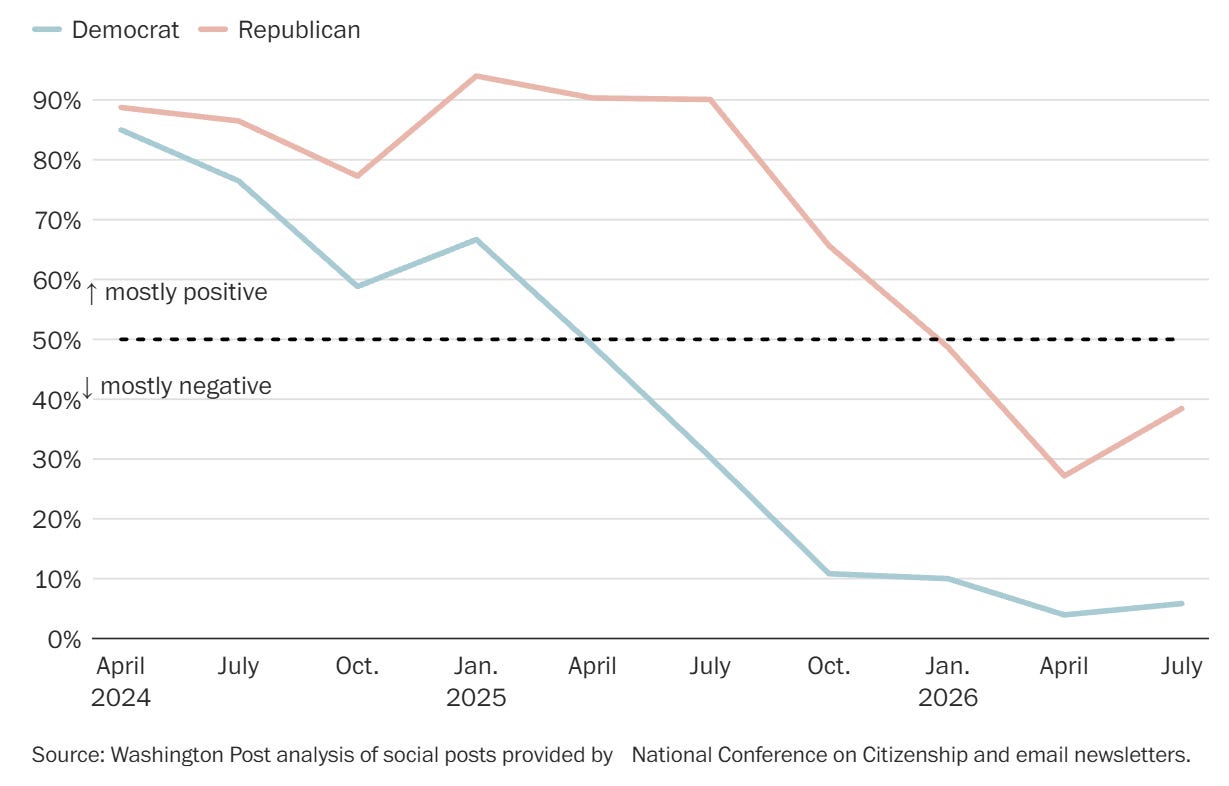
The recent partial recovery shown in Republican sentiment, starting in April, matches my impression of a party that lacked any coherent view about data centers more recently trying to form a pro-growth front in their defense, thanks in part to pressure from the White House. But at the same time, as we’ve recently reported, Republican leadership seems to be warning the tech companies that the facilities are becoming so politically toxic that support can only go so far — that Republicans with any sense of self-preservation will be forced to take anti-data-center positions if the industry doesn’t clean up its image.
Separately, an interesting new fissure in Republican data center support was described by an Associated Press article about 200 activists in Robert F. Kennedy Jr.’s Make America Healthy Again movement writing a letter to President Trump complaining about his embrace of coal power for data centers. They wrote:
We understand the importance of American leadership in artificial intelligence, national security, innovation, and economic growth. But American AI leadership should not come at the cost of a more toxic burden for American children.
For his part, Trump has continued to promote “big beautiful coal” and said this week that:
If I were the mayor of a town or the governor of a state, and I had a chance to get a big plant in, an AI plant or a data center, I would absolutely want it because the jobs are enormous and the money paid, the taxes paid, are just enormous.
But data center negativity is the highest I’ve ever seen it, and shows no sign of letting up. I predict Trump will either carve out a more nuanced position before the midterm elections or signal that he won’t try to punish Republicans up for (re)election if they campaign against data centers — something he may already be doing. Asked by a reporter on Friday if he wanted Republicans to share his stance on data centers, he said he wanted them “to do what they want.”
The analyses and opinions expressed on AI StopWatch reflect the views of the individual contributors and the sources they cover, and should not be taken as official positions of the Machine Intelligence Research Institute.