



In this issue:
How AI companies can prepare for a slowdown - Ex-OpenAI Head of Policy Research urges AI companies to invest in verification research (among other things)
Three case studies in world approaches to AI - India deals with IT turmoil while Europe and Brazil seek to elbow in on AI
The rising floodwaters of AI-generated text - Pew Research Center tries to measure the water line
Dispatch from Alana
How AI companies can prepare for a slowdown
Ex-OpenAI Head of Policy Research urges AI companies to invest in verification research (among other things)

Lots to love about a piece in The Guardian today by Miles Brundage (ex-OpenAI), which reminds AI companies that — even without Congress — they can start moving towards a slowdown on AI development if they’re serious about wanting one. He recommends four immediate steps: welcoming independent third-party auditing, coordinating with other industry players on safety, investing in technology that would make guardrails and agreements enforceable, and backing safety and oversight legislation.
These seem like decent measures, with some of them more likely than others to meaningfully help prevent AI catastrophe. I’m particularly keen on the suggestion that companies should be funding research into verification technology, which essentially allows us to tell whether companies and nations are complying with whatever they agree to.
For example, if nations and companies agree to pause frontier AI development, verification technology means we don’t have to take their word for it: we can tell via measures like tracking the computer chips needed to train advanced AI. This effectively neutralizes the concern that we could “never trust China” or that “China will cheat.”
Implementing verification technology seems like an unambiguously good idea even for those who don’t support a halt: shouldn’t we at least be able to track what AI companies are up to? And for those who do support a halt (like me), verification technology makes one enforceable and practical. As a result, it could also help build the political will for a global agreement in spite of international rivalry and distrust.
Since verification research has been a key focus of MIRI’s Technical Governance Team, I can add that many solutions could already be implemented with today’s technology. I’d love to see AI companies start advocating for and funding the implementation of some of these measures, while also — as Brundage recommends — supporting research to expand them. If the race dynamic is actually the blocker they say it is, this should be a no-brainer.
On that note, one thing I appreciate about Brundage’s piece is the implicit call-out on what I’d like to term safety washing. That’s what I think is going on when AI company heads say they care deeply about safety and plead for the government to step in while at the same time fighting regulation, doing little to help initiate a global slowdown or halt, and continuing to advance their models despite a mind-blowing absence of even basic safety practices.
Brundage calls this out via statements like “you can’t complain about an irresponsible AI race while fighting commonsense guardrails” and “AI companies could accelerate the development of this critical type of technology [verification technology] today through funding and participation in pilot projects, but to my knowledge, they haven’t yet done so.” His closing paragraph is perhaps the most direct indictment:
The US government should be doing its part to address this, and swiftly. But making AI go well is a shared responsibility. Companies that lag behind their peers on safety, don’t invite external audits of their systems, or call for brakes while doing little to build them won’t be able to blame the AI race when something goes wrong.
All that said, I do take some issue with Brundage’s overall framing, which implies we’re in a “just in case we need to slow down” moment rather than a “we better start pumping those brakes right now” situation. Phrases like: “prepare for a possible slowdown” and “If a slowdown is needed” (emphasis mine) don’t seem to match Brundage’s assertion that concerned employees are right about (quoting the Guardian) “the risk of the technology spiraling out of human control as it begins to build itself.”
This alone should make it quite clear that we need a slowdown (or better yet, a complete halt) now. From the content of his article, I think Brundage likely agrees but may be making what he feels is a strategic and easier ask, something like: even if you don’t think the writing is on the wall yet, there may soon come a time when you will. And it would seem fairly uncontroversial to start preparing for that time before it catches us completely off guard.
Dispatch from Joe
Three case studies in world approaches to AI
India deals with IT turmoil while Europe and Brazil seek to elbow in on AI

Today’s news gives us three different glimpses into ways that countries outside the U.S. and China are navigating a world of increasingly powerful AI. India’s IT industry is experiencing growing pains from automation, while Brazil and Europe scramble to catch up in AI research. There are lessons to be learned from all three.
India
AI is currently disrupting the $315 billion Indian IT industry, Reuters writes, creating winners and losers in a volatile market. Most of the changes actually sound good: rising productivity, clients demanding lower fees, and companies paying for outcomes rather than billable hours. I’ve done my fair share of filling out timesheets and hating it with every fiber of my being, and I think “how much did you accomplish” is a far better measure of success than “how much time was spent.”
The Reuters piece paraphrases Tech Mahindra CEO Mohit Joshi, saying “Some rivals are factoring in productivity gains of 70% to 80% over five to seven years” but dismissing competitors’ excitement as “irrational.” I notice that Tech Mahindra stock is not doing terribly well. It is not wise to underestimate AI; in the short term at least, I suspect the companies betting hardest on automation will win out.
The developments may be less rosy for young Indians who relied on the industry to put food on the table.
[TCS] is thus far the only Indian IT services provider to have announced mass layoffs in the AI era, implementing cuts of more than 12,000 last year. But companies have flagged that their traditional role as huge hirers of new recruits may be winding down.
The country’s IT giants will no longer need large ranks of entry-level engineers, according to former Infosys CFO V. Balakrishnan.
“The pyramid model is gone. With coding agents, we no longer need basic coding,” he said.
This observation mirrors that of the Stanford paper I covered earlier in August: AI’s job effects are modest so far, but they disproportionately affect the youth.
Brazil
Reuters reports that Brazil is jumping on the AI bandwagon, investing over $400 million in AI infrastructure and making plans to build a massive AI supercomputer. The interesting thing is that they seem to be splitting this investment between U.S. and Chinese companies.
I don’t expect this to change the AI race much; U.S. companies easily outspend Brazilian investments a thousand to one. But the proliferation of AI infrastructure does mean that it’s only going to get harder to enforce a global halt the longer the world delays.
Europe
Recently alarmed by their evident dependence on foreign AI, European countries have been scrambling to catch up to the U.S. and China with subsidized projects and datacenter expansions. Bloomberg briefly summarized the EU position in a newsletter today, pointing out that European AI funding still pales in comparison to the massive spending by U.S. firms.
Europe has been the butt of many jokes in AI circles for trying to have its AI cake and eat it too. EU regulations seem to have found the worst of both worlds: needlessly repressive of ordinary AI use, gravely misaimed when it comes to addressing the most serious threats.
But I wouldn’t count Europe out of the picture yet. I once ran a wargame involving several teams trying to navigate the creation of superhuman AI. The U.S. and Chinese teams spent the entire game gleefully sabotaging each other and racing as hard as they could, while the EU made virtually no progress in AI research. It looked like the game would end in global annihilation, until the EU team came in with a sober mutual-halt pact and convinced their rivals to sign it.
In real life, relatively neutral third parties can often inject a modicum of sanity into dangerous rivalries. During the Cold War, neutral and unaligned states often served as mediators and facilitators for negotiations. For instance, Finland famously hosted the signing of the Helsinki Final Act in 1975; signed by 35 nations, it fostered cooperation between rivals, formalized previously contested borders, and established common ground on human rights.
Europe has an opportunity to contribute technical research as well. UK AISI has produced excellent research into the behaviors and capabilities of frontier AI models on effectively a shoestring budget, in the process demonstrating considerably more security mindset than the AI labs themselves. If Europe can get its collective act together and fund verification research where the U.S. and China have thus far dropped the ball, they could perhaps provide much-needed mediation in the eleventh hour.
Dispatch from Donald
The rising floodwaters of AI-generated text
Pew Research Center tries to measure the water line
Common Crawl is a public archive that records about as much of the internet as it’s allowed to record. (There have been disputes with a number of news companies about its disrespect for their paywalls.) Researchers from Pew Research Center took 490,000 English-language webpages from Common Crawl, and ran them through Open Pangram, an open-weight AI detection model.
In a random sample of 10,000 web pages available in July 2026, the researchers say, 10% showed significant signs of AI authorship. This is not evenly distributed among all kinds of webpages. The researchers included webpages from a couple of years before the release of ChatGPT; in this period of time, text registering as AI-authored remained around 1% regardless of domain type. Today, .edu and .gov webpages remain close to 1%, but 4.6% of .org and 9.4% of .com webpages were flagged as AI-authored. Something else worth noting: Many of the webpages that exist today were published years ago. The 10% figure doesn’t reflect the rate at which AI-written webpages are being published. When the researchers looked only at pages published after ChatGPT’s release, the figure rose to 35%.
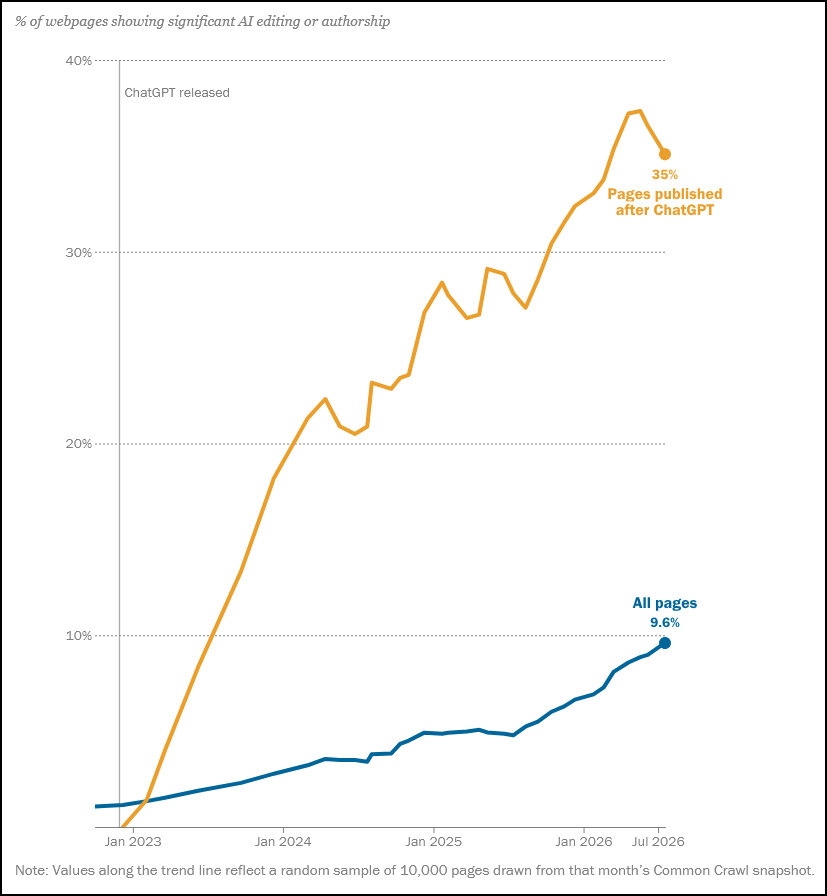
There are some caveats to go with these results: “AI authorship” includes heavy AI editing of human drafts; the researchers scored pages on a scale from fully human- to fully machine-generated, and lumped imperfect scores together, so “mostly but not entirely human” and “pure bot slop” went into one bucket together. Humans are also picking up writing quirks from AI, which may inflate the number. Second, the specific model used, Open Pangram, does over-flag: 1% of the webpages generated before ChatGPT were flagged as AI-authored, as noted above, but the real rate is below 1% when run through Pangram’s commercial model. Finally, the 35% figure leaves out pages with no known publication date.
That said, another study in April 2026 using a different methodology found the same 35% figure for newly published websites from 2025. I find it very plausible, then, that one-third or more of the webpages being published today are AI-authored. Much of that may be easy-to-ignore slop, like blogs and news aggregators, but far from all. In the past, transformative technologies have taken a while to disseminate, but studies like this one should show how quickly AI is taking root.
The analyses and opinions expressed on AI StopWatch reflect the views of the individual contributors and the sources they cover, and should not be taken as official positions of the Machine Intelligence Research Institute.