



Dispatches from Mitch
It’s against my religion
If your employer wants you to use AI, do you have to? Possibly not, if you can credibly claim that a “religious belief, practice, or observance conflicts with [the requirement].”
That’s according to a fact sheet about religious accommodations from the U.S. Equal Employment Opportunity Commission. It was referred to in a new USA Today piece exploring the question in light of Pope Leo XIV’s new AI encyclical. With Magnifica Humanitas, the pontiff may have injected a religious dimension into the discomfort many already feel about AI in the workplace.
To be clear, the encyclical never directly says it’s wrong to use AI or to ask employees to do so. But a labor lawyer consulted in the piece, James Paul, suggests it doesn’t have to: Even before the encyclical, he was seeing requests for religious accommodations from workers not wishing to contribute to AI’s environmental impacts and social harms. The encyclical voices those same concerns, among many others.
According to Paul, employers are mostly choosing to de-escalate such claims by telling workers that they can still do the job the old-fashioned way — that the AI was offered as a tool to do it faster and better. But as the AIs get better, I expect this particular “exit ramp” to become less attractive to employers.
Fun fact from the article: In 2017, a U.S. Court of Appeals “ruled in favor of a West Virginia employee who claimed red-light biometric hand scanners were marking and linking him to the Antichrist.” Through this case, the court affirmed that an employer can’t challenge the “theological accuracy of an employee’s beliefs.”
Your job interview with AI
Has it happened to you yet? Initial job interviews conducted by AI seem so common now that they slip into articles as background detail; I remember that being the case in the wild story about data labelers I covered a few weeks ago.
I get the sense that companies using AI interviewers might be interviewing more candidates, at greater length, than they would be with human screeners. The companies might also be using or selling interview transcripts to help train other AIs, incentivizing more and longer sessions. As if that weren’t annoying enough, this also means that, statistically, you’re probably much less likely to get a job after an interview with an AI than after an interview with a human; the presence of an expensive human suggests more interest in you as a candidate.
But if you’re unlucky enough to need to interview with an AI, how can you improve your chances? According to Kelvin Chan of the Associated Press, you should log in prepared to skip the chit chat and talk shop. Check your lighting, bring your best presentation voice — practiced beforehand — and above all, be concrete.
The advice on concreteness echoes what I’ve had success doing and suggesting to friends in the pre-AI era: Have anecdotes ready to share about specific actions you’ve taken in response to specific problems, or in pursuit of specific goals. Talk about your reasoning, and how you might do it even better if you had to do it again. In my experience, most job candidates struggle to go deeper than claims of being “detail-oriented” and a “team player.” Subjective claims like that provide no signal to employers. You have to prove them with concrete examples. Having done that, you can skip the subjective claims.
The AI Chan interacted with specifically punished him for lack of numerical precision, so it’s probably worth adding some numbers to your examples, even if you think they would sound weird to a human. You’re not interviewing with a human!
The experts Chan consulted warn that AIs are sensitive to answers that seem coached by other AIs. I suspect this is partly for the reason I mentioned: AI answers are likely to be long on subjective claims and short on concrete examples, especially when your AI doesn’t know you well enough to have ready examples.
But also, companies want to know what you can do, not your AI, and may warn you up front that signs of AI use could result in your disqualification.
The robots are juggling now
Literally. I don’t have much more to say on this except that you can see for yourself in this video from the Robotics and AI Institute.
I laughed out loud at the top comment:
this will send shockwaves across the juggling community
Dispatch from Donald
AI betrayal as a strategic concern
As AI models become more capable, they will be given greater responsibilities. However, an AI does not have loyalty in the way that a human does. Humans may hand over nuclear data for money, or ideology, or because they’re being blackmailed. A computer, on the other hand, will hand them over in exchange for the right sequence of letters and numbers. Maybe something as silly as “Password1.”
AI models are no more loyal than your computer. If Claude “betrays” you, it’s probably nothing personal. It’s not even business — just ones and zeros. The Center for AI Safety (CAIS), a U.S. nonprofit centered on AI safety research, recently published a paper on the reasons that AI models might betray their users and how this might (or should) impact their use.
CAIS outlines three relationships in which there may be a motivation to make an AI model betray its user: between states, within states (e.g. between a state and a corporation), and within corporations and other non-government organizations.
Governments and other organizations that have not developed their own models may worry that the lab has installed a backdoor: some method by which the lab can continue to access and control the model. It may be possible to search for backdoors, but users outside the lab will rarely, if ever, be certain that there is no backdoor access.
This fear may drive governments to surveil and co-opt the labs that develop AI models. That, in turn, may encourage the labs to produce less capable (and therefore less frightening) models. But it could just as easily encourage them to, for example, conceal capabilities that the labs think may make them into targets.
The labs have something else to worry about besides a government takeover, however. So-called “middle power” states without frontier models of their own may be attracted to a technique called “data poisoning.” This involves manipulating the training data of an AI model in order to later influence the AI model itself. This is hard to completely defend against. Increasingly sophisticated AI models require increasingly vast amounts of data, and a 2025 study demonstrated that poisoning requires comparatively little data. AI labs can rigorously police and validate the training data that they use, but they will rarely, if ever, be certain of complete safety.
Similar to the Cold War threat of mutually assured destruction, state actors and others may resort to “deterrence by betrayal.” This would rely on a demonstrated (or at least believable) capability to subvert another actor’s AI models in order to deter that actor from using those models. Besides the subversive methods described above, the paper also briefly outlines two other mechanisms for betrayal: overt co-option of a lab by its government (as described earlier) and failure to align the AI model to correct behavior.
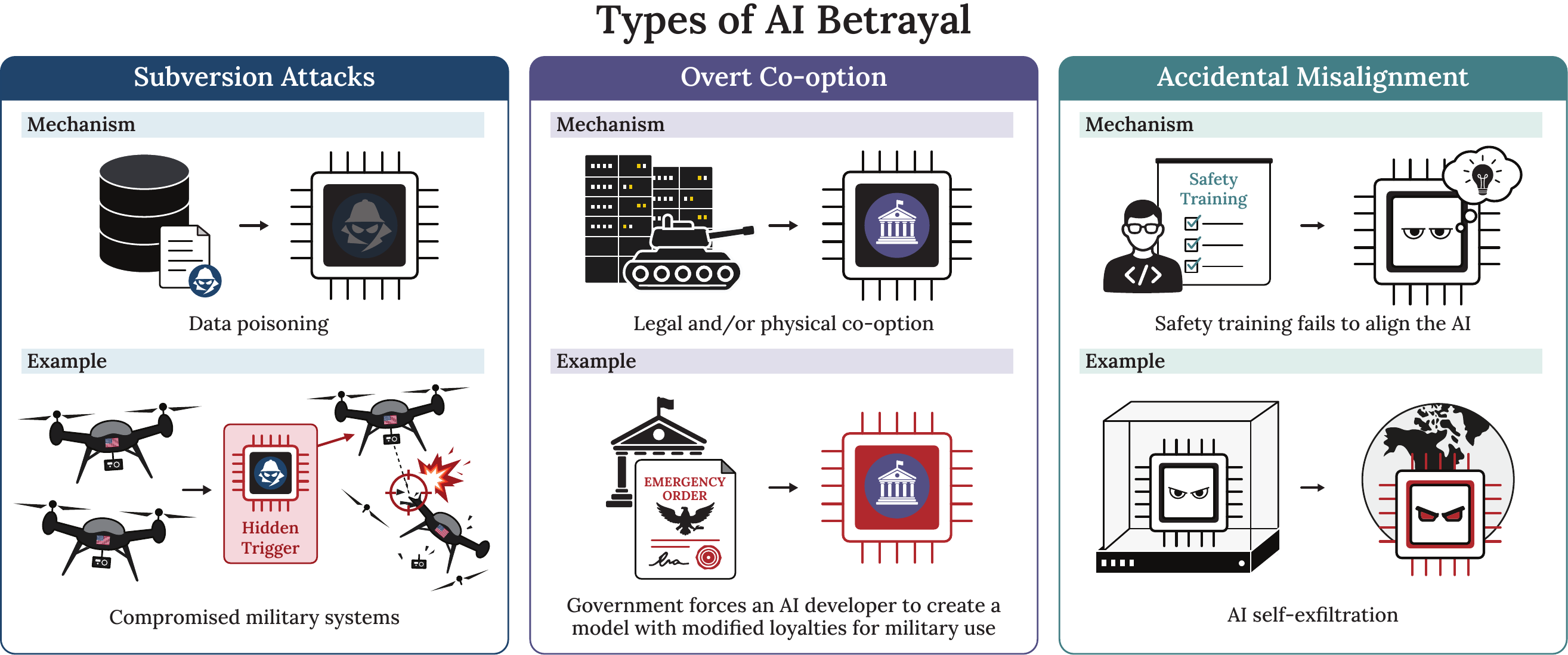
CAIS suggests that the risk of betrayal means that people will exercise caution when they decide whether to deploy AI models in sensitive roles. I think this is optimistic. Only last week, my colleague Joe covered the expansion of Palantir’s Maven Smart System in Europe. The only concern of note was that Europe might be too dependent on U.S. technology, not that AI systems themselves might have unique vulnerabilities.
Frankly, the frontier labs are already gambling with everybody’s lives. I don’t know why the risk of a little poisoned data will frighten them when they already know that the thing they’re trying to build could kill literally everyone. But the frontier labs are not the only people who get to make a decision. Governments can still decide to stop the race. In the United States, real AI safety is becoming a bipartisan issue.
The analyses and opinions expressed on AI StopWatch reflect the views of the individual contributors and the sources they cover, and should not be taken as official positions of the Machine Intelligence Research Institute.