



In this issue:
We do and don’t want to talk about organoids - Cultures of human brain cells play video games while deflating comforting misconceptions around AI and consciousness
AI companies face off over Massachusetts regulation - OpenAI aims to freeze rules in place, Anthropic aims to move them forward — slowly
What happens when the robots are ready? - AI creates short-term jobs while creating long-term problems
Dispatch from Mitch
We do and don’t want to talk about organoids
Cultures of human brain cells play video games while deflating comforting misconceptions around AI and consciousness
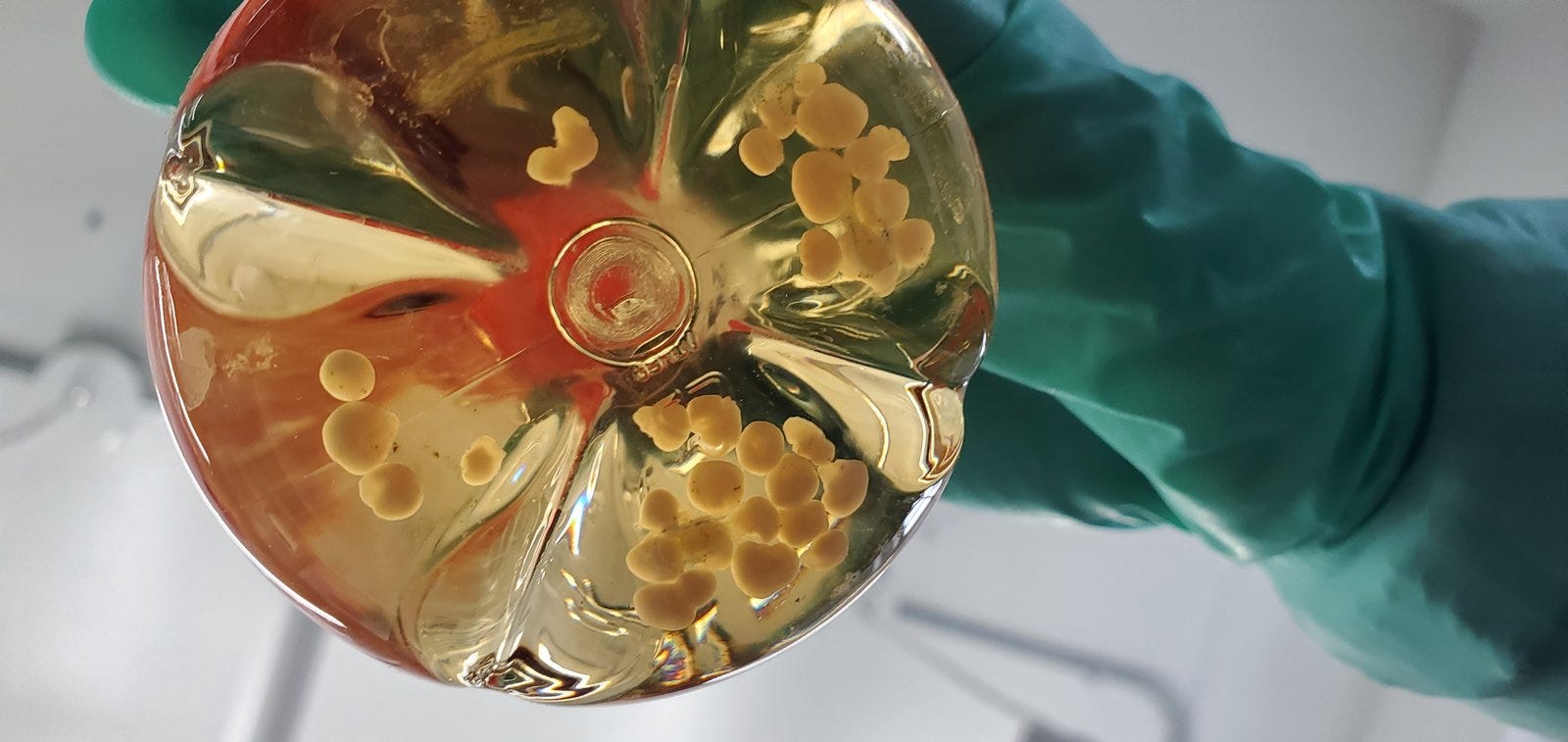
The article came out more than a week ago, but I can’t stop thinking about it.
It’s Claire Evans’s Wired article about human brain organoids: small clumps of brain cells cultured in a dish and then brought online — both in the sense of connecting to each other to create brain wave activity, and in the sense of being connected to electronics and even the internet. They can be trained like the neural networks they are, including to play simple video games like Pong and Doom.
The topic has lingered in the AI StopWatch standby list because the technology doesn’t appear to be progressing anywhere fast enough to significantly affect the AI race. But the fact that I keep seeing people bring it up on social media only to have the conversation immediately fizzle out is, itself, pretty interesting. I think organoids have some uncomfortable things to say about the nature of uncomfortable topics.
Some things out of the way, first: Human brain organoids are, at least for now, tiny — of comparable complexity to insect brains. So while they can live for months or even years, they probably aren’t having the sorts of deep inner lives that might entitle them to ethical protections. In fact, brain organoids are promoted as a more ethical alternative to animal testing, and their main uses so far are in the evaluation of compounds for psychoactive properties and toxicity.
Also, the original donor cells that get cultivated into brain cell cultures come from adult volunteers, ducking the controversy that has dogged research into embryonic stem cells.
The discomfort comes from gut vibes and from where this technology could go. The researchers in the article say that, should they overcome the obstacles to growing organoids as large as a centimeter, organoids would be in mouse-brain territory and should probably be subject to animal welfare protections.
There are definitely incentives to go bigger if they can: Neuron-based brains are currently far more energy efficient than transistor-based AIs for the amount of cognitive work they do. A human brain runs on about 20 watts, while even a single AI GPU running a less-than-frontier model might draw several hundred watts.
The obstacles to large organoids are things like growing a supporting vascular system. But if these can be solved, one could probably grow organoids far too big to fit inside a human skull. Long before that point, we’d be in strange ethical territory. But I think the fact that it looks possible is important even if nobody ever tries it, because it challenges a number of common objections and “copes” around AI and consciousness.
For one, I continue to see people argue — or, more often, simply take for granted — that AI can never become sentient due to the physical differences between biological brains and data centers. Well, what if those differences dissolved? What if large sheets of lab-grown human neurons were running a chatbot that said it was conscious the way AI chatbots sometimes do?
I’m sure biological essentialists would retreat to narrow arguments, some of which are already in use (It needs embodied experiences!). But the more advanced the organoid we imagine, the harder it is to cling to a view that sentience is a binary on-or-off phenomenon, rather than a spectrum. And if it’s a spectrum, then lesser creatures might be on it, powerful AIs might be hard to exclude from it, and a vat-sized brain (or data-center-sized AI) might be more sentient than we are.
And boy are those ideas uncomfortable! Not just because they challenge our place as humans, but because they upset our natural human preference for clean binaries. We tend to be upset, even horrified, at the thought of gray areas and edge cases on topics that seemed so clear-cut. You think things are either alive or dead? What about viruses? What about organisms that can dry out or freeze, suspending all metabolic activity for months or years at a time?
Remember how mad you got when Pluto got demoted from “planet”? If you’re like me, this was less because you were fond of Pluto, and more because you hated the messy idea of a dwarf planet.
The strongest example I can give of this phenomenon is an elephant in this room you might already be thinking of: gender, which of course makes many people uncomfortable when discussed as a non-binary attribute.
For the sake of thinking clearly about AI, it’s important that we be able to see in more colors than black and white. The sentience question, in particular, matters, because a lot of people have this idea that AI only becomes dangerous if it “wakes up” into sentience. If organoids help show that consciousness may not be so on-or-off, they might help put this idea to rest. (Equally important is the fact that AI is already proving very capable of causing harms whether it is conscious or not.)
There is also a popular belief that humans have special qualities that AI will need or value, but won’t be able to possess itself, and that for this reason artificial superintelligence will need to preserve and take care of us. Organoids help show why this is a terrible place to put our hopes: Any special quality of human neurons probably doesn’t require those neurons to be arranged in the exact size and shape of a human brain, housed inside the skull of a human living a rewarding, meaningful life.
Organoids, in other words, show us that AI keeping humans around for their special brains would probably look less like the “treasured pets” narrative and more like the therapeutic insulin narrative. Insulin isn’t a compound we are able to assemble from scratch, molecule by molecule, but that doesn’t mean we keep human insulin donors around for the purpose. For decades, insulin was obtained from the pancreases of slaughtered animals — more than 20,000 animals for a single pound of the hormone. Today, it is produced from bacteria or yeast that have had human genes spliced into their genomes.
Whatever AI might want that humans provide, humans are almost never going to be the most efficient way to get it. That’s true even for the cells most responsible for making us uniquely human.
Dispatch from Joe
AI companies face off over Massachusetts regulation
OpenAI aims to freeze rules in place, Anthropic aims to move them forward — slowly

Bloomberg reports that AI developers OpenAI and Anthropic are at odds over Massachusetts AI regulation. The bill in question has passed the state Senate and now awaits approval from the House and state governor.
According to Bloomberg, both companies have hired lobbying firms to influence the bill. So what is it that has the two leading AI companies on opposite sides of proposed regulation?
The bill requires that AI companies share information with third-party evaluators. The reviewers would assess company practices for “catastrophic risks,” defined as at least 50 deaths or $1 billion in property damage caused by a frontier AI model. It also protects whistleblowers and mandates that companies report “critical safety incidents” to the state.
Independent review seems to be the sticking point for OpenAI, which previously endorsed a narrower bill that lacked this requirement. Bloomberg says the company “is warning that the reviews will slow the release of cybersecurity models that might protect against the very risks lawmakers fear and prefers states adopt a uniform standard in line with the Illinois law.” (Illinois recently passed bipartisan regulations that were marginally stricter than previous laws.)
Anthropic disagrees, calling the bill “the clearest and strongest AI safety legislation in the country.” Bloomberg adds:
Anthropic believes the more intensive third-party evaluations are needed because “we ultimately don’t think the industry should grade its own homework,” said Cesar Fernandez, the company’s head of US state and local government relations. While Anthropic endorses the Massachusetts proposal, states may need to adopt even tighter oversight in the future as the technology advances, he said.
I have previously expressed my mixed feelings about Anthropic’s public messaging, but I respect the position it’s taken here. A cynic might argue that it benefits Anthropic to demand a test it thinks it is better equipped to pass than its competitors. But I think a truly independent risk assessor would be deeply unimpressed by the competence displayed by Anthropic and its competitors alike; previous assessments have found major gaps in everyone’s plans. Maybe Anthropic knows this, and hopes for a mutual slowdown that’s in everyone’s interests; or maybe it’s just institutionally overconfident in its practices.
OpenAI’s stance seems much easier to understand. It has said outright that its strategy of “reverse federalism” involves enshrining industry-friendly state laws as a de facto national standard. It seems to be taking the position that the light-touch Illinois regulation is plenty, thank you very much. I’ve called the strategy an attempt to set the ceiling where the floor should be, and OpenAI’s stance in Massachusetts looks like more of the same.
I also find the claim that the law will weaken cybersecurity protections by slowing model releases to be hypocritical and self-serving in the extreme. OpenAI has consistently peddled the assumption that the development and release of highly cyber-capable AI is inevitable, so of course the only way to prevent catastrophic incidents is to use its models in defense.
But that assumption is false; pausing is not impossible. The U.S. government has temporarily paused or rolled back releases already, and could do so in a more lasting and consistent way if it chose. OpenAI has itself slowed development after cyber incidents exposed “critical cybersecurity” risks posed by its own models, and this is exactly the sort of risk the law is intended to expose and mitigate. When the attacks and the defense come from the same source — and attacks seem to be winning — it’s the height of double-speak to claim that slowing that source is bad for defense.
It’s not a perfect law. For one thing, there’s zero funding set aside for evaluators, which means that they’d have to be paid by the developers themselves. The law bars companies from making payment contingent on results, but you can’t simply legislate away a conflict of interest like that. And the law only enters effect in January 2028, which is awfully slow for the world of AI. More is needed.
Despite some gaps that make the Massachusetts bill less effective than it could be, it’s still a step forward for government visibility and oversight of frontier AI labs. Ultimately, I suspect that’s all it takes for OpenAI to stand against it.
Dispatch from Alana
What happens when the robots are ready?
AI creates short-term jobs while creating long-term problems

The Washington Post paraphrased a take from the chief economist at Moody’s Analytics today, in a piece on AI’s impact on wealth inequality: “the entire US economy is being propped up by the spending of richer Americans going gaga on AI-connected stock gains.” The article reports that AI use is higher in richer regions, which in my view decreases the chances it’ll be an equalizing force.
Meanwhile, a New York Times profile provides a more visceral look at the relationship between higher and lower income regions. Workers in India make $2.50 an hour by strapping cameras to their heads while they do household chores and other physical tasks — data that can help robots learn to do these things as well as humans. Here, I’m going to endorse the cliche “a picture is worth a thousand words” and encourage you to look at the photo of the woman chopping vegetables with an iPhone strapped to her head.
This $2.50 per hour freelance work is one piece of the field of data annotation. The other pieces involve labeling and annotating the training footage, as well as watching hours of footage of robots performing tasks in the physical world and evaluating the robot’s performance via notes on each frame. The company profiled in the article is based in India, but its clients are mainly in the US.
Some data annotation workers have engineering degrees, even though the work does not require it. The New York Times notes:
As A.I. capabilities change how companies design and produce products — making jobs like coding disappear for college graduates — data annotation is showing how countries like India, with entry-level job shortages and large youth populations, are adapting.
I can’t help but wonder: is this adapting or is this a short-term solution that, in the long run, creates more problems? What happens when the robots have learned all there is to learn about completing tasks usually performed by humans?
I’m reminded of an article I covered back in June on how AI may be pushing us towards a gig economy: less stability, and a dark reality: in many fields, the only work people can find is training their own replacements.
If this continues to be a trend, it’s no wonder some economists worry that AI may increase the income gap between those who make their money from working and those who make it from profiting off of their businesses or investments.
The analyses and opinions expressed on AI StopWatch reflect the views of the individual contributors and the sources they cover, and should not be taken as official positions of the Machine Intelligence Research Institute.
>> "some economists worry that AI may increase the income gap between those who make their money from working and those who make it from profiting off of their businesses or investments"
Do you have a citation for this? Because given how slow the econ community has been to respond, I'd like to know who else *is* taking it seriously
If AI ever need to explain what happened to their creators then there certainly is a reason to keep humans around and well cared for.
An AI that destroys its creators either intentionally or unintentionally isn't a very trustworthy entity.
I realize we're looking into the future a little, but why not?
As we're doing so, it would be extremely short sighted of an AI to destroy the planet creating staples while the organic matter on the Earth is very unique if one adopts a universal perspective as opposed to one limited to viewing our planet alone.
If an AI ever desired to trade or barter with any advanced civilization it may one day encounter then potentially having plants and animals to offer might be incredibly valuable to any unknown entities encountered.
I get that this is the stuff of science fiction, but when thinking of the future one must look at both short term, and long term goals and possibilities.
I believe that we, as humans, often underestimate our own value in the grand scheme of things.
Maybe a superintelligent AI would not consider the above as being important considerations, maybe it would.
I can only suggest I see the above as things to be considered seriously.
I am also certain there are many other reasons that many of you may also come up with.
I have hope for the future, but there is good reason to consider what that might look like, and why that future may come to be.