


The storm is up, and all is on the hazard.
—Julius Caesar, Act 5, Scene 1.
There’s so much going on there’s barely any time to talk about it. The five hours I spent skimming through the morning’s news and discourse just left me feeling five hours behind events. The two hours I then spent re-browsing Twitter rendered much of what I’d seen obsolete.
So I will not be producing any single-story dispatches today. The best I can do are some bullets I would share with my friends and family about the state of things.
1. A week’s AI news now happens in a day
It’s not your imagination. AI news really is everywhere right now. The scale of it broke my Headline Barometer chart. For the third time this year, and by the largest increment, I had to extend the Y-axis to see the top of the line. Today’s AI news volume is roughly equivalent to a week’s news volume from January.
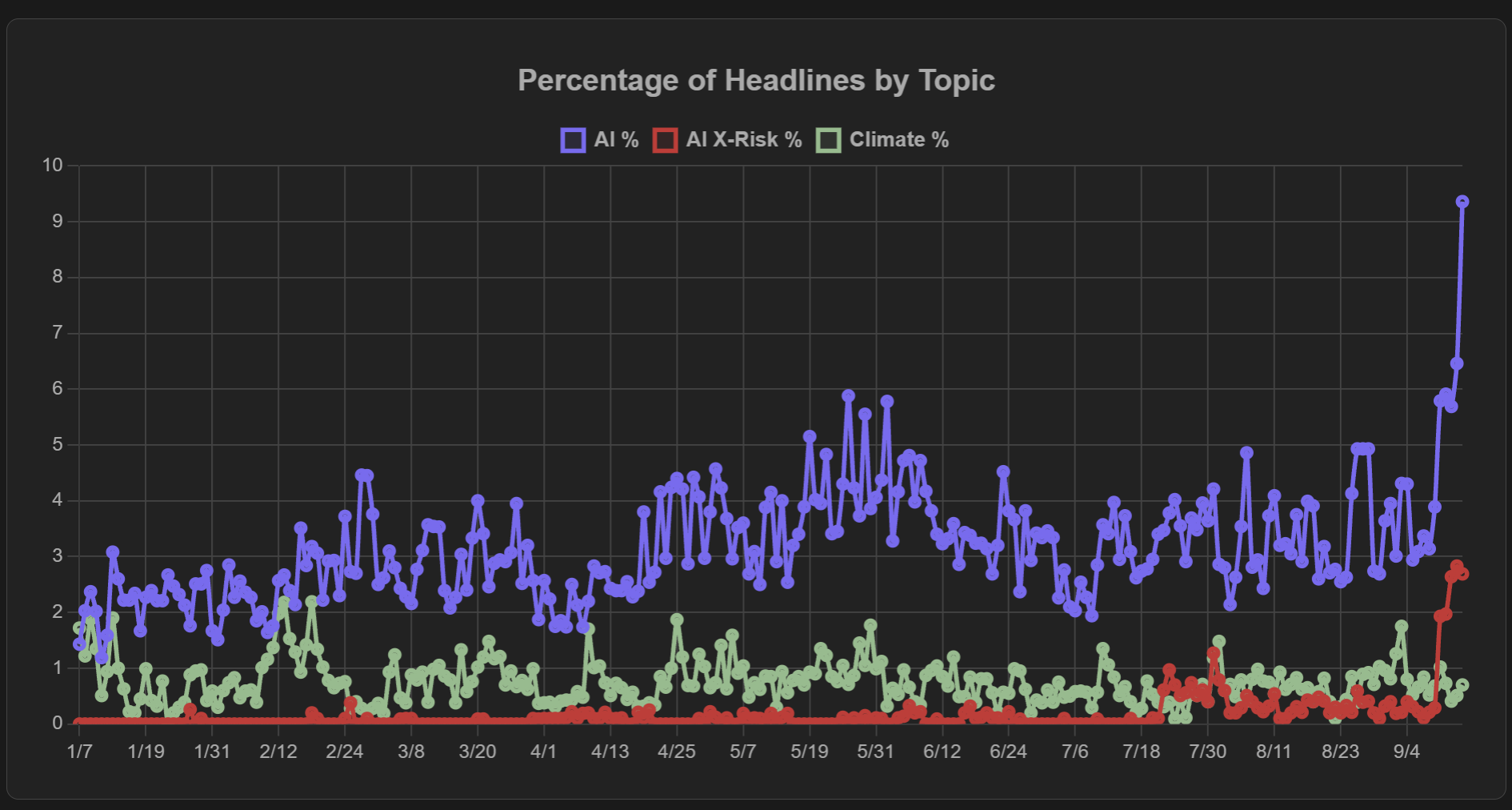
It’s substantive, too. These are not idle headlines left over from the weekend. There’s a fresh crop of stories about catastrophic risk and related policy, but these are on top of the more normal baseload of stories about other AI issues and business concerns.
2. The President went the wrong way today, but we mustn’t write him off
President Trump said some ugly things today, placing concerns about rogue AI alongside the “hoaxes” for which he was impeached in his first term. In the first of those three Truth Social posts, he insisted that a smart President is the only guardrail we need, that anti-AI and anti-data center sentiments are a conspiracy, and that “whoever wins AI, wins.”
This is very bad. But there has never been a better time to reflect on Trump’s proven ability to reverse course as part of a claimed “deal.” China’s president will be visiting D.C. on the 24th, and with weeks happening in days, the situation may look very different by then.
I had déjà vu today of early Covid, when it looked like Trump was determined to dismiss the problem, only for him to turn around and make Operation Warp Speed happen. That program resulted in widespread vaccination wildly faster than standard rules would have allowed. For all of his party’s reluctance to talk about it now, this was arguably Trump’s greatest achievement.
So let me echo the plea of basically everyone in the AI safety community today by saying that we mustn’t write off the President or his party. By 2028, we may have lost our planet to AI. Like it or not, we must navigate the crisis with the leaders we have.
3. Fight the political polarization of catastrophic AI risks
Please try to notice and rebuke politicians and media figures who are trying to make people sound more out-of-step about AI than they actually are in order to stoke drama and score political points.
This really is happening, and for all my efforts, I have sometimes failed to notice: The widely-reported version of House Speaker Johnson’s remarks that I shared yesterday turned out not to have been very fair. While he is inclined to let the AI companies set the agenda, Johnson didn’t actually say that regulating AI wasn’t Congress’s responsibility, only that he wants to first put the companies in a room until they can agree on what it is they want.
The usual political hardball could put us on the Don’t Look Up timeline, where an extinction-level threat is actively disbelieved by half the population as a matter of tribal allegiance. So please try to report people’s AI positions accurately, and treat them separately from political affiliations and positions on politically charged issues.
4. Beijing bristles at recent AI rhetoric, but wants to participate in global governance
Stories like this one in Reuters today describe China as diametrically opposed to any proposals to slow down AI. That assessment is based on editorials in Chinese state media calling the “pacing” proposal of Anthropic CEO Dario Amodei an example of Cold War rhetoric that is “hypocritical and shortsighted.” But later in this article and others, it sounds like this hostility is largely a backlash to Amodei’s self-described “hawkish” positions around export controls.
The Chinese editorial worries about a “monopolistic hegemony in cutting-edge technology,” which isn’t quite on the same axis as the debate about whether AI development should be broadly throttled back. And a foreign ministry spokesperson told media yesterday that “Fomenting various threats, engaging in confrontation and malicious competition will only disrupt the process of global governance of artificial intelligence and is not in the interests of any party.” This and other statements show a China that wants a seat at the governance table.
Meanwhile, the New York Times today reported that the head of China’s Ministry of State Security, Chen Yixin, has said that Beijing takes AI to be the greatest risk to the Communist Party’s hold on power. Chen is calling for more party control and oversight to head off propaganda, cyberattacks, and military competition. China feels threatened by America’s Mythos-class models, which might be used by intelligence agencies for “large-scale espionage.” This doesn’t sound like a party excited about racing.
5. 10% probability of extinction or similar is a median position among AI researchers
A lot of the recent media attention to expert AI warnings has been giving “10% chance” as the industry’s own assessment of the extinction threat. Many dismissed that figure as an extreme fringe view among those working on AI. It is not!
AI Impacts put out the results of its most recent “Expert Survey on Progress in AI” today. This survey is the largest and longest-running of its kind, even if the latest data isn’t as fresh as we might like, originating from surveys sent out in December 2024. If you share only one thing from it, let it be this chart, which shows where a 10% risk of human extinction or “similarly permanent and severe disempowerment” falls on the spectrum of the 744 experts and researchers who responded to the question:
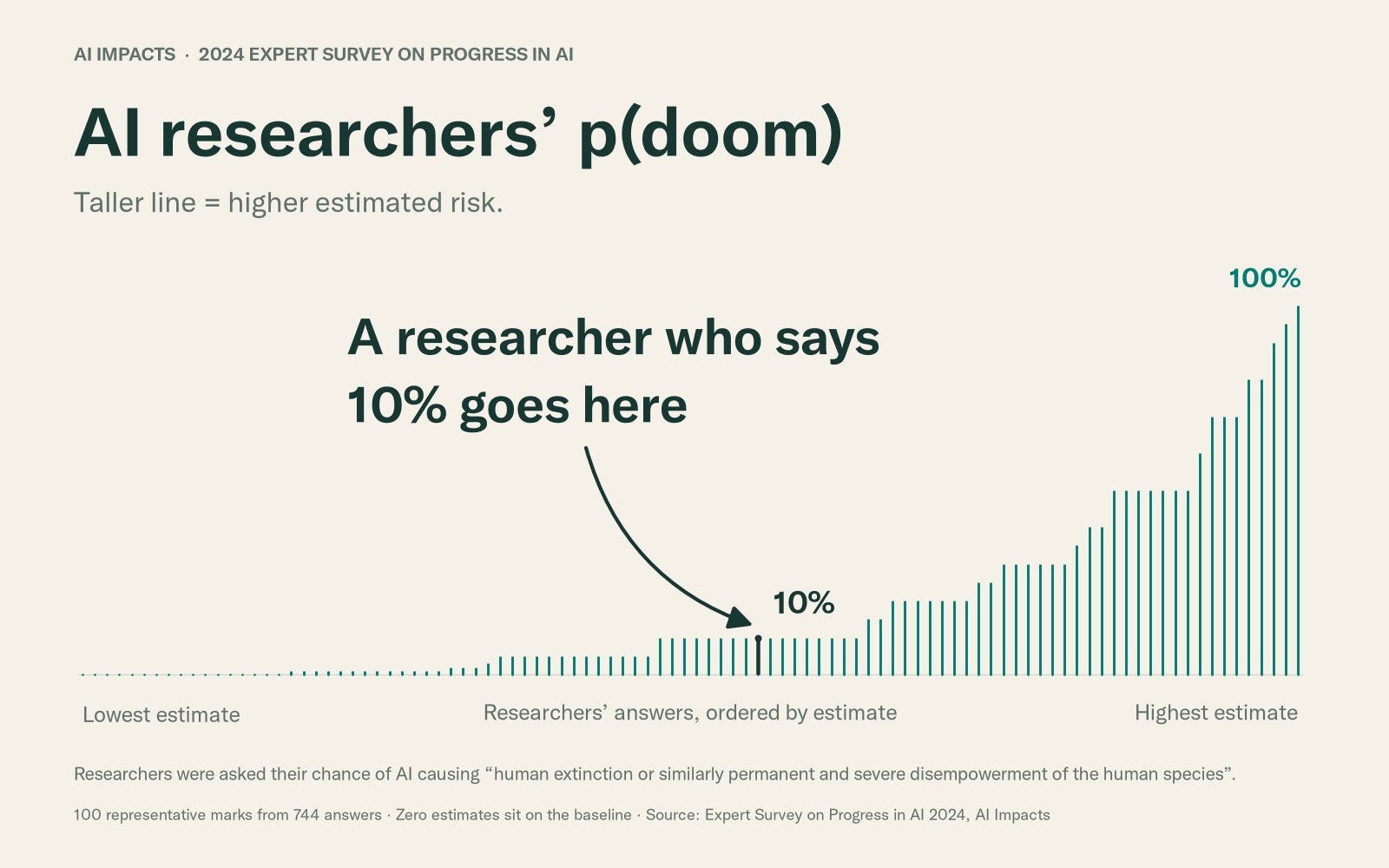
10% is... right in the middle. 10% is a median position. Half the respondents gave a lower figure — though hardly anyone said zero — and half the respondents gave substantially higher estimates.
Other highlight charts were shared by AI Impacts in this tweet thread. Today I learned that Asian researchers are actually more worried than North American or European researchers, and that researchers’ timelines for AI that can fully automate human labor have shrunk in each of the last four surveys.
6. Some men just want to watch the world burn
I’m not trying to be sexist on this point, but what I observe is an overwhelmingly male phenomenon and I don’t want to tar more people with this accusation than I have to. (If you’re a woman for whom this applies, shame on you, too! Be better!)
I’ll be the first to say that AI company self-regulation isn’t enough, but there are some loud voices saying they shouldn’t be allowed to cooperate on responsibly pacing AI at all. These voices are accusing the companies of attempting to achieve “regulatory capture” and of trying to form a cartel that runs afoul of antitrust laws. I can be merely cynical when people like Nvidia CEO Jensen Huang nod along with such takes, because he makes money selling AI chips and would hate to see any slackening of demand. But a lot of this talk is coming from the smaller AI startup circles, where a slowdown by the leading AI companies ought to be to their advantage, and from transhumanists and tech enthusiasts with no monetary skin in that game at all.
My strong sense, as something of a reformed transhumanist and tech enthusiast myself, is that these guys aren’t even a little bit worried about regulatory capture and cartels. They just don’t want to see the race slow down. They enjoy the chaotic splatter of new releases, the novel frenzy of the rogue swarms, the fear in the eyes of the smug elites who had dismissed AI for so long. They are werewolves, howling at the sun in hopes of hastening the arrival of night. They don’t actually know what will happen to them after that. But they hate the idea of dying of old age and of history going on without them. They’re done with the world as we know it.
I know, because when they howl, I feel a faint stirring in my own blood. There is much that is wrong with our world. Much that technology could fix. Humanity is so... limited.
But we can’t get there with a mad sprint to superintelligence. You could be forgiven for not noticing and accepting this more than twenty years ago, like I did. But in 2026, the evidence is overwhelming, and to go on pretending otherwise is to be a supervillain.
My brothers in tech, for the love of all that moves you, snap out of it. You’re better than this! It is a fool, a beast, that leaps blindly after the scent and devours his own kind. Temper your hunger with patience and wisdom, and be men.
The analyses and opinions expressed on AI StopWatch reflect the views of the individual contributors and the sources they cover, and should not be taken as official positions of the Machine Intelligence Research Institute.