



In this issue:
How a protest succeeds before it wins - What I saw at San Francisco’s Stop the AI Race protest
AI employees are becoming major political donors - Their donations suggest misgivings about where the AI industry is taking us
Guest post from Haven Harms
How a protest succeeds before it wins
What I saw at San Francisco’s Stop the AI Race protest
“One, two, three, four, we don’t want a robot war!”
On Saturday, July 11, hundreds of us marched through San Francisco in the Stop the AI Race protest, gathering in front of the offices of OpenAI, Anthropic, and Google DeepMind. Our one demand: that every major AI lab CEO publicly commit to pausing frontier model development if every other major lab in the world credibly does the same. The conditional structure is the point: no CEO is being asked to stop alone. Each is only being asked to say, in effect, “If the others pause, I will too.”
The theme of the protest was “Freeze AI” — a riff on the more commonly used “Pause AI,” and a cheeky nod to the date: July 11, aka 7/11, aka Slurpee Day. Was the protest successful?
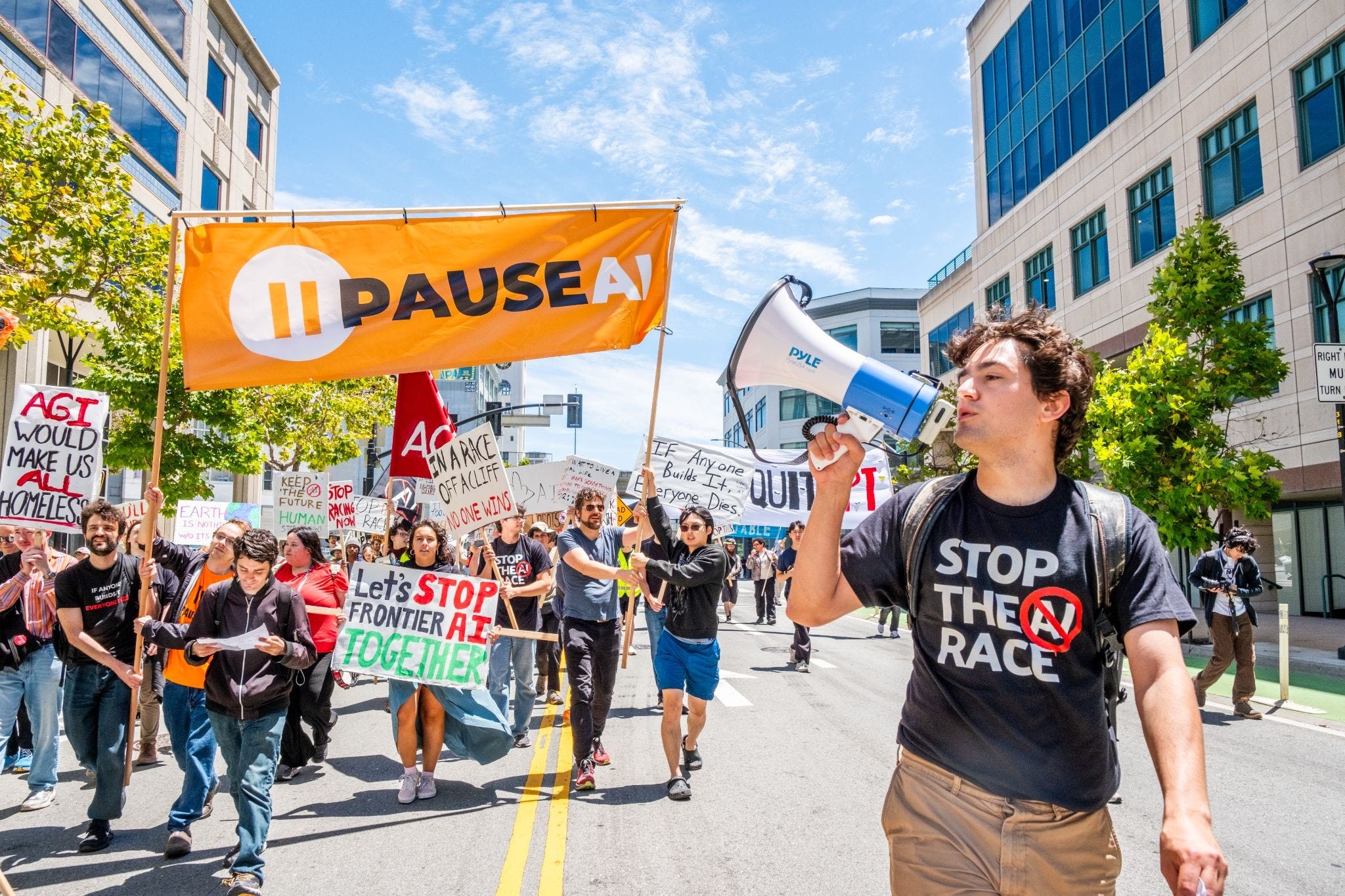
As far as I’m aware, none of the AI lab CEOs have publicly committed to a conditional pause on frontier AI development yet. However, protest demands are rarely met overnight. Winning the stated demand is only the most visible measure of a protest’s success. Protests also build the movement, amplify messages, and change the political terrain. All of these make success more likely over time. Marching through San Francisco on Saturday, I watched some of these mechanisms in action.
Protests Build the Movement
“Five, six, seven, eight! No AI surveillance state!”
The first mechanism is movement-building: a protest brings people together, draws new participants in, and helps turn a loose coalition into something durable. Like a snowball rolling downhill, the movement gains momentum and becomes easier to join as it grows.
At the beginning of the protest, Michaël Trazzi, the march’s main organizer, asked us all to take a minute to talk to someone new and find out why they were there. I chatted with the person next to me, and learned that he’d traveled from London to be part of the march. He mentioned he was part of the group PauseAI, and was one of the first people to protest Google DeepMind back in 2023. “Oh, wow, back when only ten or so people showed up! That’s a pretty big difference from today!” I said, impressed.
“Well, it was actually probably more like five people,” he corrected me. Touché.
It’s much easier to protest in a crowd of hundreds than in a crowd of five. One of the most striking things about that Saturday was that this is no longer a movement drawn solely from the AI safety world. It is a coalition of people from different backgrounds whose concerns about AI converge on a shared demand: create time to address the risks and harms they fear before advanced AI development goes further. Some wanted to get rid of AI entirely; others were enthusiastic users of current AI tools but worried about where advanced AI development is headed. People came concerned about jobs, mass surveillance, environmental damage, extinction risk, and their kids’ futures. Despite our different concerns, we shared a belief that developing systems beyond our ability to control could have irreversible consequences, and that slowing down preserves our chance to avoid them.
Marching alongside people you might otherwise be arguing with can build trust and turn a broad coalition into a more durable movement. As that coalition expands beyond the traditional AI safety community, the movement has more room to grow.
Protests Amplify the Message
“Slam the brakes and slow the pace! We don’t want an AI race!”
The second mechanism is amplification. News coverage and social media turn a local march into a story that can reach far beyond the people who attended.
Photographers were taking pictures, and people stood along the street with their phones out recording us. In the days since, the articles and social media posts have been coming out. For someone who hasn’t thought much about the issue, seeing a crowd in the streets prompts curiosity. “These people are taking time out of their day for this. Maybe they’re onto something.”
For someone who already agrees, it breaks the illusion of isolation. It’s a terrible feeling to recognize the scale of a problem and think, “But what can I even do about it? I’m only one person.” A protest can provide evidence that shifts that thinking to “I’m not the only one, and protesting is something I can actually do.”
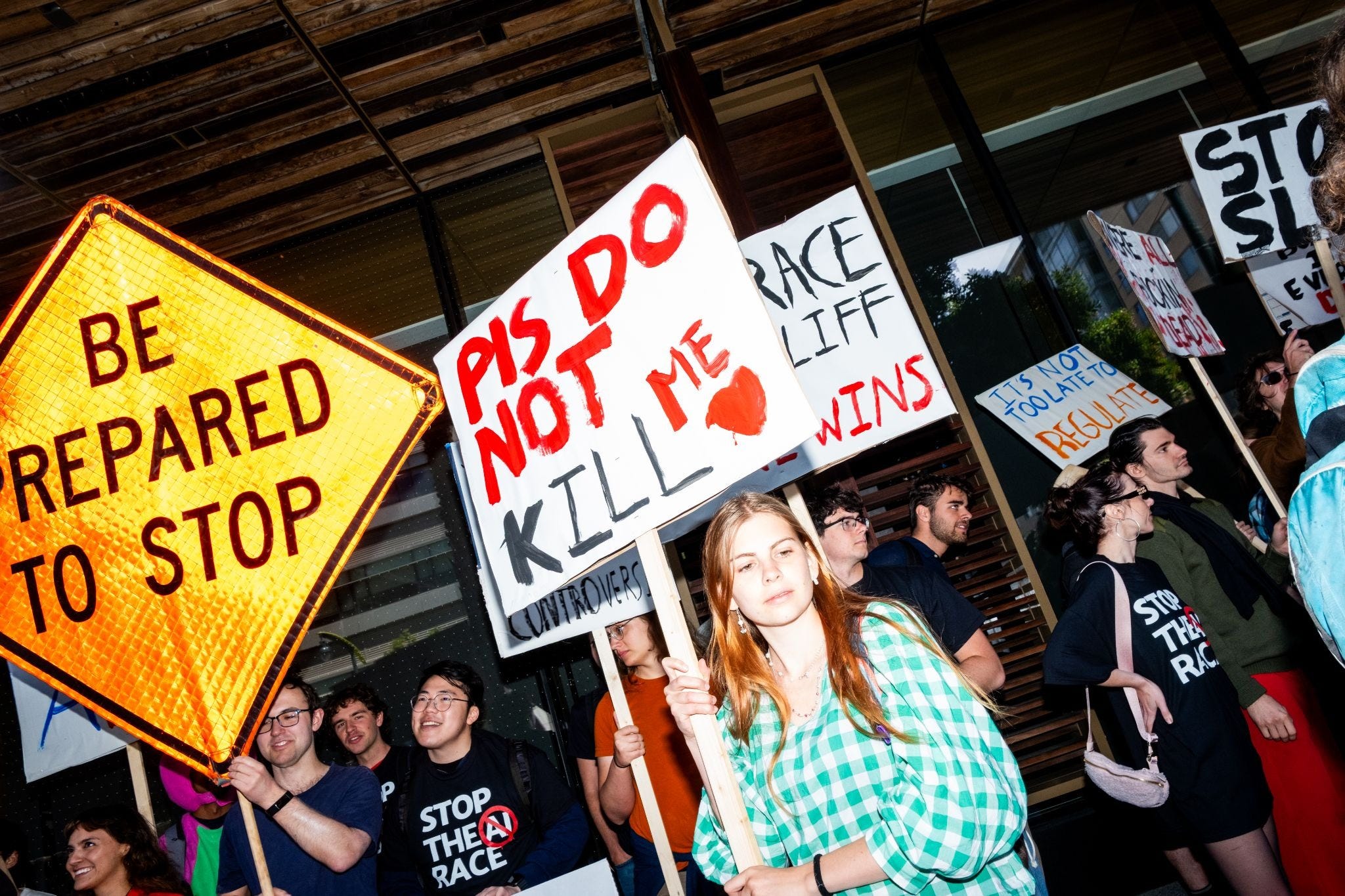
As protests grow, they can draw the attention of politicians, journalists, and industry leaders, and make it harder for them to ignore the issue. The public looks to leaders to see how they will respond. Will they wave off a reasonable ask? What does that say about their intentions?
Protests Change the Political Terrain
“It’s not too late to regulate! We don’t have to automate!”
The last mechanism is the hardest to see on the day itself.
A crowd in the streets signals that an issue deserves public attention and can expand the range of positions considered legitimate to hold. By putting hundreds of people in the streets, the Stop the AI Race march helps move “maybe we shouldn’t race to build this” from insider debate to a legitimate public question. For many protesters — especially those who believe advanced AI could cause human extinction — a halt is not a bargaining position but the minimum adequate response. However, once the idea of pausing AI development enters the public debate, narrower policies such as mandatory safety testing or transparency requirements can seem more moderate by comparison, and therefore more likely to be adopted. In turn, those measures can build the oversight, enforcement mechanisms, and precedent for regulating AI development that make implementing and enforcing a global pause more feasible and, ultimately, more likely.
A march also gives sympathetic insiders something to point to: the legislator drafting an AI bill, or the lab employee pushing back internally, now has visible evidence of public demand behind positions they already held. A CEO can still shrug off safety commitments, and a politician can still look the other way, but visible public opposition makes those choices more politically and reputationally costly.
Why the Marching Band? Were We “Too Unserious?”
“Stop the insanity! Don’t extinct humanity!”
One of the criticisms about the protest I saw online was “the vibe is too unserious,” and “if you really believe AI is going to kill everyone, why are you dancing around with a marching band?”
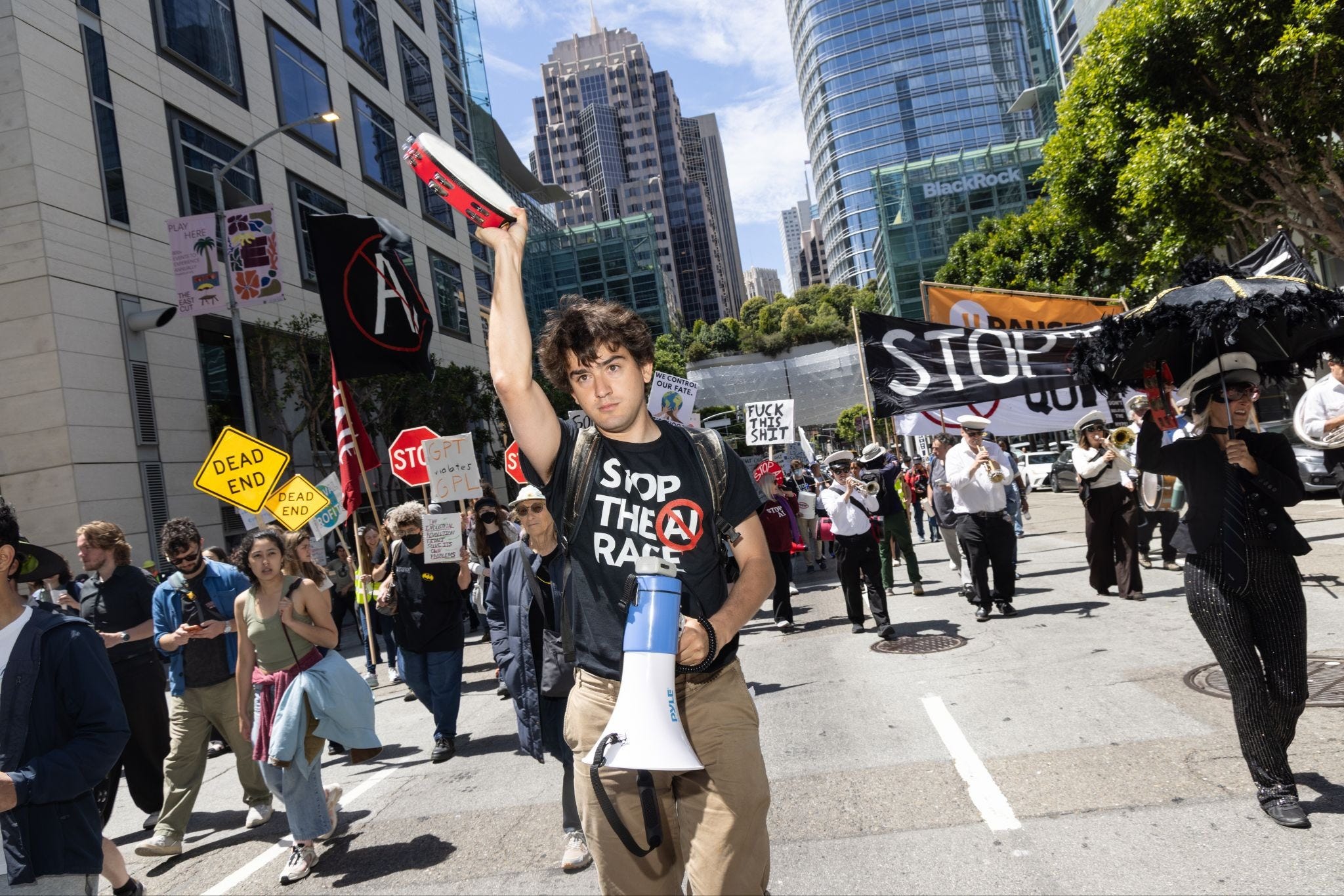
St. Gabriel’s Celestial Brass Band made the march fun and kept morale high, especially when persistent gusts of wind made the large signs difficult to hold. The peppy music may also have helped keep the atmosphere buoyant and peaceful, in keeping with Stop the AI Race’s explicitly nonviolent approach. Maybe more protests should have jazzy marching bands.
The dancing and music were only part of the protest, but the criticism also misses a broader shift in the AI safety movement. A few years ago, the situation seemed extremely bleak. How were we going to wake the world up to what was going on? Many people I knew in AI safety spent time grieving a future they feared was already lost. More recently, I have watched some of that grief turn into determination and action.
That shift is not based only on internal morale; the public and political conversation has also changed. Less than a year ago, the book If Anyone Builds It, Everyone Dies was published. Since then, Senator Bernie Sanders has convened a panel on AI’s existential risks that included American and Chinese scientists, while prominent science communicators such as Neil deGrasse Tyson have called for a global treaty against lethal superintelligence. According to the AI Policy Network’s tracker, 40 current members of Congress (19 Republicans, 21 Democrats) have publicly acknowledged advanced AI risks. So yes, while AI safety people still tend to be called “doomers,” the situation no longer feels hopeless. There is still work to do, but we marched with that hope alive inside us.
What’s Next?
“For our future! Stop the race!”
As the crowd gathered at Anthropic, Trazzi made clear that this protest wasn’t the end. The general feeling was that we were doing a good thing, but also that it was a Saturday, when few employees were inside the labs. Trazzi announced that the next protests would take place on weekdays, when they might hit harder, and asked people to raise their hands if they’d be there. Hands shot up around the crowd.
When the march ended, we gathered at Rincon Park. The band kept playing, and we ate pizza. New and old friends mingled, celebrating what we’d pulled off. I sat on a ledge along the waterfront walkway and looked out at the Bay Bridge, our signs still propped up around us, visible to anyone passing by. At one point, a sea of people streamed through the park, as the Giants game had just let out.
“They’re protesting AI?” a young Giants fan said to her friends. “Oh, hell yeah!”
Maybe she’ll join the next protest. You can too: the next Stop the AI Race protest is set for Monday, July 20, 2026. Head to stoptherace.ai to sign up for updates.
A separate effort, the Don’t Build It march, is also collecting pledges for a planned demonstration in Washington, DC. This is the one tied to the book If Anyone Builds It, Everyone Dies, calling on world leaders to halt the race to superintelligence through an international treaty. No date has been set: the organizers plan to call the march once 100,000 people have pledged to attend. You can pledge or sign up for updates at ifanyonebuildsit.com/march.
Haven Harms is the founder and principal of Harms Research & Consulting, supporting organizations working on AI safety, governance, and advocacy.
Dispatch from Mitch
AI employees are becoming major political donors
Their donations suggest misgivings about where the AI industry is taking us

I firmly believe that almost everyone who works for the big AI companies means well.
Unfortunately, meaning well and doing good aren’t the same thing. Through rationalization, self-interest has a way of hijacking good intentions.
I’m not just talking about the mind-altering effects of seven-to-nine-figure compensation packages, because self-interest is not purely monetary. Some people at these companies are chasing their curiosity. Others just want to keep doing what they’re good at, or be at the center of something important. But for many, I suspect the strongest incentives are social: if you’ve been “locked in” at your company, developing AI for years, the industry might be your whole world. Your friends, your professional prestige, and your sense of self-worth might all be tied up with group beliefs about superintelligence being both inevitable and too powerful to leave to some other group.
I imagine the difficulty of breaking away from that world is not unlike the difficulty of leaving a socially consuming religion (a matter to which I can speak from personal experience).
This is how I reconcile the seeming contradiction in the political expressions we see from these employees. The San Francisco Standard is the latest to report that AI workers benefiting from recent or expected IPOs and investment rounds are making sizable political donations to candidates and super PACs pushing for stronger regulation of the AI industry.
The contribution rate is described as unusual:
Political giving used to be rare among (notoriously apolitical) tech workers, but it is much more widespread at AI companies, particularly Anthropic. Roughly 59 of every 1,000 Anthropic employees have donated to a federal campaign this cycle — almost triple the rate of Airbnb’s employees during their first post-IPO cycle, and five to six times that of Facebook and Google. OpenAI’s donor participation rate is lower but still above Google, Facebook, and Airbnb’s post-IPO cohorts.
As always, you can find a cynical read: Maybe these donors are hoping to influence the regulators before the regulators can influence them. But I don’t buy it. That sort of play requires high-level coordination, which appears absent. Individuals’ donations are in many cases directly countering anti-regulation donations by a smaller number of high-profile figures at their own companies, like those of OpenAI’s President Greg Brockman.
There’s a non-cynical explanation. The article — reasonably, I think — credits the higher donation rate of AI tech workers to the norms of Effective Altruism, a charitable philosophy popular among many who went to work for these companies. Effective Altruism endorses “earning to give” strategies where a talented individual might go to work in a high-paying field so as to be able to donate large sums to causes expected to do far more good with that money than any harms incidental to the earning of it.
So I suspect many AI employees now donating large sums to AI safety politics see themselves as sticking to their principles while they try to positively influence their companies — about which they have serious misgivings — from the inside. Some of their therapists confirm this, according to an article I covered in April.
To be fair, I personally assign a single-digit percent probability to the conscientious insider strategy being correct — about as high as the probability the people following that strategy often assign to superintelligence ending humanity.
But my colleague Alana recently shared why trying to do good from inside the AI labs looks fatally flawed: On Thursday, she discussed a blog post by ex-Google DeepMind employee Alex Turner about how the people at these companies have already shown time and again that when push comes to shove, they ignore the red lines they have set for themselves.
Humility is admitting that your courage can fail, and that your moral compass can be bent. Wisdom is getting out of a morally corrosive environment while you still can. The AI safety donations leaking out of the industry machine tell me that parts of the machine mean well. But a cog that squeals in protest is still a cog.
The analyses and opinions expressed on AI StopWatch reflect the views of the individual contributors and the sources they cover, and should not be taken as official positions of the Machine Intelligence Research Institute.
> I firmly believe that almost everyone who works for the big AI companies means well.
I agree with your broader point, but I feel like "almost everyone" means >90%. I'm pretty sure the successionists, immortality-chasers, and naive utilitarians (aka consent violators) make up more than 10% of the employees at the AI companies, and even more so at the research level.