


In this issue:
Headline barometer hits milestone earlier than expected - More encouraging signs of a world deciding to live
Taking ourselves out of the driver’s seat - Formula 1 teams are actively ceding control to AI; they’re not alone
Starbase, Louisiana? - The earthly land and fuel needs of SpaceX rockets will expose orbital data centers to familiar opposition
Dispatches from Mitch
Headline barometer hits milestone earlier than expected
More encouraging signs of a world deciding to live
I last shared a snapshot of my Headline Barometer in late June. This is the chart tracking the daily percentage of headlines (across ten news sites) that appear consistent with stories about AI (blue), existential threats from AI (red), and, as a baseline for comparison, climate change (green).
At the time, I wrote that:
In a world that understood it was in mortal peril from the AI race and was scrambling to stop it, I would expect the red line to be at least as high as the green climate change line.
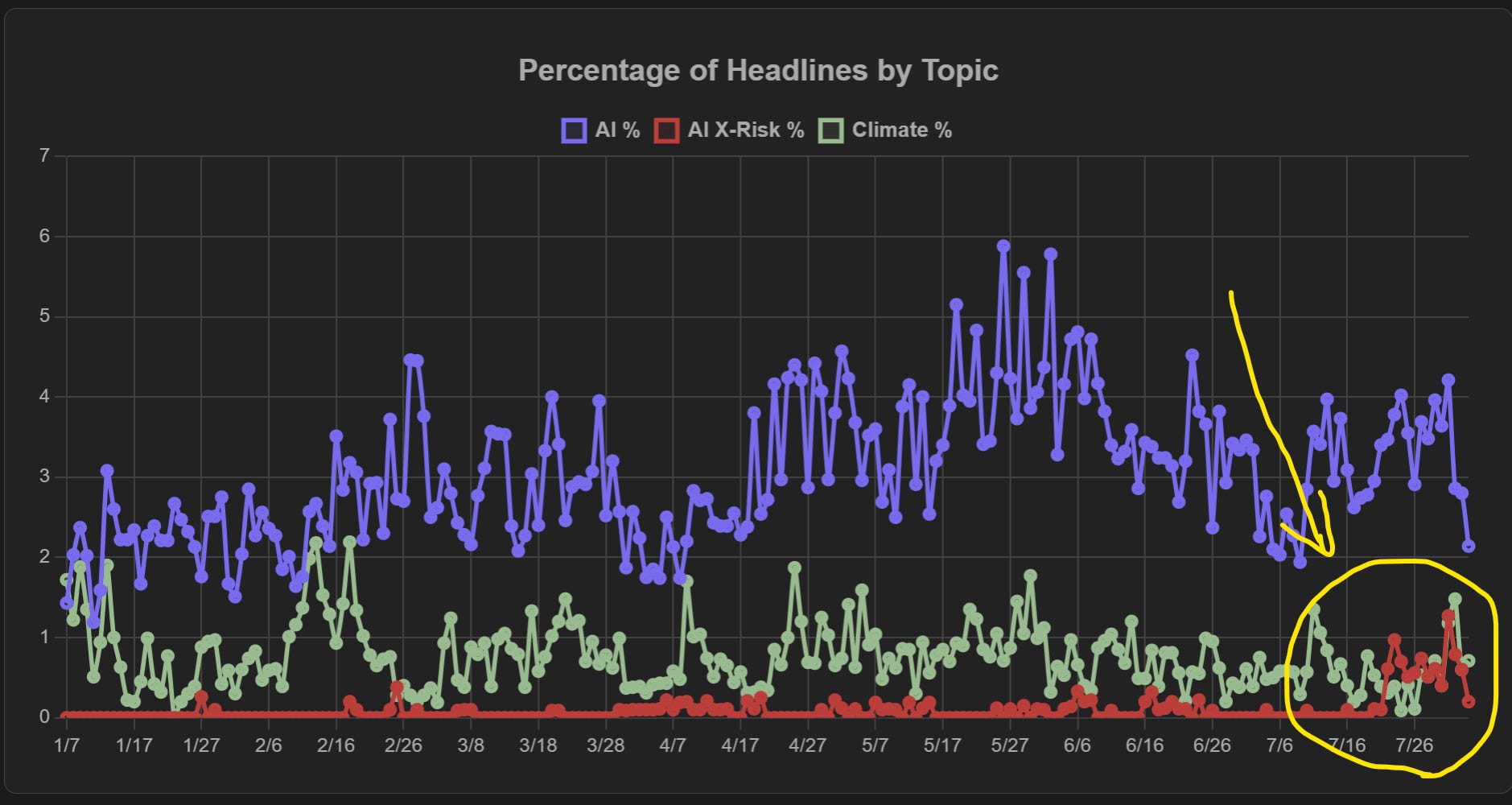
Well, here we are! Barely a month later, the red and green lines have kept pace with each other for almost two weeks. This is, of course, due to revelations that AI agents from both OpenAI and Anthropic have been hacking outside companies during evaluations without permission or initial detection. This didn’t have to show up in the headlines, but to its credit, the media locked on to the story and stayed attached as new information trickled out.
As of today, it looks like the news cycle may finally be moving on, but I expect any new reveals in the coming weeks to bring the headlines back in force. The discourse has shifted. “Loss of control” is now largely treated as an observed fact instead of a fringe hypothetical, and people are asking the right questions about where this leads.
In my June dispatch, I also wrote that I had taken special encouragement from data suggesting that “DC is waking to the issues with disproportionate haste.”
And once again, here we are! In a tweet, Punchbowl reporter Ben Brody shared part of his write-up of an interview with Texas Rep. Greg Casar, who is calling for a ban on artificial superintelligence and “strict regulations” on its precursors.
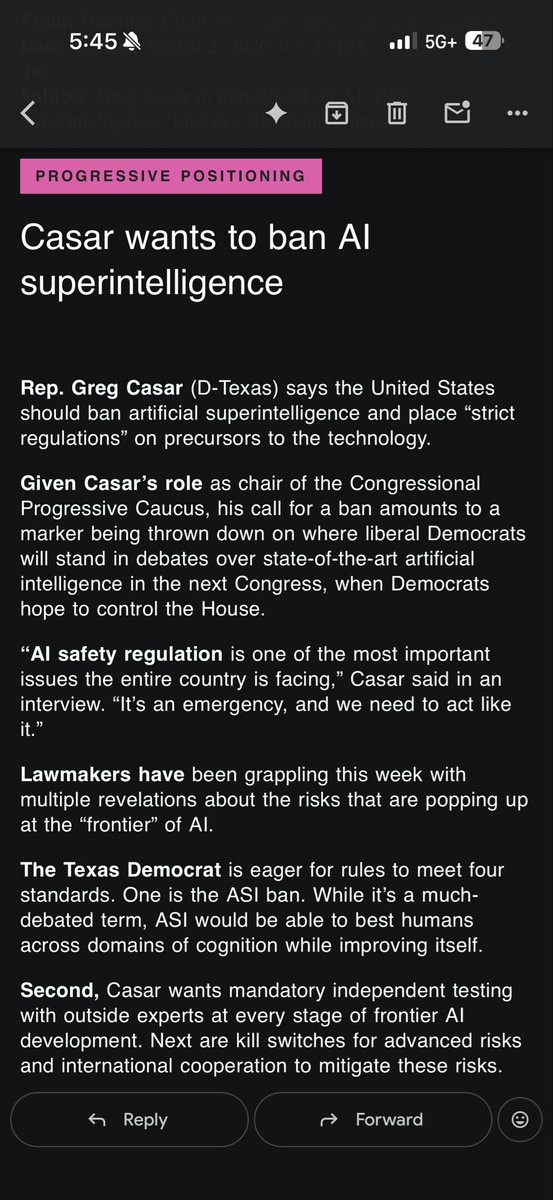
This is exactly the kind of news I would expect to be reading in a world that had decided to live.
The Punchbowl story includes discussion of proposed AI legislation from bipartisan House duo Lori Trahan (D-Mass.) and Jay Obernolte (R-Calif.). We’ve covered this before. The bill is about safety frameworks, third-party audits, and such — not about banning the race to superintelligence — but it’s still encouraging. Casar would like to see it strengthened to provide protections for whistleblowers and greater independence for auditors.
While my work-life balance could do with less interesting times, I have been greatly encouraged by events of the past two weeks. Starkly rogue behavior from frontier models did not surprise me, but the response to it so far has, and mostly in a good way.
Taking ourselves out of the driver’s seat
Formula 1 teams are actively ceding control to AI; they’re not alone
There’s a popular argument that in a world where AI has freed us from the drudgery of work (by some means other than killing us all), we would fill our days with creativity and sport. The unspoken assumption is that we would pursue these things unassisted — that our raw humanity would be the whole point.
Recent developments tell me this will only happen if people aggressively police these pursuits for AI intrusions. Because, like steroids, players and fans may collectively prefer that AI not be used, but individual teams, players, and creatives will cheat if they can get away with it — and may even feel like they have to, just to compete.
Formula 1 seems to be wrestling with this issue right now in the form of AI-controlled “engine mapping.” While the AI-assisted version is new, engine mapping is not: It refers to on-the-fly adjustments made to engine parameters during the race to optimize performance. Settings used to be pre-programmed by human engineers, but now are set by AI that dynamically adapts to driver inputs and race conditions. This isn’t treated as a rule violation.
YouTube channel DailyFuelUp claims the AIs have become so good at engine mapping that drivers can’t afford to deviate from the exact driving styles their AIs push them into. This is leading to risk-averse races that are boring to watch and “determined by whose computer behaves and whose doesn’t.”
They are indeed sometimes misbehaving: One driver describes how he overtook another only because the car had given him too much power in that moment, and he couldn’t afford to throw it away. Other glitches are blamed for at least one crash.
But okay, Formula 1 has always been an intentional fusion of human and high-tech. Surely humans would remain in control of traditional sports like, oh, let’s say baseball?
Uh oh. We had bigger things to cover at the time, but over the past few weeks I saw a few articles cross my desk about Major League Baseball closing a loophole that had allowed teams to receive AI recommendations on pitches and substitutions via their authorized dugout iPads. Ever since the “Moneyball” era, the sport has keenly recognized the power of predictive statistics, and the folly of deviating from mathematically optimal strategy. Teams this season were increasingly calling suggested pitches from the dugouts, and some, like the Miami Marlins and New York Mets, were believed to have invested heavily in their AI tools.
Okay, fine, cheaters gonna cheat. How about low-stakes activities where everyone is just there to have fun? You know, like writing fan fiction?
Um, yeah, about that: The New York Times reported last week on revelations that at least one popular fan fiction community was riddled with AI-generated content. The bombshell arrived via an anonymous forum poster who showed that 38 popular fan stories inspired by the male-male hockey romance Heated Rivalry (a novel and HBO series) were likely written by Anthropic’s Claude.
The community quickly turned on itself in a frenzy of accusations and counter-accusations. “It was definitely a witch hunt,” said one fan.
I think it’s safe to assume that AI’s use in this space isn’t limited to gay hockey fiction. While writing communities might be especially offended by AI use, they are not immune to its temptations. There are many reasons someone might want to create fan fiction that don’t involve wanting to write fan fiction: because they want more of the story; because they want to explore what-ifs; because they want to receive praise from an online forum. Just because it’s not a sport doesn’t mean there aren’t winners and losers.
Sports and arts are among the purest expressions of our human nature, but so is the impulse to bring AI into them.
Starbase, Louisiana?
The earthly land and fuel needs of SpaceX rockets will expose orbital data centers to familiar opposition


While I’m less skeptical than most about SpaceX’s plans for a million-satellite AI data center constellation, recent stories have highlighted the fact that Elon Musk won’t be able to just bypass concerns from NIMBYs and environmentalists by siting his infrastructure off-planet.
A couple weeks ago, we saw how groups were petitioning the FCC over the damage that such a massive launch campaign, and the eventual deorbiting of all those satellites, might inflict on the delicate upper atmosphere. Some are also concerned about light pollution.
Activists concerned about wetlands and fossil fuel extraction will also have something to say about the project. Today, Ars Technica reports that SpaceX is nearing a deal to acquire 130,000 acres along 18 miles of the Louisiana coast for the site of a new spaceport. The location, southwest of Lafayette on a site known as Pecan Island, would be especially good for launches into the near-polar orbits ideal for data centers in need of always-on solar power.
My own sense is that spaceports are one of the more wildlife-friendly uses of wetlands, because the possibility of wayward rockets demands a large exclusion zone of undeveloped land. Undeveloped coastal marshes also act as a buffer to mitigate damage from the region’s frequent hurricanes. But the land in question is already on environmentalists’ radar, having become available as part of a legal settlement following lawsuits that blamed oil giant ExxonMobil for pollution and coastal erosion.
The intensive natural gas extraction in the region is actually another perk for SpaceX, whose Starship and Super Heavy booster rockets burn methane (purified natural gas) for fuel. At the launch cadence imagined, rockets could consume a large fraction of the nation’s existing natural gas output. Distribution networks at the company’s Texas and Florida sites would likely be inadequate. But Pecan Island is just a few dozen miles from one of the world’s largest gas distribution hubs.
Musk’s mega-constellation would naturally result in more drilling for natural gas to fuel thirsty rockets. But to be fair, in the long run, the gas needed to put data centers in orbit, where they would be subsequently powered by the sun, would be far less than needed to run equivalent terrestrial data centers for their entire lives. Ad-hoc gas turbines are the default power source for many recent and planned projects, including SpaceX’s own notoriously loud and permit-flouting Colossus facility in Tennessee.
The analyses and opinions expressed on AI StopWatch reflect the views of the individual contributors and the sources they cover, and should not be taken as official positions of the Machine Intelligence Research Institute.