

In this issue:
Sanity on the march - Protesters converge on San Francisco to urge a stop to the AI race
Chatting up the grass roots - Campaign text message bots can carry on full conversations, at scale
What’s your plan? - “AI 2040: Plan A” and the necessity of hard choices
Dispatches from Mitch
Sanity on the march
Protesters converge on San Francisco to urge a stop to the AI race
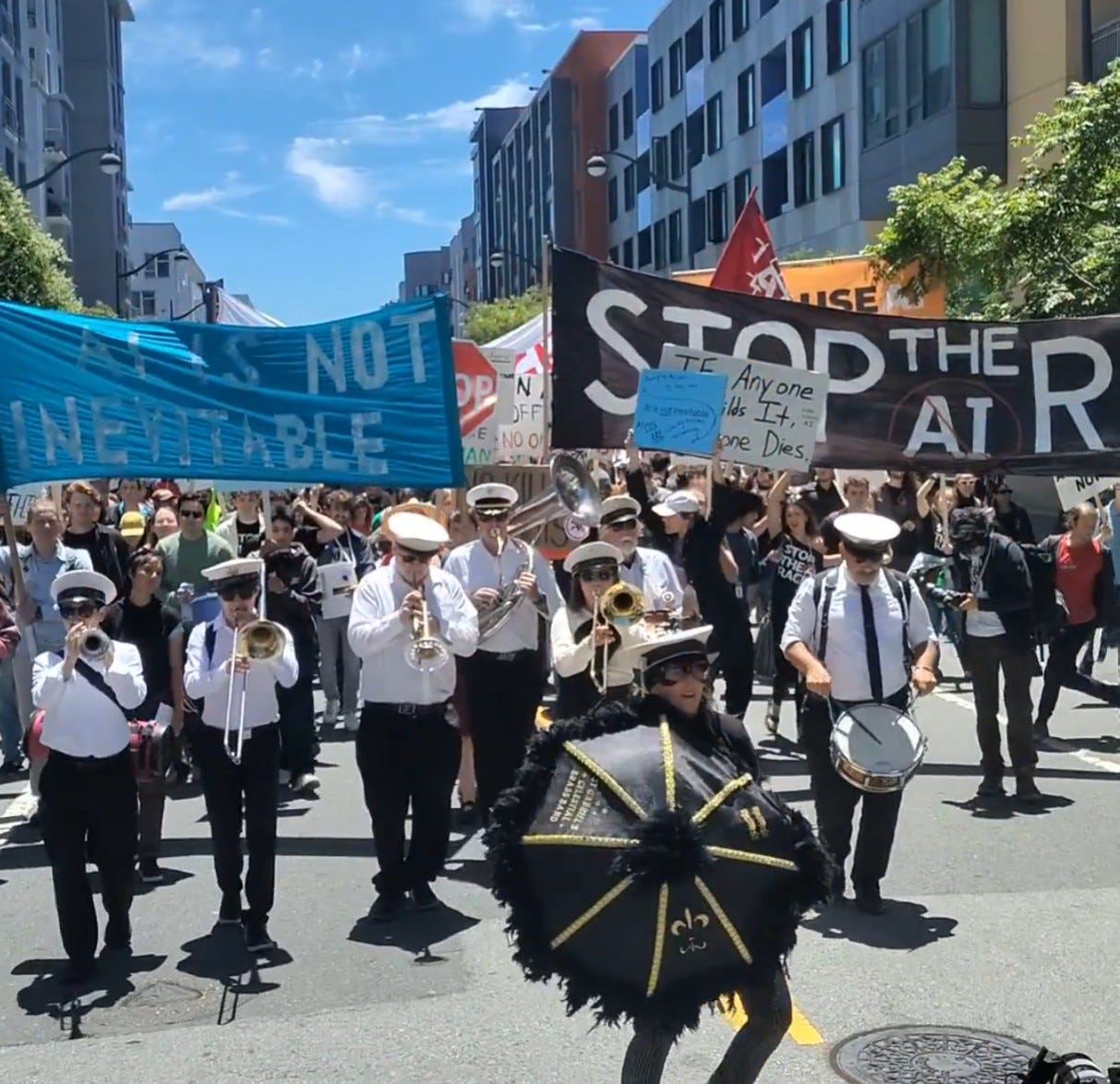
The San Francisco Chronicle reported on yesterday’s “Stop the AI Race” march. Roughly two hundred people walked past the San Francisco offices of OpenAI, Anthropic, and Google DeepMind, demanding that each company commit to stop training frontier models if the others make the same commitment.
This is a good protest demand. It would cost the companies little to agree to it, and it would be a way for them to reaffirm concerns their leaders have all, at different times, voiced about the extreme dangers of developing artificial superintelligence under competitive racing conditions.
A commitment by the top AI companies would not be enough to halt the race — that would require coordinated international action to prevent anyone anywhere from pursuing superintelligence — but it would send a strong signal that could spur said coordination. I think the U.S. government would be keen to avoid a situation where other countries continued towards the brink while American companies showed more sense.
The lead organizer of yesterday’s protest, Michaël Trazzi, had participated in a hunger strike outside Google DeepMind’s London office last year, with the same demand for a conditional commitment to stop racing. In the months that followed, DeepMind CEO Demis Hassabis essentially agreed. Asked in a January interview whether he’d be willing to pause if others would do the same, Hassabis said, “I think so,” and reiterated his longtime dream that researchers would carefully work on this together once AI was far enough along.
AI StopWatch has additional coverage of yesterday’s protest planned, from first-hand accounts of those who participated. The vibes, I am told, were amazing.
Chatting up the grass roots
Campaign text message bots can carry on full conversations, at scale

Earlier this month, I expressed some measured enthusiasm for the practice of voters using chatbots to help them research candidates. I am somewhat less enthusiastic about this when the chatbots are specifically trained or hosted by political campaigns, and in some cases impersonate the candidates themselves.
NPR’s Maham Javaid reports that such AIs are being used to extend the use of text messages as a canvassing tool. Where replies to these texts might once have been the responsibility of a few overworked volunteers — if anyone handled them at all — now they can all be replied to with patience and care by a chatbot.
A representative of a company that provides campaign chatbots said that “in some cases, we have people talk to our agent for hours” and that response rates to messages are as high as 5-10%. He claims that half a million outgoing messages this year have resulted in a total of twenty to thirty thousand conversations.
I think these bots could be good for democracy so long as voters know they are talking to a bot and who is paying for it. But I don’t trust this to reliably be the case. North Dakota and California have laws requiring campaign bots to reveal that they are AI in the first message, but even in those states I expect things to get murky and for rules to be ignored by shady third parties that pop up and vanish just before the election.
As we’ve seen in other recent coverage, Javaid’s article claims that Republican campaigns are more eagerly taking advantage of such tools, because Democratic campaigns tend to be more worried about the optics of AI use.
But as polls keep finding, concerns about risk from AI remain very bipartisan.
What’s your plan?
“AI 2040: Plan A” and the necessity of hard choices

Over the past week, my colleague Joe has twice encouraged our readers and listeners to engage with AI 2040: Plan A, the new scenario from the AI Futures Project.
Now it’s my turn.
I won’t retread the ground Joe has covered, but I will note that one of the passages Joe quoted (possibly my favorite) has already proven prophetic in the worst way. The passage reads:
We hope critics will judge us against the existing state-of-the-art for plans to navigate the AI transition (if they can find any) and not against some hazy but pleasant fantasy where no one has to make any hard choices yet everything will probably be fine.
Alas, the chatter I’ve seen about this plan on X (Twitter) has been overwhelmingly of the hole-poking variety, without giving alternative answers to the hard choices ahead.
Hard choices do have to be made! That’s true even in the futures where we’re getting pretty lucky, where it’s proving suspiciously easy to keep powerful AIs from stealing our planet to pursue the strange preferences their training will unintentionally but unavoidably cause them to develop.
Plan A is already easy mode. It takes place within one of those suspiciously lucky futures where AIs can be trusted to do our AI alignment homework for us, designing more powerful and more trustworthy AIs that humans themselves could not. Only in those futures will it be enough to slow AI for a mere decade or so, as the Plan proposes. The group’s Plan S — which they say they are sympathetic to and think might be better than Plan A — is the “simpler” plan that tries to prevent superintelligence for as long as it takes humans to know how to get it right on the first and only try, which could be a few decades or more.
Both plans depict the balancing act that awaits us if we slam on the brakes but don’t turn the car around. We avoid plunging straight off the cliff, but still creep towards it, picking up speed because the AIs that will already have been created by the time a pause takes hold will be powerful enough to transform the world — economically, militarily, and socially, if not in the literal extinction-causing sense that we’d get with superintelligence.
It’s a balancing act because these transformations will be destabilizing. On one side of the beam: war, chaos, anarchy. On the other side: exploitation, tyranny, oppression. Maintaining the balance will require hard choices about things our institutions weren’t built to handle. What happens when total surveillance is cheap and easy? When nuclear deterrence is undermined? When every terrorist can design a bioweapon? When individual companies are more powerful than nation-states? When a huge fraction of the population is unemployable? Critics of Plan A are calling it naive, but assuming business as usual will work out fine is the most naive plan of all.
As others have pointed out, the rate of economic and technological progress depicted in Plan A is still blazingly fast — faster, indeed, than most AI boosters expect business as usual to go, because boosters tend not to grasp AI’s full implications. So theoretically, those who want to accelerate AI should be just as happy with Plan A as those who want to slow it down.
Anyone complaining that Plan A is a luddite stagnation fantasy needs to read the Public Perspective section at the end of it. This is introduced as a “shorter, more accessible story we wrote to convey what Plan A would feel like to a typical American,” and it’s wilder than almost all of the sci-fi you’ve ever been exposed to. It’s not until 2028 that you finally lose your job and start seeing robots walking around in numbers, doing real work, but by 2034 you’re living in a luxury high-rise in a city that didn’t exist five years earlier, and by 2040 you’re pondering whether you want to remain in your biological body and what you might want to do with the ten-billionth slice of the universe you stand to receive.
And that’s just the beginning. Read the Epilogue and Space Governance Proposals for the truly wild stuff.
You may not like Plan A, Plan S, or any plan you’ve seen so far. Cool! I don’t wholeheartedly love any plan I’ve seen yet, either. But if you’re not down with something like Plan A or Plan S as a starting point, what’s your alternative? If you don’t have one, who do you trust to come up with a better one for you, and how will you empower them to enact it? The choices are coming, and they must be made.
Maybe you’re looking at all of this and wishing humanity didn’t have to face any of these choices in your time. Okay! How will you not just stop the car, but turn it around? I think it’s possible. You might even be able to talk me into supporting it.
But you’re going to need a plan.
The analyses and opinions expressed on AI StopWatch reflect the views of the individual contributors and the sources they cover, and should not be taken as official positions of the Machine Intelligence Research Institute.